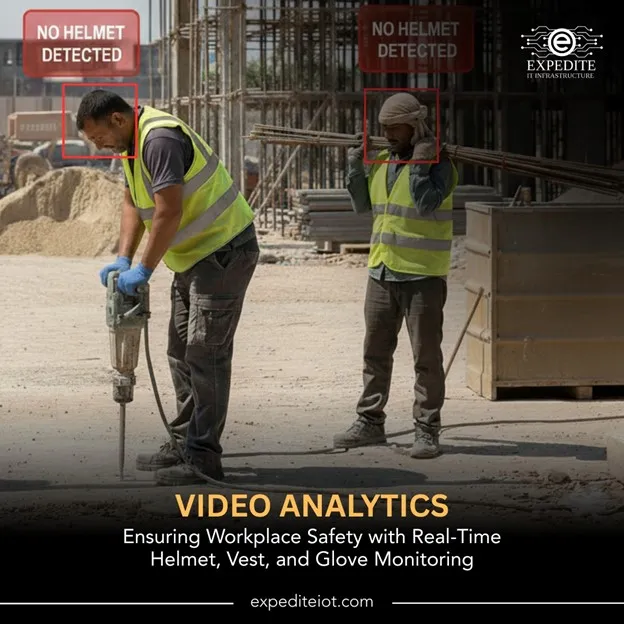

Video Analytics is fundamentally transforming construction site safety across the Gulf region. In Qatar — a nation in the midst of unprecedented infrastructure growth — the ability to automatically detect Personal Protective Equipment (PPE) compliance in real time is no longer a luxury; it is an operational imperative. Powered by deep learning and computer vision, AI-Powered Video Analytics from Expedite IoT delivers the intelligence, speed, and accuracy that modern Qatari construction projects demand.
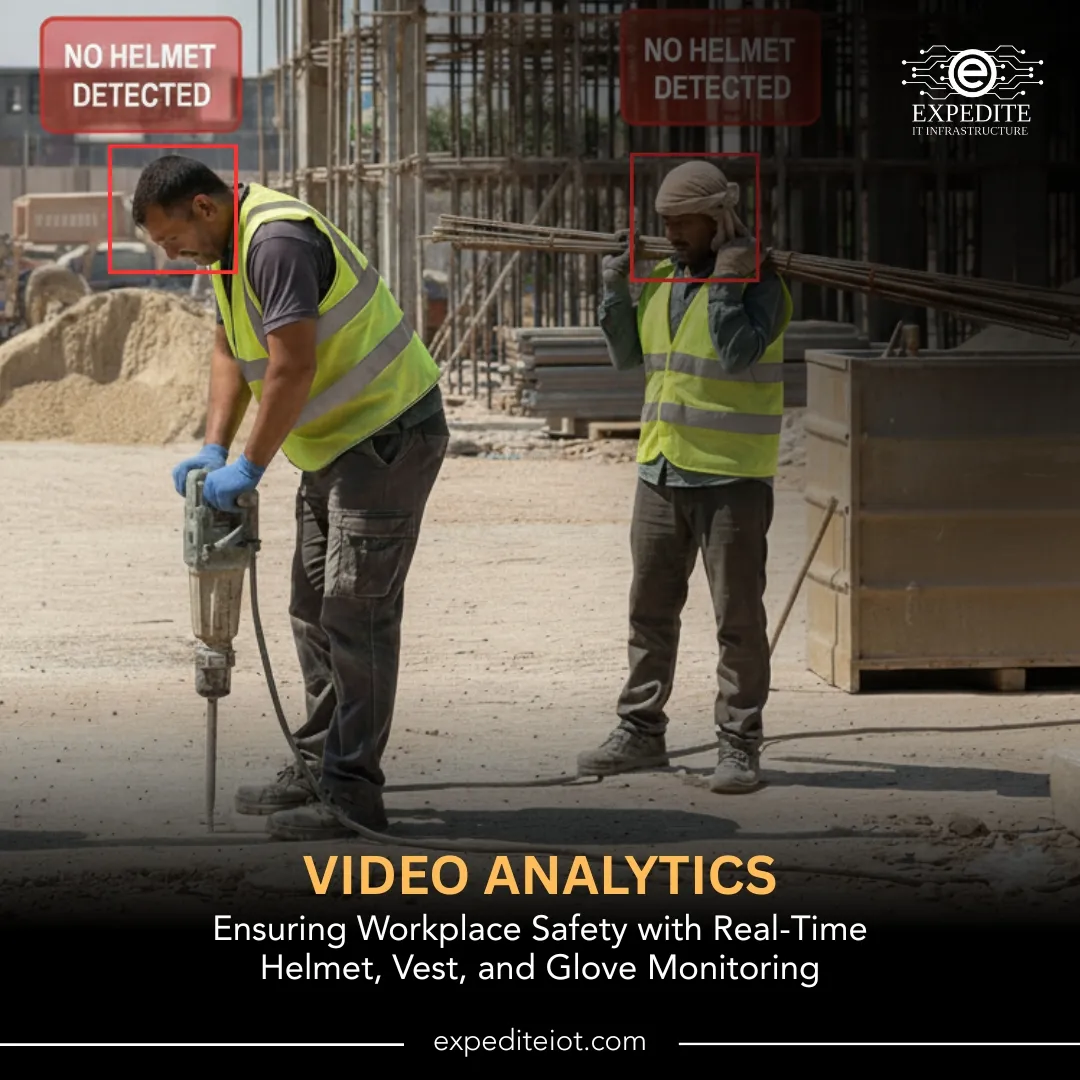
Why PPE Compliance Is a Critical Safety Challenge in Qatar's Construction Sector
Qatar's construction landscape is among the most dynamic in the world. Mega-projects, including transportation hubs, stadiums, smart city developments, and energy infrastructure, bring together tens of thousands of workers from diverse national backgrounds onto active job sites simultaneously. In such an environment, manually verifying that every worker is wearing the correct safety gear — hard hats, high-visibility vests, gloves, steel-toed boots, and safety goggles — is a near-impossible task for human supervisors alone.
Non-compliance with PPE regulations exposes workers to serious injury risks and exposes project owners to regulatory penalties under Qatar's evolving occupational safety and health framework. Traditional CCTV surveillance, without analytical intelligence layered on top, captures footage but cannot detect, alert, or report compliance violations in real time. This is precisely the gap that Video Analytics Solutions are designed to bridge.
Key challenges driving the need for intelligent surveillance on Qatari construction sites include:
- Multi-zone worksites: Multiple active zones — each with different PPE mandates — operating simultaneously make uniform monitoring virtually impossible without technology.
- High workforce density: Large numbers of workers on a single site increase the probability of undetected violations during manual walk-throughs.
- Shift-based operations: Round-the-clock construction schedules require 24/7 monitoring capability that human inspectors cannot sustain.
- Language and literacy barriers: A multilingual workforce mean that verbal or written safety reminders are inconsistently absorbed, making visual enforcement essential.
- Regulatory pressure: Qatar's Ministry of Labour and relevant authorities have tightened occupational safety standards, making compliance documentation a legal necessity.
What Are Video Analytics and How Does It Work for PPE Detection?
Video Analytics Software refers to the application of artificial intelligence — specifically computer vision and machine learning algorithms — to automatically analyze video streams and extract actionable intelligence. Unlike standard CCTV monitoring, which requires a human operator to watch and interpret footage, video analytics platforms process visual data autonomously, identifying objects, behaviors, and anomalies at machine speed.
In the context of PPE detection, the system works through the following process pipeline:
- Video ingestion: Live feeds from IP cameras installed across the construction site are streamed into the analytics engine in real time.
- Frame-by-frame analysis: The AI model analyzes each video frame, detecting human figures and identifying the presence or absence of designated safety equipment on each individual.
- Classification and scoring: Each detected person is classified based on their PPE compliance status — compliant, partially compliant, or non-compliant.
- Alert generation: When a violation is detected, the system immediately generates a notification to site supervisors via dashboard, SMS, email, or integrated site communication systems.
- Logging and reporting: Every detection event is time-stamped, logged, and compiled into compliance reports for audit and regulatory purposes.
This end-to-end automation transforms safety management from a reactive, incident-driven process into a proactive, data-driven discipline.
Core Capabilities of AI-Powered PPE Detection: What Makes It Effective
Real-Time PPE Compliance Monitoring
Real-Time PPE Compliance Monitoring is the foundational capability of any effective video analytics deployment on a construction site. The system continuously scans live camera feeds, identifying workers within the frame and assessing their equipment status without any human input. When a worker enters a designated zone without a hard hat, or removes their high-visibility vest mid-shift, the alert is triggered within seconds. This immediacy is what converts a safety system from a logging tool into an active risk mitigation mechanism — supervisors can intervene before an accident occurs, not after.
On large Qatari projects where a supervisor may be responsible for hundreds of workers spread across vast site areas, real-time monitoring provides an extension of oversight that is physically impossible to replicate through manual inspection alone.
High Accuracy Detection Using Deep Learning
High Accuracy Detection is achieved through the use of purpose-trained deep neural networks optimized for construction site environments. Unlike generic object detection models, these algorithms are trained on thousands of labelled images featuring workers in varied lighting conditions, camera angles, distances, and occlusion scenarios commonly found on active job sites. The result is a system capable of correctly identifying whether an individual is wearing a helmet versus carrying one, whether a safety vest is properly fastened, or whether protective eyewear is on the face rather than pushed up on the forehead.
Modern construction site models routinely achieve detection accuracy rates that significantly outperform manual inspection rates, particularly in high-density crowd scenarios or low-visibility conditions such as night shifts or dusty environments — challenges that are especially relevant to Qatar's desert climate.
AI-Powered Object Recognition Across Multiple PPE Categories
AI-Powered Object Recognition enables the system to simultaneously track and classify multiple categories of protective equipment within a single video frame. A single camera view may require the system to assess:
- Hard hats (presence, color-coding by role or zone)
- High-visibility safety vests
- Safety boots and foot protection
- Protective gloves
- Safety goggles and face shields
- Respiratory protective equipment in hazardous zones
- Harnesses in elevated work areas
The ability to recognize and report on all of these simultaneously — across dozens of cameras — makes the platform exponentially more powerful than any manual inspection protocol.
Customizable PPE Rules and Alerts for Zone-Specific Compliance
Customizable PPE Rules and Alerts allow site safety managers to define different compliance requirements for different zones within the same project. A welding area may require face shields and flame-retardant gloves in addition to standard PPE; an electrical substation zone may mandate insulating gloves and arc-rated clothing; a confined space entry point may trigger additional respiratory equipment requirements. The platform allows these zone-specific rules to be configured through an intuitive dashboard, ensuring that alerts are contextually relevant and actionable rather than generic.
Alerts can be routed by severity level, zone, time of day, or specific violation type — giving site management full control over how the safety intelligence is delivered and prioritized.
Video Analytics Qatar: The Business Case for Deployment
Video Analytics Qatar deployments are delivering measurable returns for construction operators across the region. The business case for adopting intelligent PPE monitoring extends well beyond regulatory compliance, encompassing tangible financial, operational, and reputational benefits:
- Reduced accident rates and associated costs: Early intervention through real-time alerts prevents incidents that carry enormous direct and indirect financial consequences — medical costs, compensation claims, project delays, and reputational damage.
- Lower insurance premiums: Demonstrable safety performance records, backed by video analytics data, can serve as evidence for insurers, potentially reducing liability and project insurance costs.
- Regulatory compliance documentation: Automated logs and reports provide the audit trail required by Qatari health and safety regulators, removing the burden of manual record-keeping from site supervisors.
- Improved workforce accountability: The presence of an AI-powered monitoring system itself acts as a behavioural nudge, improving voluntary compliance among workers who know that violations are consistently detected.
- Operational efficiency: Safety managers can focus their physical presence on high-risk activities and exception handling rather than routine surveillance, improving the overall quality of human oversight.
Video Analytics Doha: Implementation Across Major Project Types
Video Analytics Doha implementations span a broad range of construction and industrial project categories. Whether it is a high-rise residential tower in Lusail, a commercial development in West Bay, a petrochemical facility in Mesaieed, or a road and utilities project on the outskirts of the capital, the platform adapts to the unique surveillance infrastructure and compliance requirements of each site type.
Key deployment scenarios in the Doha metropolitan region and beyond include:
- High-rise and mixed-use construction: Multi-floor monitoring using strategically placed cameras at each level, with zone-specific PPE rules for different stages of construction.
- Infrastructure and civil engineering projects: Wide-area coverage for linear infrastructure projects such as roads, bridges, and utilities using pan-tilt-zoom cameras integrated with the analytics engine.
- Industrial and energy facilities: Enhanced PPE detection for hazardous industrial environments, including refineries and processing plants, where respiratory and chemical protection requirements are stringent.
- Logistics and warehousing: Monitoring of workers in large covered or semi-covered logistics hubs where forklift activity and elevated platforms create significant PPE compliance requirements.
Why Expedite IoT Is the Trusted Provider of Video Analytics Solutions in Qatar
Expedite IoT brings together deep regional expertise, cutting-edge AI capability, and a proven implementation track record across Saudi Arabia, Qatar, and Oman. As specialists in industrial IoT and intelligent video surveillance, the company delivers end-to-end Video Analytics Solutions that are architected for the demanding conditions of Gulf construction environments.
Proof points that distinguish Expedite IoT's offering:
- Experience: Extensive hands-on deployments across GCC construction, oil and gas, and industrial sectors, with documented safety performance improvements at client sites.
- Expertise: A specialized team of computer vision engineers, IoT architects, and safety technology consultants with domain knowledge in both AI systems and Gulf regulatory frameworks.
- Authoritativeness: Recognition as a regional leader in AI-powered industrial surveillance, with a portfolio that spans multi-site deployments for major project developers and EPC contractors.
- Trustworthiness: Transparent reporting, data privacy compliance, and long-term client relationships built on measurable safety outcomes rather than vendor promises.
The company's platform is designed to integrate seamlessly with existing site CCTV infrastructure, reducing deployment time and capital expenditure, while the cloud-based or on-premise analytics engine can scale from a single camera to enterprise-wide multi-site surveillance networks.
Understanding the Broader Safety Technology Landscape
For organizations evaluating intelligent safety monitoring technology, it is useful to understand how Video Analytics Software fits within the broader ecosystem of construction site safety technologies. Related and complementary concepts include:
- Computer vision for safety: The underlying AI discipline that powers PPE detection, crowd analysis, and behavioural monitoring.
- Smart construction site technology: The convergence of IoT sensors, GPS tracking, BIM integration, and video analytics into a unified site intelligence platform.
- Occupational health and safety (OHS) compliance management: The regulatory and operational framework within which video analytics PPE detection operates.
- Incident prevention analytics: The use of behavioural data and pattern recognition to identify and mitigate safety risks before incidents occur.
- Edge AI for construction: On-device AI processing that reduces latency and bandwidth requirements for real-time video analytics in remote or bandwidth-constrained site environments.
- Digital twin integration: The linking of real-time PPE compliance data with digital site models to create a live safety performance overlay for project managers.
- GCC safety regulatory compliance: The specific occupational health and safety standards applicable to construction projects in Qatar, Saudi Arabia, UAE, and Oman.
Conclusion
The construction industry in Qatar is operating at a scale and pace that demands intelligent, automated safety infrastructure. Video Analytics powered by artificial intelligence delivers the Real-Time PPE Compliance Monitoring, High Accuracy Detection, and Customizable PPE Rules and Alerts that modern construction sites need to protect their workforce, satisfy regulators, and optimize operations. From the first camera feed to the final compliance report, the technology transforms PPE enforcement from a manual burden into a scalable, data-driven safety discipline.
Expedite IoT's Video Analytics Solutions are purpose-built for the environmental and regulatory demands of Qatar's construction sector, delivering measurable safety improvements for project operators across Doha and the wider GCC region. For organizations ready to elevate their site safety performance, the technology is available, proven, and scalable today.
FAQs
1. What types of PPE can AI-powered video analytics detect on a construction site?
Modern AI-Powered Object Recognition systems can detect a comprehensive range of PPE items including hard hats, high-visibility vests, safety boots, gloves, safety goggles, face shields, respiratory masks, and fall arrest harnesses. The specific categories are configurable based on site requirements, and the system can apply different detection rules for different zones within the same project.
2. How quickly does the system generate an alert when a PPE violation is detected?
Alerts are generated in near real time — typically within one to three seconds of a violation being detected in the video feed. This immediacy is what enables supervisors to intervene before a worker reaches a hazardous area without adequate protection, making the system a genuine incident prevention tool rather than a post-event documentation platform.
3. Can the system work with existing CCTV cameras already installed on our site?
In most cases, yes. Expedite IoT's Video Analytics Software is designed to integrate with standard IP camera infrastructure, meaning organizations can leverage their existing surveillance hardware. The analytics engine connects to the camera network through the existing network infrastructure, significantly reducing the capital cost and deployment timeline for organizations that already have cameras installed across their sites.
4. How does the platform handle different PPE requirements for different zones on the same construction site?
The Customizable PPE Rules and Alerts feature allows safety managers to define site-specific zone configurations through the platform dashboard. Each camera or camera group can be assigned to a named zone, and each zone can have its own set of required PPE categories. Violations are then assessed and reported based on the specific requirements of the zone in which they occur, ensuring that alerts are contextually accurate and operationally relevant.
5. Is video analytics for PPE detection compliant with Qatar's data privacy and cybersecurity regulations?
Expedite IoT's Video Analytics Qatar deployments are architected with data privacy and cybersecurity best practices. The platform offers both cloud-based and on-premise deployment options. On-premise deployment ensures that video data never leaves the client's network, which is particularly important for projects with strict data sovereignty requirements. The system processes video for PPE detection purposes without storing identifying biometric data beyond what is operationally necessary, and access controls ensure that compliance data is available only to authorized personnel.
For more information contact us on:
Expedite IT
+966 502104086
































Sign in to leave a comment.