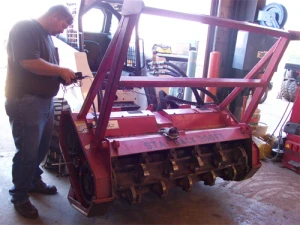

The inevitable defects in the machining and assembly of rotating machines generate major vibration problems. One of the most important vibration problems is imbalances that generally cause synchronous vibrations.
The appearance of unbalance is also often linked to the normal ageing of rotating machines (wear, oxidation, etc.), to imbalance or poor alignment and causes an increase in vibration levels. And the vibrations thus caused are transmitted to the bearings of the rotor, and all the points of the bearings receive it once per revolution. Choose Dynamic Balancing Companies for taking advantage of bearing services.
Imbalance or unbalance Unbalance is an imbalance of the rotor caused by the non-coincidence of the main axis of inertia with the axis of rotation of the shaft. In other words, unbalance is the state in which a rotor finds itself when a force or a vibratory movement is communicated to its bearings.
Dynamic balancing Dynamic balancing consists of generating and controlling unbalanced forces on a rotating shaft and balancing the rotor at predetermined speeds to reduce vibrations when passing critical speeds. It then makes it possible to find, without dismantling, optimal operating conditions and a vibration level close to that of a new machine.
On a rotating machine Balancing on a rotating machine is practised when the origin of the unbalance is the breakage or deterioration of part of the rotor. In addition, if the imbalance has created very significant vibrations, there is a risk that the bearings or the structure have been damaged.
On the site It is called field balancing to balance a rotor rotating on its bearings without disassembling. This is the dynamic balancing method most used by maintenance technicians. Balancing offers many advantages:
The rotor is balanced under normal operating conditions (loads, temperatures, speed, etc.) Disassembly, reassembly and realignment are not necessary.
How it works? Car wheels normally reach a rotational speed of 20 to 40 revolutions per second, at which each gram of the wheel is subjected to a centrifugal force of the order of a few hundred grams. If the wheel were perfectly homogeneous and if its mass was uniformly distributed around the axis of rotation (centre of gravity on the axis), the elementary forces acting at each point of the wheel would balance each other: the wheel would be balanced.
Suppose that, during sudden braking (locking of the wheels), a few grams are removed at one point of the tread, and the centrifugal force exerted on the opposite side will no longer be compensated. Dynamic Balancing denver has a force of a few kilograms (a mass of 50 g distributed on the periphery causes a force of about 40 kg at 70 km/h) which rotates with the wheel and causes an alternating movement in the permitted direction by the suspension arm.
The dynamic balancing will consist of the suitable distribution of the counterweight required by the static balancing. To this end, two masses will be placed, one inside and the other outside the rim, to balance the moment generated by the centrifugal force of the unbalancing mass. In conclusion, static balancing aims to bring the wheel's centre of gravity back to the axis of rotation. That dynamic balancing eliminates the effects of torque caused by centrifugal forces. The imbalances of the front wheels give rise to the shimmy, characterized by oscillations and vibrations of the steering wheel. These disadvantages are accentuated when the road surface is smoother and more uniform. Dynamic Balancing Services provides the best facilities in this field.
Finally, their intensity is greater at certain speeds when there is a resonance of the wheel-suspension assembly and the corresponding elastic elements.



























Sign in to leave a comment.