
Introduction
Most color deviation, blurry imaging, and unstable detection issues in machine vision systems stem from unfiltered infrared light. Industrial CMOS and CCD sensors are sensitive to a wide spectrum of light, including invisible near-infrared radiation generated by workshop equipment, lighting, and high-temperature machinery.
Without IR-cut filters, infrared light interferes with visible light signals, causing color cast, chromatic aberration, and reduced AI detection accuracy. An IR-cut filter is a coated optical glass component built into machine vision lenses, designed to filter out redundant infrared light and restore true, human-eye consistent colors for industrial imaging. It is a standard core configuration for professional color machine vision lenses.
Working Principle & Key Benefits of IR-Cut Filters
1. Working Principle
TOWIN adopts two mature IR-cut filter technologies for industrial lenses. Absorption blue glass filters physically block infrared light with stable performance for conventional miniature lenses. Interference coating filters use multi-layer optical film to offset infrared wavelengths, featuring higher light transmittance and ultra-stable spectral performance for high-precision detection scenarios.
2. Core Benefits for Machine Vision
Restore true color reproduction: Filters out infrared interference to ensure consistent imaging results with manual visual inspection, avoiding misjudgment in automated color sorting and defect detection.
Suppress industrial ambient noise: Effectively blocks thermal infrared radiation from factory equipment, stabilizing image brightness and contrast for 24-hour continuous production inspection.
Optimize lens imaging performance: Unifies the focal plane of visible light, reduces lens chromatic aberration, sharpens tiny object edges, and improves the recognition accuracy of AI vision algorithms.
Extend lens service life: Isolates infrared thermal radiation, prevents internal lens coating aging, and enhances the durability of industrial lenses in harsh working environments.
Core Technical Parameters of IR-Cut Filters
To select a qualified machine vision lens with IR-cut function, focus on four core parameters to match your application scenarios:
Cut-off wavelength: 650nm and 700nm are the two mainstream industrial standards. 650nm is suitable for high-precision color inspection, while 700nm applies to low-light day-night dual-purpose imaging.
Visible light transmittance: High-quality IRCF maintains a transmittance of over 90% in the visible light range, ensuring bright and clear imaging without light loss affecting low-light shooting.
IR blocking depth: OD3 and OD4 are common specifications. OD4 blocks 99.99% of infrared light, suitable for strict color detection; OD3 meets the needs of conventional surveillance and general industrial detection.
Transition edge steepness: A narrow transition band avoids attenuation of red light, preventing dark distortion of red-toned products in imaging and ensuring full-spectrum color restoration.
Built-in IRCF is always preferred for industrial machine vision over external filters. Integrated lens-built filters avoid vignetting, light leakage, and optical offset, delivering more stable and professional imaging than detachable external filters.
IR-Cut Filter Matching for Different Lens Mounts
As a professional industrial lens manufacturer, TOWIN equips its full-range mount lenses with standardized and customizable IR-cut filters to cover all mainstream machine vision scenarios.
1. M12/S-Mount Lenses
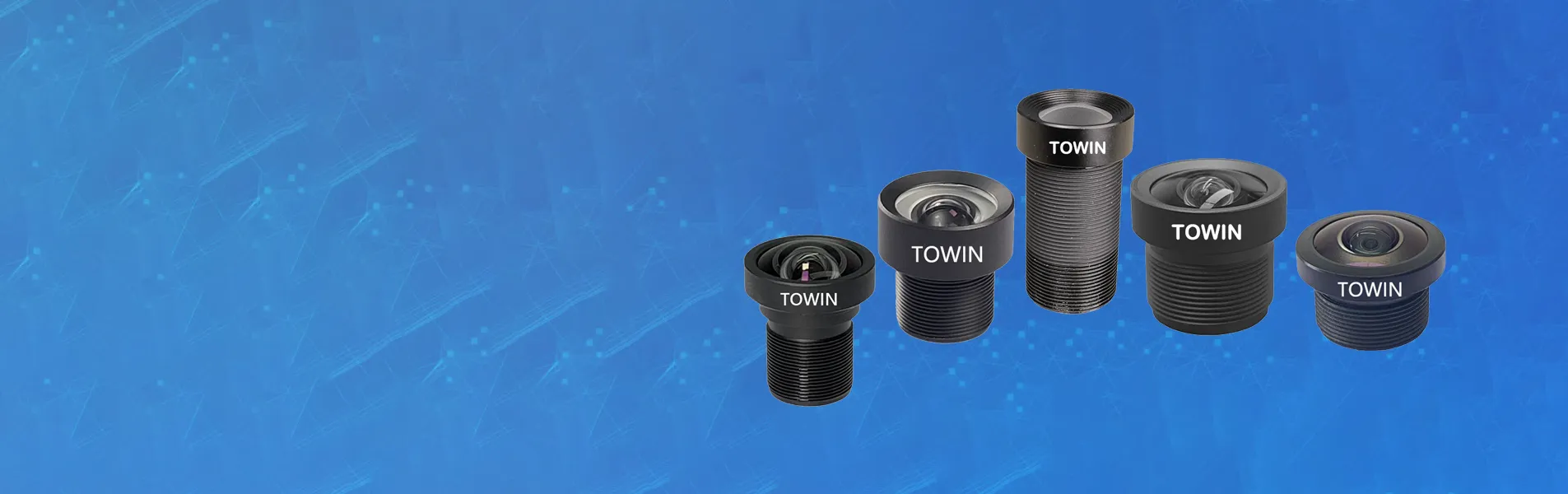
Compact M12 miniature lenses are widely used in small camera modules. All TOWIN M12 series are pre-installed with standard 650nm OD4 IR-cut filters, including hot models CCL121625MPRF and S6822023F adapted to IMX335 sensors, perfect for PCB detection, barcode scanning, and portable AI vision equipment.
2. CS-Mount Lenses
Our CS-mount lenses support dual IRCF solutions: fixed 650nm filters for daytime color surveillance, and dual-band filters for 24-hour outdoor monitoring. They are widely used in network IP cameras and video surveillance systems for stable day-night imaging.
3. C-Mount Lenses
High-precision C-mount industrial lenses support customized IRCF coatings. Suitable for large-sensor industrial cameras, they adopt high-steepness IR-cut filters to meet ultra-high-precision detection needs such as food grading and printing color difference inspection.
4.4 Custom IRCF Solutions
TOWIN provides personalized IR-cut filter customization services, including exclusive cut-off wavelength, blocking depth, and anti-corrosion coating for harsh environments. We support one-stop customization for special industrial vision detection projects.
Typical Application Scenarios
1. Scenarios That Must Use IR-Cut Filters
All color-based machine vision systems require IRCF configuration, including food grading and impurity detection, textile and printing color difference inspection, electronic PCB AOI defect detection, intelligent traffic license plate recognition, and pharmaceutical and cosmetic packaging inspection.
2. Scenarios Without IRCF Requirements
IR-cut filters need to be removed for monochrome near-infrared detection equipment, laser positioning measurement systems, and ultra-low-light night monitoring equipment to retain full infrared light sensitivity and ensure normal equipment operation.
Step-by-Step IR-Cut Lens Selection Guide
Step 1: Confirm the sensor type. Color CMOS/CCD cameras require IR-cut filters; monochrome NIR sensors do not need IRCF.
Step 2: Clarify the working environment. Choose standard 650nm IRCF for indoor fixed lighting, and dual-band filters for semi-outdoor day-night alternating scenarios.
Step 3: Determine core parameters. Prioritize OD4 650nm filters for high-precision color inspection, and OD3 specifications for conventional monitoring.
Step 4: Match the lens mount. Select M12 for miniature modules, CS for surveillance cameras, and C-mount for high-precision industrial vision equipment.
Step 5: Apply for sample testing. Submit your equipment parameters and detection requirements to TOWIN to obtain matched lens samples and technical reports.
FAQs
1. Do IR-cut filters reduce lens light throughput?
TOWIN high-grade IRCF has a visible light transmittance of over 90%, with negligible light loss that does not affect daily industrial imaging and low-light shooting effects.
2. Can TOWIN upgrade or replace IRCF for existing lenses?
We support IRCF replacement and upgrade services for all self-produced M12, CS, and C-mount lenses, and can provide customized transformation solutions for third-party lenses after optical structure evaluation.
3. What is the difference between IR-cut filters and dual-band filters?
Standard IR-cut filters fully block infrared light for pure color imaging. Dual-band filters transmit both visible light and specific infrared light, suitable for day-night dual-mode monitoring with slight color saturation trade-offs.
4. Are 650nm IRCF compatible with 5MP/8MP high-resolution lenses?
All TOWIN megapixel high-resolution lenses are pre-installed with optimized 650nm IRCF, which perfectly adapts to high-definition sensors and eliminates full-resolution color distortion.
Conclusion & CTA
IR-cut filters are the key to stable and accurate color imaging of machine vision lenses. Reasonable IRCF selection directly determines the detection accuracy and operational stability of industrial automation equipment.
As a reliable Chinese machine vision lens manufacturer, TOWIN provides standardized and customized IR-cut lens solutions covering all mainstream mounts. Our products are widely used in industrial detection, AI vision, intelligent traffic and other fields, with strict optical calibration and stable quality.
Get professional support now 1. Browse our full range ofM12/S-Mount, C-Mount, CS-Mount industrial lenses 2. Obtain free lens datasheets and IRCF spectral parameter reports 3. Send your project requirements to [email protected] for customized quotation and technical consultation.























Sign in to leave a comment.