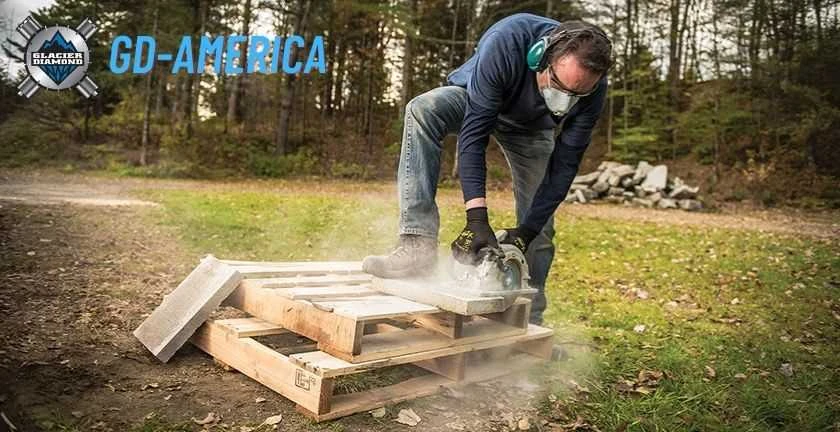

Cutting concrete can be quite daunting, but fortunately, that's not always the case if you have the right tool like a circular saw or a grinder. Asphalt blade in this article, we'll take a closer look at how this device works and how to cut concrete with precision.
Types of blades for cutting concrete
In this part of the article, we are going to
Look at the different types of blades used for circular saws or grinders and what they are used for:
Abrasive blades for masonry
These types of blades are usually quite inexpensive – a 7″ blade will set you back less than $5. They are widely available and can be used to cut asphalt, stucco, as well as concrete. Unfortunately, the low price of abrasive corundum blades has a negative effect on their speed, as they are only able to cut shallow passages from 1/2″ to 1/4″. Cutting with them can take a long time and they also wear out quite quickly.
A 7″ abrasive corundum blade will wear down to 6 1/2″ after cutting a foot or two along your cut line. This means that the operator must frequently change the depth of the saw in order to expose more of the blade. These types of blades create plumes of dust and usually get so hot that they glow. But they are still the best choice for people on a budget and for those who only need a few shallow cuts.
Diamond blades
These types of blades feature a metal blade that is coupled with a diamond or metal composite. When used, their metal composite wears slowly and reveals a cool, sharp diamond edge. Buying a diamond blade for your 7″ circular saw can be a big investment, but you can be sure it will outlast an abrasive type blade – it's a perfect choice for those who cut a lot of concrete.
Dry diamond blades: These usually have toothed or serrated rims that help them eject waste and cool the blade. They are exceptionally well suited for making deeper and deeper cuts. Their biggest drawback is that they create a lot of fine dust. When used indoors, the entire work area should be sealed with tape.
Wet Cut Diamond Blades: These are either smooth perimeter or standard tooth, with water cooling the blade and keeping dust away. Cutting with these blades is quick and clean, but the only way to use a wet cutting blade is to place it in a saw that can dispense water. One solution is to plug the machine into a cord protected by an GFCI and have someone direct a stream of water past the machine while you're using it.
How fast can concrete be cut?
The time frame depends on several different factors, including weather conditions, blade type, hardness, aggregate size, and concrete mix design. Those who start cutting too soon risk cracking, and those who cut too late are sure to see uncontrolled cracking. If the weather is warm, the cut should start somewhere after an hour, although this also depends on how the concrete reacts. Of course, the operator can do a few test cuts and try to determine if the material is ready to be saw cut. If the workpiece is too large, the wisest decision would be to run two saws at the same time. Some contractors like to delay the whole process to protect their tools and reduce abrasion. The types of blades mentioned above can be used depending on how quickly cuts can begin and the current condition of the target concrete. Avoid the following actions
How to make the cut
Once you know which seams need to be cut, you should mark them with chalk. If you are about to use the water cut, you will need to run water through your blade. Asphalt blade Always allows the blade to reach the necessary depth, and then begin to move the device slowly while following the chalk line. Take a look at some additional recommendations:
Never bend the blade
Never let the blade spin while in the cut as this increases wear
When cutting with heavy rebar, you should use blades that have segments of soft metal
How deep should the cut be?
In our experience, a good rule of thumb is to always cut the gasket to 1/4 or 1/3 the thickness of the part. Always check that the depth of the cut is sufficient and that it is in accordance with the engineer's recommendation. If it is too deep, the interlock will simply not be sufficient for load transfer. If it is too shallow, chances are random cracks will occur. Factors such as slab thickness and length, type of base, and curing techniques should all be considered before deciding where the seams will be cut.
0





















Sign in to leave a comment.