

In many Asian American households, resilience is measured by what you can endure in silence. We are taught early on to convert emotional distress into academic and professional accolades, functional compliance, and family pride. But the human nervous system keeps score. For the high-functioning adult, childhood emotional neglect, the crushing weight of conditional love, and the chronic stress of cultural marginalization do not vanish with a high salary or a perfect title. None of it traces back to a single dramatic event. It accumulates quietly, across years and inside the relationships that were supposed to keep you safe, and that slow, relational buildup is exactly what complex trauma is.
What "Complex" Actually Means
When most people hear the word trauma, they think of a single, nameable event: an accident, an assault, a disaster. That kind of trauma is real and serious, and it is also relatively easy to point to. You know roughly when your life split into before and after.
Complex trauma, sometimes called developmental trauma, works differently. It usually does not come from one moment. It builds slowly, in early relationships, through experiences that repeat so often they stop registering as events at all and start feeling like the weather. There may be no single story you can hold up and say, this is the thing that happened to me. For many people, that is exactly why it goes unrecognized for so long. If nothing dramatic happened, it is easy to assume nothing did.
Why High Achievers Tend to Miss It
Here is the part that surprises people: being high-functioning can be one of the ways complex trauma hides.
A child who grows up in an unpredictable or emotionally demanding environment learns to read the room before they can read words. They learn that being useful, easy, and impressive keeps things calm. They get good at anticipating needs, smoothing tension, and not adding to anyone's load. Those skills get rewarded, at home and later at school and at work, so they sharpen. By adulthood, the same patterns that once kept you safe look like competence, discipline, even success.
The Cultural Layer
For many people raised in Asian American or Chinese families, this picture has another layer that makes the trauma even harder to name.
In a lot of these homes, emotional restraint is read as maturity, and not making a fuss is treated as strength. Achievement often becomes the main language through which care is spoken and received, so love and pressure can be hard to tell apart. And for many children of immigrants, a parent's sacrifice sits in the background of everything. When you know how much they gave up and how much harder their road was, it can feel almost ungrateful to suggest that something in your own childhood hurt you. The reflex becomes, who am I to complain.
What It Can Look Like Day to Day
In a high-functioning adult, complex trauma rarely looks like a crisis. More often it looks like this.
You finish something you worked hard for, and instead of joy there is a strange distance, as if you are watching your own life through glass. Rest feels almost impossible, and the moment you slow down, guilt arrives to fill the space. You put other people's needs first so automatically that you often cannot say what you actually want. A voice in your head stays just shy of satisfied, quietly turning every accomplishment into the new baseline. In close relationships, you might notice yourself doing all the holding, or pulling back when things get too near.
If some of these feel familiar, it does not mean you are broken. It means you are looking at the cost of strategies that worked.
What Healing Can Look Like
Healing complex trauma is usually less about understanding it and more about your nervous system slowly learning something it never got to learn the first time: that it is safe to stop. You can grasp every pattern intellectually and still feel them run, because the original lessons were never stored as ideas. They were stored in the body, in the reflex to brace, to produce, to stay a step ahead of whatever might go wrong. Change tends to arrive there too, in the felt sense, in the small moments where something that has always been tense is allowed, briefly, to let go.
Because the injury happened in a relationship, the repair tends to happen in the relationship too. This is part of why doing the work alone, through discipline and self-help, so often stalls. What was missing was never information. It was the experience of being met. In therapy, that can begin to happen in real time, when a feeling you would normally have pushed down is allowed to surface and someone stays with you while it does, instead of needing you to manage it or hurry past it.
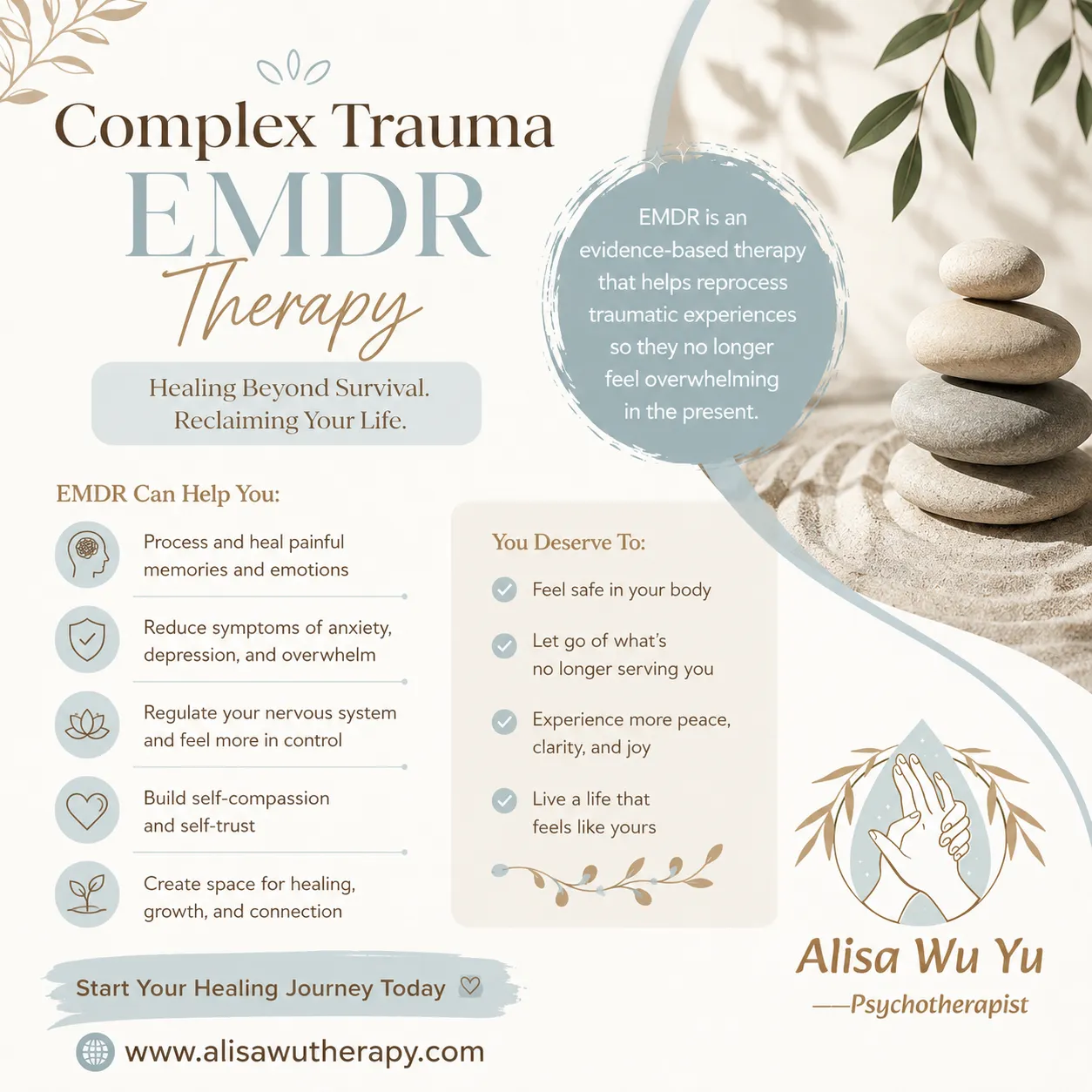
For many individuals, approaches such as complex trauma EMDR therapy can help process painful memories and reduce the emotional intensity that remains stored in the nervous system. When combined with a culturally sensitive therapeutic relationship, EMDR can support deeper healing from developmental and relational trauma.
For many high-achieving adults, there is a quiet fear underneath all of this, that healing means losing the edge that got you here. It does not. The goal is not to make you less capable. It is to stop charging your whole self for the capability, so that producing becomes something you can choose rather than the only way you are allowed to exist. There is often grief along the way, for the years spent armored and for what a younger version of you needed and did not receive. Letting that grief move through you is not a setback. It is frequently where the real softening begins.
And doing this with someone who understands the world you come from can matter more than it sounds. So much of what shaped you lives in what was never said out loud. You should not have to explain or defend your own family before you can be understood. At Alisa Wu Therapy, the therapeutic process is grounded in an understanding of complex childhood trauma, cultural identity, and the unique experiences of Asian American and Chinese adults navigating relationships, achievement, and self-worth.
A Gentle Close
If reading this stirred something, it does not mean something is wrong with you. It may mean that something you have carried quietly for a long time finally has a name. That is not a small thing, and it is not the end of the story. Reaching out for support is allowed, and it is usually a far smaller step than it looks from the inside.
Alisa Wu is a bilingual (English and Mandarin) trauma therapist in New York City, offering individual and couples therapy with a focus on complex childhood trauma and the experiences of Chinese and Asian American adults. Through Alisa Wu Therapy, clients receive compassionate, culturally attuned support for healing, growth, and lasting emotional change. Learn more at alisawutherapy.com.





























Sign in to leave a comment.