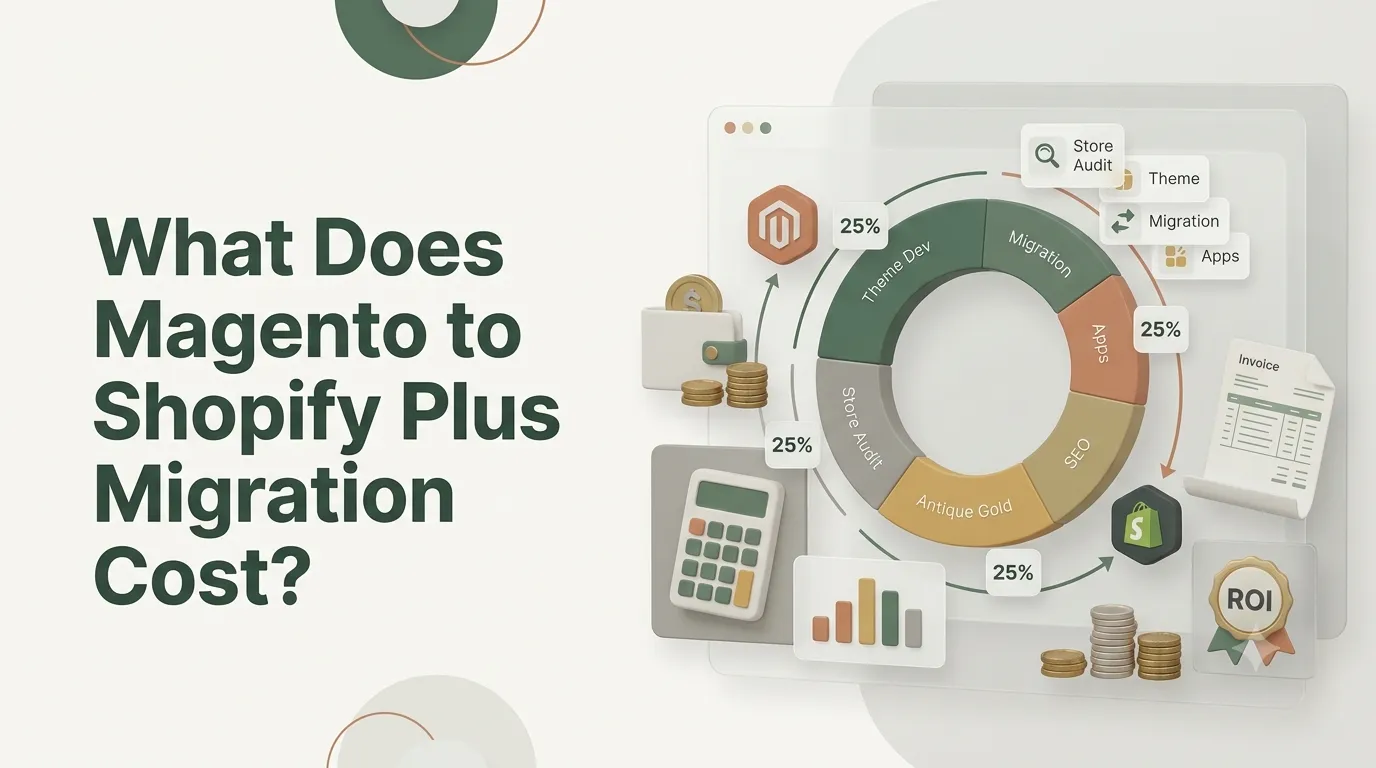

Magento to Shopify Plus migration cost runs from $20,000 for clean, simple B2C migrations to $250,000 or more for enterprise replatforms with complex ERP integration and full B2B wholesale configuration. Shopify Plus adds a monthly platform fee of approximately $2,300 to $2,500 on top of that one-time project investment. Five variables determine where your project lands in that range: catalog complexity, integration depth, custom functionality scope, B2B requirements, and theme approach. Brands that understand these variables before entering a quote conversation produce more accurate budgets, avoid scope surprises mid-project, and make better decisions about which migration approach matches their actual commercial situation. This guide covers all five drivers, what professional services deliver, the hidden costs most brands encounter too late, and the honest financial case for migrating versus staying.
Five Variables That Determine Where Your Migration Cost Lands
Migration cost reflects the actual complexity of translating your current Magento environment into Shopify Plus's architecture. Understanding the five variables that drive cost before any agency conversation produces estimates that hold through the project rather than expanding after kickoff.
Catalog Size and Complexity
SKU count is the largest individual cost driver. Simple products with fixed pricing transfer faster and require less mapping work than configurable products with multiple variants, which must be deliberately mapped onto Shopify's variant structure. Digital products, subscriptions, and gift cards each add app-level configuration requirements that standard physical catalogs do not need.
Data migration services with structured validation at each transfer stage catch mapping errors before they surface as catalog problems on a live store, rather than after customers encounter them.
Integration Depth
Every third-party system connected to your Magento store must be rebuilt or replaced for Shopify's API architecture. Integration count and complexity both drive cost, and the rebuild effort scales directly with how deeply each system is embedded in current operations:
- ERP and PIM systems: bidirectional sync rebuilt from scratch, the highest-cost integration category in most migration scopes
- 3PL and shipping providers: reconnection or replacement with Shopify-compatible alternatives based on platform availability
- Email service providers: audience segments, behavioral triggers, and automation flows rebuilt in the new environment from the ground up
- Loyalty platforms: direct Shopify app replacement or custom integration work depending on the platform and feature requirements
Each integration in scope adds time and cost in proportion to its complexity and how tightly it connects to core business operations.
Custom Functionality and Extension Mapping
Every active Magento extension needs an equivalent in the Shopify ecosystem. Some replace directly with turnkey Shopify apps. Others require custom development because no app covers the specific functionality at the level the business currently uses it. The distance between those two outcomes, turnkey replacement versus custom build, is one of the largest sources of cost variance across migration projects and one that only a thorough discovery audit can assess accurately before development begins.
B2B Configuration Requirements
Shopify Plus delivers native B2B capability, company accounts, custom pricing lists, net payment terms, and a dedicated wholesale storefront. Configuring those capabilities to match existing wholesale logic still adds meaningful build time to any project that runs wholesale operations. B2B wholesale commerce solutions on Shopify Plus require pre-build documentation of pricing rules, quantity break structures, and customer hierarchies before development begins. Skipping that documentation step creates rebuild cycles later that add unplanned cost and compress timelines.
Storefront and Theme Approach
The choice between Liquid theme and headless Hydrogen build affects both project cost and timeline significantly:
- Liquid theme: faster to complete, lower cost, appropriate for most mid-market brands with standard performance requirements
- Headless Hydrogen: higher project cost, sub-second load performance, greater design flexibility, appropriate for high-volume brands where standard themed store performance falls short of requirements
One factor applies to every 2026 migration regardless of theme approach: Shopify Scripts retired permanently on June 30, 2026. All checkout customization, discount mechanics, and promotional logic previously built in Scripts must be rebuilt in Shopify Functions before DNS cutover, a hard pre-launch dependency in every current project scope, not deferred post-launch work.
Migration Cost by Project Type: Where Most Brands Land
Three project profiles cover the majority of Magento-to-Shopify-Plus migrations and define the realistic cost landscape for brands budgeting in 2026.
Simple Migrations: $20,000–$50,000 Over 3–4 Months
Simple migrations suit single-store B2C brands with clean product data, a pre-built or lightly customized storefront theme, and minimal third-party integrations requiring rebuild. These projects move efficiently because complexity stays contained and data arrives organized for transfer. Brands in this range typically have limited Magento customization history and straightforward catalog structures that translate cleanly onto Shopify's product architecture.
Mid-Complexity Migrations: $50,000–$120,000 Over 4–6 Months
Mid-complexity migrations cover established mid-market brands requiring custom theme development, moderate catalog complexity, and two to three integrations that need rebuild rather than simple reconnection. Most brands with meaningful Magento customization history land in this range. Custom theme requirements alone push projects out of the simple tier, and multiple integrations requiring rebuild add scope that standard timelines cannot absorb without extending the project duration.
Enterprise and B2B Migrations: $120,000–$250,000+ Over 6–9 Months
Enterprise migrations address multi-store setups, deep ERP synchronization, full B2B wholesale configuration, and complex checkout logic requiring Shopify Functions development built from scratch. These projects involve the most stakeholders, the most technical dependencies, and the longest validation cycles. The upper end of this range reflects genuine complexity in translating a sophisticated multi-system Magento environment onto a fundamentally different platform architecture.
The complete cost breakdown across these project types and individual drivers is covered in the Magento to Shopify Plus migration cost guide.
Shopify Plus Platform Fees: What You Pay Monthly After Migration
Base Monthly Fee and What It Covers
Shopify Plus charges a flat monthly fee of approximately $2,300 to $2,500 regardless of sales volume up to a defined revenue threshold. That predictability differs fundamentally from self-hosted Magento, where monthly infrastructure costs vary based on traffic events, unplanned patching cycles, and development needs that arise without scheduling, making annual budget planning for Magento significantly less reliable than for Shopify Plus across any full operating year.
Variable GMV-Based Fee Above Threshold
Once revenue crosses Shopify's defined threshold, a variable fee tied to gross merchandise value activates alongside the base fee. For most mid-market brands operating at standard volumes, the flat fee covers normal operations entirely and the variable component becomes relevant only at revenue levels significantly above current generation for brands in this category.
Shopify Plus Fees vs. Magento Total Cost of Ownership
Self-hosted Magento typically runs $4,000 to $15,000 or more per month when hosting, security patching, infrastructure management, and dedicated development resources are fully and honestly counted. Shopify Plus's flat fee absorbs every one of those cost categories into a single predictable monthly line. A certified Shopify Plus partner builds the ongoing fee comparison into the migration business case before launch, so the cost difference with previous Magento operating expenses is understood and planned for rather than encountered as a post-launch financial surprise.
What Professional Magento to Shopify Plus Migration Services Actually Deliver
Professional Magento to Shopify Plus migration services cover substantially more than transferring data between platforms. A qualified agency delivers across the full migration scope:
- Discovery and audit: complete review of catalog structure, integration map, and business logic that defines accurate project scope before development begins, preventing the scope additions that consistently drive cost overruns on under-scoped projects
- Data migration: products, customers, complete order history, and CMS content transferred with structured validation at each stage to catch errors in the controlled migration environment rather than after go-live
- SEO redirect mapping: 301 redirects, meta titles, descriptions, and schema markup preserved completely to protect organic search rankings through and after cutover
- Storefront and checkout build: theme development targeting Core Web Vitals benchmarks and checkout logic rebuilt in Shopify Functions where Scripts previously handled that customization
- Soft cutover and post-launch monitoring: controlled go-live with active monitoring through the first critical weeks after launch when most migration issues surface under live traffic conditions
SEO services for migration projects run as a dedicated parallel workstream alongside the technical build, not as a post-launch cleanup activity. Organic traffic recovered after a poorly executed cutover consistently costs more and takes longer to restore than rankings protected correctly during the migration build. The complete process is documented in the Magento to Shopify Plus migration guide.
Hidden Costs Most Brands Discover After the Budget Is Locked
Several cost categories consistently catch brands off guard during migration projects. Understanding these before finalizing any migration budget prevents the surprises that arrive after kickoff when addressing them disrupts timeline and budget simultaneously.
App Stack Replacement Creates Ongoing Monthly Cost
Magento extensions rarely replace on a one-to-one basis with Shopify apps. Some replacement apps cost more than the extensions they succeed. Others require custom development because no app covers the exact functionality at the required level. Others need multiple Shopify apps to replicate what a single Magento extension currently handles. The accumulation of app subscription fees across multiple replacements creates a recurring monthly operating cost that brands consistently underestimate when building their post-migration financial model.
Custom Theme Development Costs Exceed Initial Assumptions
Template-based Liquid builds keep project costs toward the lower end of the range. Any storefront requiring unique layout structures, brand-specific component behavior, or non-standard navigation adds dedicated design and development time that moves project cost meaningfully upward. The gap between a template build and a fully custom Liquid theme is significant. The gap between a custom Liquid theme and a headless Hydrogen build is larger still, and each step up represents genuine performance and capability improvement that justifies the cost for brands whose requirements genuinely demand it.
QA and Testing Scope Gets Underestimated Consistently
Thorough checkout testing, payment gateway validation, redirect verification, and integration testing requires dedicated scope that initial estimates consistently underallocate. A checkout failure or broken integration caught during pre-launch testing costs far less to fix than the same problem encountered by live customers after cutover. Any migration budget without explicit QA scope underestimates actual project cost, and that difference surfaces at the most inconvenient moment in the project timeline.
Customer Password Reset Carries Real Operational Impact
Magento's password hashing method cannot migrate to Shopify. Every existing customer must reset their password at first login on the new platform. This does not appear as a development cost but generates elevated customer support volume, demands proactive email communication planning, and creates a post-launch friction point that affects customer satisfaction scores in the weeks following go-live. Brands that treat this as a minor technical note consistently encounter post-launch support loads that exceed their staffing plan.
After launch, accurately measuring whether the new platform outperforms Magento requires tracking both macro and micro conversions against documented pre-migration baselines from the first day of operation on Shopify Plus.
Migration Cost vs. Staying on Adobe Commerce: The Honest Comparison
A One-Time Investment Versus a Compounding Recurring Expense
Migrating to Shopify Plus requires a defined one-time project investment. Staying on Adobe Commerce requires ongoing monthly expenditure on hosting, infrastructure management, security patching, platform upgrades, and custom development, spending that maintains existing capabilities rather than expanding them. The replatforming investment that appears large in isolation looks substantially different when compared against cumulative Magento operating costs across a three to five year planning horizon rather than against zero.
Every Year of Deferral Increases the Total Cost
Brands that postpone migration because their current Magento store functions adequately today accumulate technical debt with every quarter that passes. Each year on Magento consumes development resources that could apply to growth initiatives, adds to an upgrade backlog that becomes more expensive as version gaps widen further from current releases, and limits the speed at which the business can adopt commerce capabilities that competitors on modern platforms already operate as standard features.
The Comparison Decision-Makers Need to Make
The accurate financial comparison is migration cost versus cumulative Magento operating costs over the same period, not migration cost versus zero. For most growing brands, the business case extends beyond cost savings to include faster feature deployment, operational simplicity, native B2B and multi-market capability without third-party application overhead, and a platform infrastructure that reduces engineering burden rather than compounding it year over year as the technical environment ages and the cost of maintaining it climbs.
How to Get an Accurate Migration Quote Before Committing
Information to Organize Before a Quote Call
Brands that arrive at a discovery call with complete and organized information receive faster, more accurate estimates. The gap between a rough estimate and a reliable project budget almost always traces to missing information at the initial discovery stage:
- Catalog and SKU audit: total product count, active variant count, and any complex bundling, configurable product structures, or digital product categories in the current catalog
- Integration map: every third-party system connected to the current Magento store with a clear description of data flows between each connection
- Custom functionality documentation: a complete list of active Magento extensions and any custom code that needs to be replicated or replaced on the new platform
Questions That Reveal Whether an Agency's Process Matches the Work
Before committing to any migration partner, these questions reveal how thoroughly the agency approaches the work and whether their process actually delivers what a successful migration requires:
- How does your 301 redirect mapping process work from initial audit through DNS cutover?
- What does post-launch monitoring include and for how long does active monitoring continue after go-live?
- How do you scope and price change requests that arise mid-project after initial scope has been agreed and signed?
A Google Analytics 4 audit before the first agency conversation establishes the clear performance baseline that the migration can be measured against from day one on Shopify Plus. After launch, a structured CRO audit surfaces the specific optimization opportunities the new platform enables, opportunities the migration creates access to but does not automatically activate or measure without deliberate post-launch analysis.
Magento to Shopify Plus migration cost is a defined investment with a predictable range, a clear set of variables that drive it in either direction, and a specific set of hidden costs that brands consistently underestimate without prior migration experience. Staying on Adobe Commerce is a recurring expense with costs that grow as technical debt accumulates and each upgrade cycle becomes more expensive to defer. Brands that understand both sides of that comparison before the first agency conversation make better decisions and encounter fewer surprises when the project is underway.





















Sign in to leave a comment.