
Polyurethane foaming machines are among the most crucial pieces of equipment in modern manufacturing, powering production in sectors from automotive and construction to furniture and packaging. They provide the precision, consistency, and efficiency needed to create high-quality polyurethane foam products that are integral to our daily lives. As a leading manufacturer of both high- and low-pressure polyurethane systems, Henghui Technology understands the critical role of this technology. These machines deliver superior chemical mixing, enhanced process control, and reliable scalability, making them indispensable in industries where performance and consistency are paramount.
This article explores the fundamentals of a polyurethane foaming machine, the different types available, their wide-ranging applications across industries, and the significant benefits they bring to any production line.
What is a Polyurethane Foaming Machine?
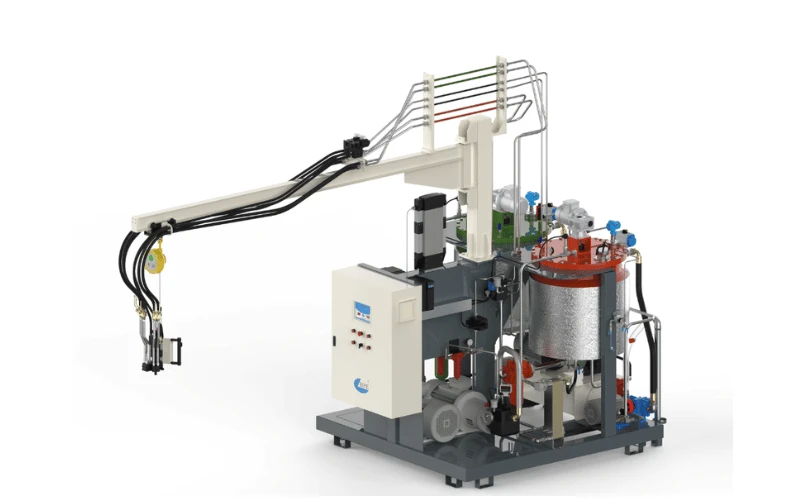
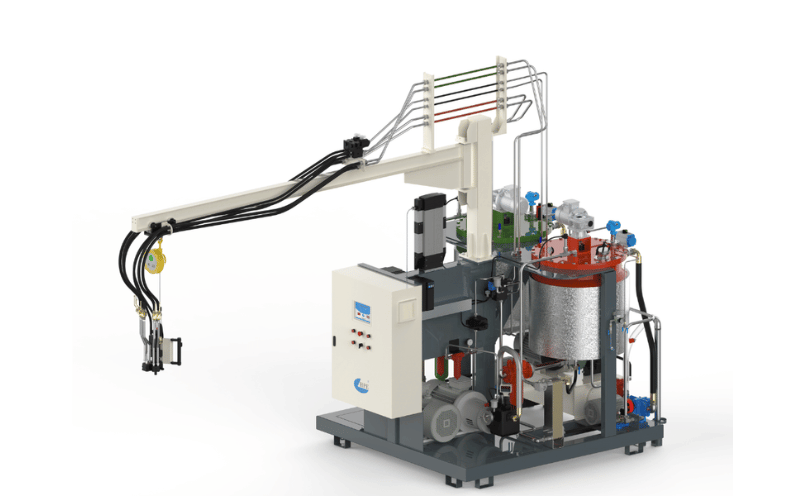
A polyurethane foaming machine is a sophisticated piece of equipment that accurately mixes two primary chemicals—a polyol blend and an isocyanate—and dispenses the resulting reactive mixture to create polyurethane foam. Depending on the machine's configuration and the chemical formulation, the resulting foam can be rigid, flexible, or integral skin, each with unique properties. Unlike manual mixing, which is prone to inconsistency and high waste, a foaming machine is engineered to deliver a precise component ratio under controlled temperature and pressure, ensuring a uniform, high-quality end product every time.
A typical polyurethane foaming machine consists of several key systems: material tanks for the polyol and isocyanate, high-precision pumps (or metering units), a mixing head, a control system, and often, integrated heating and cooling elements. The pumps draw the chemicals from the tanks and deliver them to the mixing head at a specific ratio. It is in the mixing head where the two streams are combined. High-pressure machines use impingement mixing, where the chemicals collide at high velocity, while low-pressure machines use a mechanical agitator. The control system, often a PLC, monitors and adjusts all process parameters, including temperatures, pressures, and flow rates, ensuring the process is repeatable and reliable.
The importance of these machines in modern manufacturing cannot be overstated. They are the heart of any polyurethane production process, directly influencing the final product's structural integrity, density, and performance characteristics. By automating and controlling the complex chemical reaction, polyurethane foaming machines enable manufacturers to achieve high throughput, reduce material waste, and produce complex parts with tight tolerances. This level of control is essential for meeting the stringent quality standards required in today's competitive global markets. learn more about the product.
Types of Polyurethane Foaming Machines
Polyurethane foaming machines are primarily categorized by their mixing technology, which determines their applications, scales, and costs. Henghui manufactures a range of options to suit diverse production needs.
High-Pressure Foaming Machines
High-pressure machines are the workhorses of large-scale industrial production. They use high-pressure pumps to force the polyol and isocyanate streams to collide at pressures exceeding 2,000 PSI in a small mixing head chamber. This high-velocity impingement ensures an exceptionally thorough and rapid mix. Because the head is self-cleaning due to the force of the injection, no solvent flushing is needed between shots. This results in faster cycle times, minimal chemical waste, and superior, highly consistent foam quality, making them the preferred choice for automotive interiors, appliance insulation, and other high-volume applications.
Low-Pressure Foaming Machines
In contrast, low-pressure foaming machines mix chemicals at much lower pressures, typically under 500 PSI. They rely on a mechanical stirrer or agitator inside the mixing head to blend the components. After each pour, the mixing head must be flushed with a solvent to prevent the reactive mixture from curing inside. While this process results in more material waste and slower cycle times, the machines themselves are simpler in design, easier to operate, and have a significantly lower initial investment cost. This makes them an excellent, cost-effective choice for small to medium-sized businesses, custom molding operations, or prototyping.
Portable Foaming Machines
Portable foaming machines, often called spray foam rigs, are complete, self-contained systems designed for on-site applications. These units are typically mounted on a truck or trailer and include the proportioning machine, feed pumps, heated hoses, a generator, and an air compressor. Their primary use is in the construction industry for applying spray polyurethane foam (SPF) insulation to walls, attics, and roofs. Their mobility allows them to bring the foam production process directly to the job site, providing excellent thermal insulation and air sealing for buildings.
Benefits of Polyurethane Foaming Machines
Integrating a polyurethane foaming machine into a production process offers numerous advantages that drive quality, efficiency, and profitability.
Precision and Consistency
One of the most significant benefits is the unparalleled precision these machines offer. The advanced metering pumps and control systems ensure the chemical components are mixed at the exact ratio required by the formulation, shot after shot. This eliminates the variability common with manual processes, resulting in a uniform cell structure and consistent foam density. This consistency is critical for applications where performance characteristics like insulation value, structural strength, or cushioning properties must be reliable and repeatable across thousands of parts.
Efficiency and Scalability
Polyurethane foaming machines are designed for continuous or semi-continuous operation, enabling high production throughput. High-pressure machines, with their self-cleaning heads and rapid cycle times, are particularly efficient, minimizing downtime between pours. This operational efficiency translates to lower labor costs and reduced material waste compared to batch-mixing methods. Furthermore, these machines are scalable. A company can start with a smaller, low-pressure machine for initial production and later invest in a larger, high-pressure system as demand grows, ensuring the technology can grow with the business.
Flexibility and Customization
Modern foaming machines from manufacturers like Henghui are highly flexible. Many feature modular designs that allow them to be configured for specific applications. Advanced PLC control systems enable operators to store multiple processing recipes, making it easy to switch between different products or foam formulations with minimal setup time. This adaptability allows manufacturers to respond quickly to market demands and produce a wide variety of parts on a single machine, from rigid structural components to soft, flexible cushions.
Applications of Polyurethane Foaming Machines
The versatility of polyurethane foam means these machines are used across a wide range of industries, creating products essential to modern life.
The automotive industry is a major user of polyurethane foaming machines, which are used to manufacture a wide range of components. This includes comfortable and durable car seats, sound-dampening insulation panels, soft-touch dashboards, and energy-absorbing bumpers. The ability of these machines to produce parts with consistent quality and complex geometries is vital for meeting the industry's strict safety and performance standards.
In the construction sector, portable spray foam machines are indispensable for creating high-performance building insulation. The foam is sprayed directly into wall cavities, on roofing decks, and in crawl spaces, where it expands to create a seamless air and moisture barrier. This application significantly improves a building's energy efficiency and structural rigidity. Fixed machines are also used to produce rigid insulation boards and insulated structural panels (SIPs).
Beyond these major sectors, polyurethane foaming machines are used in the furniture industry to create cushions and padding, in the appliance industry for refrigerator and freezer insulation, and in the packaging industry to produce protective foam-in-place packaging for fragile goods. Their applications also extend to manufacturing sporting goods, medical devices, and even imitation wood decorative elements.
Conclusion
Polyurethane foaming machines are advanced, versatile tools that provide unmatched control, efficiency, and scalability for modern manufacturing. By enabling precise chemical mixing, they empower industries to produce a wide range of high-quality foam products that meet demanding performance standards. From high-pressure systems for mass production to cost-effective low-pressure models for smaller operations, there is a solution for every need. As an experienced manufacturer, Henghui offers a comprehensive range of both high- and low-pressure machines designed for reliability and performance. Explore Henghui’s offerings to find the ideal machine that optimizes your production and drives innovation.





















Sign in to leave a comment.