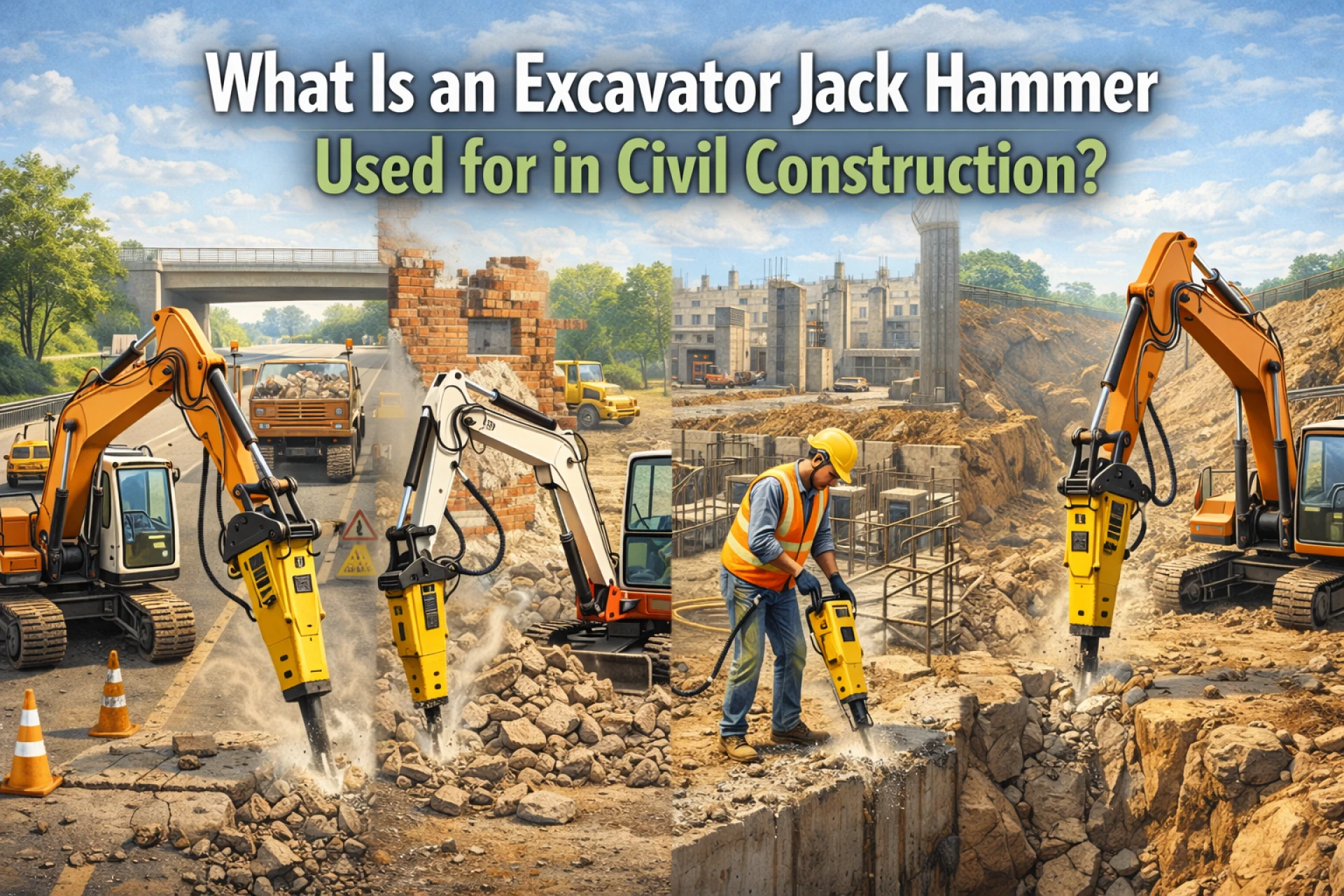

In civil construction, excavation does not always involve loose soil. Many projects require removal of reinforced concrete, rigid pavement, or hard rock layers. A standard excavator bucket is designed for digging and material handling. It cannot generate the impact force required to fracture high-strength material. In such cases, you use an excavator jack hammer.
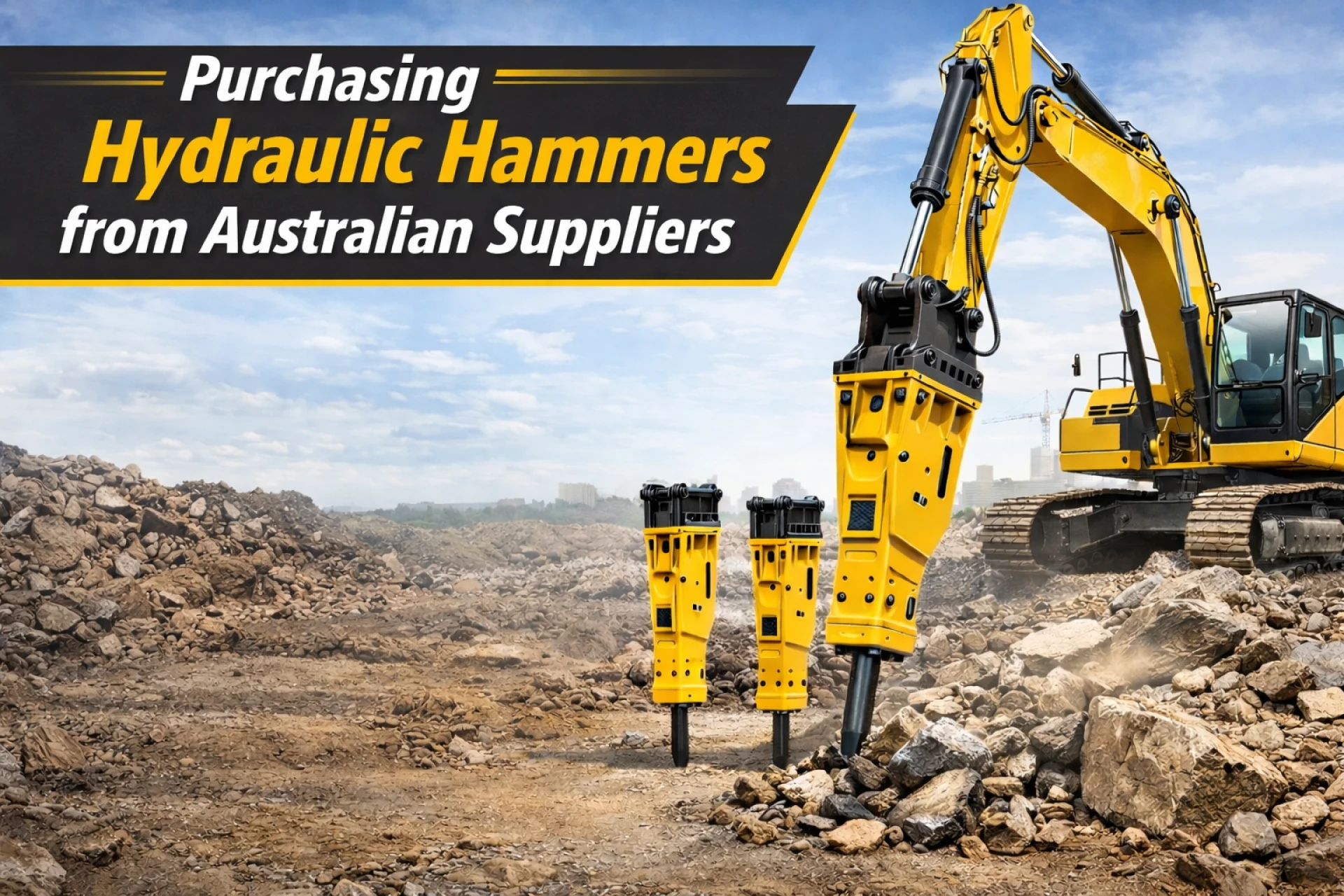
An excavator jack hammer, also called a hydraulic breaker, is an attachment that delivers repeated impact energy to break concrete, asphalt, or rock. It is used when controlled mechanical breaking is required instead of digging. This attachment improves efficiency in demolition, pavement removal, rock excavation, and foundation work.
What Is an Excavator Jack Hammer?
An excavator jack hammer is mounted in place of the excavator bucket. It connects directly to the excavator’s hydraulic system.
The breaker operates using hydraulic pressure. Oil flow from the excavator pump enters the breaker housing and drives an internal piston. The piston strikes a hardened steel tool. The tool transfers impact energy to the surface being broken.
This impact cycle repeats at high frequency. The generated stress exceeds the tensile strength of the material, causing cracks to form and expand. Over repeated impacts, the material fractures into smaller pieces that can be removed using standard excavation tools.
The performance depends on hydraulic flow rate, operating pressure, and breaker size. The attachment must match the excavator’s hydraulic capacity for stable operation.
Applications in civil construction
You use an excavator jack hammer when excavation tools cannot penetrate or break the material effectively.
Reinforced concrete demolition
In demolition projects, you often remove slabs, footings, retaining walls, and other reinforced concrete elements.
You use the breaker to apply concentrated impact force on concrete surfaces. The repeated blows fracture the concrete mass and weaken its bond with reinforcement bars. Once fractured, the material can be cleared safely.
Hydraulic breaking allows controlled demolition and is suitable in urban areas where blasting is restricted.
Road and pavement removal
In road rehabilitation projects, damaged asphalt or concrete layers must be removed before resurfacing.
The excavator jack hammer breaks the rigid pavement into manageable sections. After fragmentation, debris is removed using a bucket.
This ensures proper base preparation for laying new sub-base and asphalt layers.
Rock excavation
In rocky terrain, excavation buckets cannot penetrate intact rock formations.
You use the breaker to fracture bedrock and reduce large stones into smaller pieces. After fragmentation, standard excavation continues.
This method is commonly used in hill road construction, canal projects, and foundation cutting in rocky soil.
Foundation and base preparation
Before placing foundations, the base must meet required depth and alignment.
If rock projections or old concrete obstruct excavation, you use the breaker to remove them. This ensures uniform base preparation and proper load transfer.
It is critical in bridge construction and heavy structural work.
Utility trenching in hard ground
Pipeline and cable installation require trenching through compacted or rocky ground.
When trenching tools cannot penetrate, you first use the excavator jack hammer to break the surface layer. After that, excavation proceeds normally.
This reduces tool wear and improves work efficiency.
Technical selection considerations
Before installing a breaker, you must verify hydraulic compatibility.
You should evaluate excavator operating weight, hydraulic oil flow capacity, and working pressure limits. Using a breaker that is too large may overload the hydraulic system. Using one that is too small reduces breaking efficiency.
Tool selection also matters. A moil point is used for general rock breaking. A flat chisel is used for surface cutting. A blunt tool is used for secondary breaking.
Operation and maintenance
Proper operation improves performance and equipment life.
Keep the breaker perpendicular to the surface. Avoid applying excessive side force. Do not operate the breaker without contact with material.
Dry firing increases internal wear and reduces service life.
Routine maintenance includes inspecting hydraulic hoses, lubricating tool bushings, and monitoring tool wear. Preventive checks reduce downtime and ensure consistent impact energy.
To sum it up
You use an excavator jack hammer in civil construction when material strength exceeds excavation capability. It helps you break hard concrete, road surfaces, and rock safely and in a controlled way.
When used correctly and maintained properly, it becomes a reliable part of your civil construction work, helping you complete heavy breaking tasks efficiently and without unnecessary delays.


























Sign in to leave a comment.