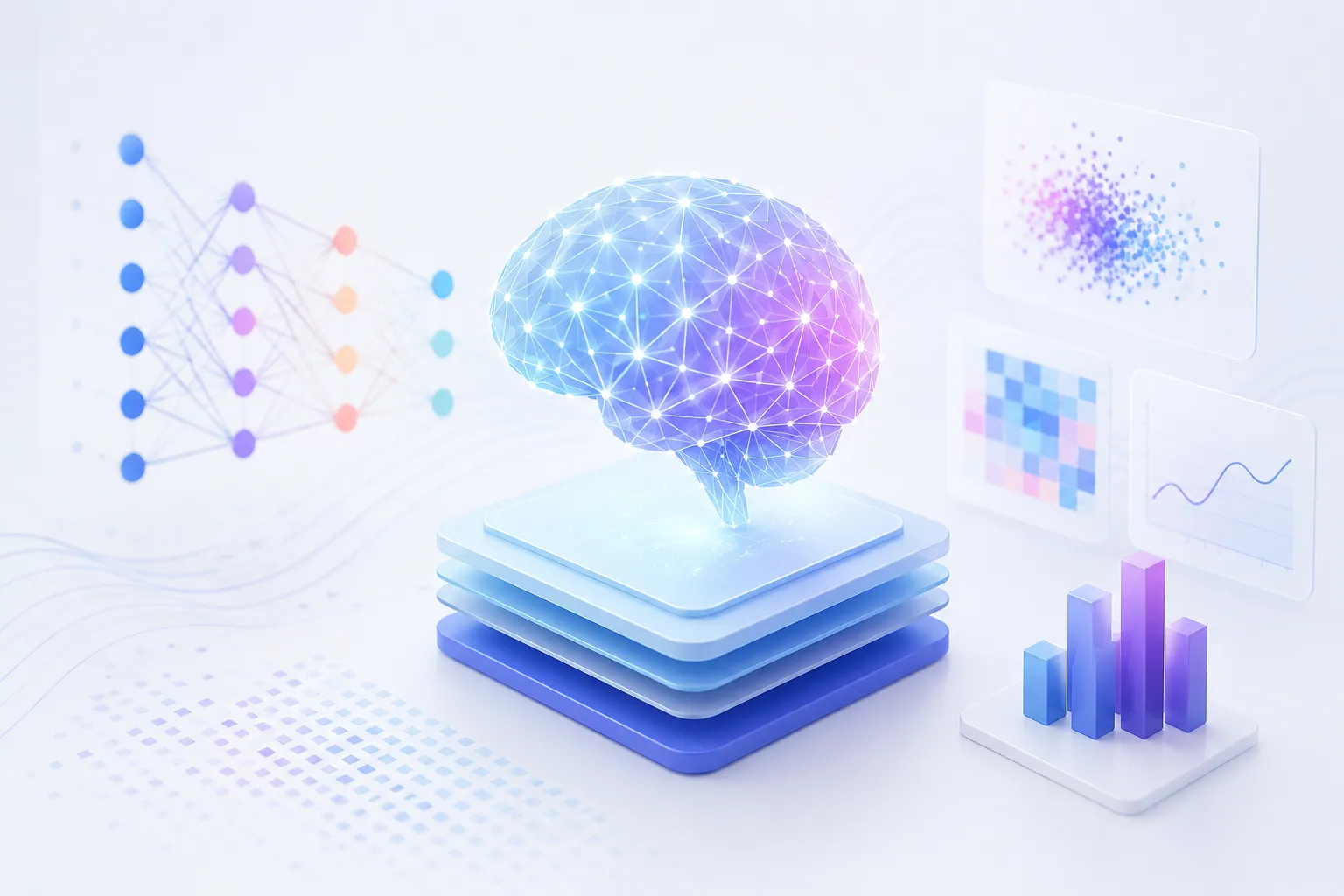

Artificial Intelligence (AI) has transformed the way we interact with technology. From voice assistants and recommendation systems to self-driving cars and medical diagnostics, many of today's most impressive AI applications are powered by deep learning. If you've ever wondered how machines can recognize faces, understand speech, or generate realistic images, understanding the fundamentals of deep learning is the perfect place to start.
In this article, we'll explore the basics of deep learning, how it works, its real-world applications, and how beginners can start learning this exciting field.
What Is Deep Learning?
Deep learning is a subset of machine learning that uses artificial neural networks to learn patterns from large amounts of data. These neural networks are inspired by the structure and function of the human brain, allowing computers to process information in ways that resemble human learning.
Unlike traditional machine learning models that often require manual feature engineering, deep learning systems automatically identify important features and patterns from raw data. This capability has made deep learning one of the most powerful technologies in modern AI.
Understanding the fundamentals of deep learning helps learners appreciate how AI systems can perform complex tasks such as image recognition, language translation, speech processing, and predictive analytics.
The Building Blocks of Deep Learning
To understand the basics of deep learning, it's important to know the key components of a neural network.
1. Neurons
Artificial neurons are the basic processing units of a neural network. Each neuron receives input data, performs calculations, and produces an output.
2. Layers
Neural networks are organized into multiple layers:
- Input Layer: Receives data.
- Hidden Layers: Process information and learn patterns.
- Output Layer: Produces the final prediction.
The term "deep" in deep learning comes from the presence of many hidden layers between the input and output.
3. Weights and Biases
Weights determine the importance of different inputs, while biases help adjust the output of neurons. During training, the network continuously updates these values to improve accuracy.
4. Activation Functions
Activation functions introduce non-linearity into the network, allowing it to learn complex relationships within data.
These concepts form the deep learning fundamentals and are essential for anyone looking to learn deep learning effectively.
How Does Deep Learning Work?
Deep learning models learn by processing vast amounts of data and adjusting their internal parameters through a process called training.
Here's a simplified overview of how deep learning works:
Step 1: Data Input
The model receives input data such as images, text, audio, or numerical information.
Step 2: Forward Propagation
Data flows through multiple neural network layers. Each layer extracts increasingly complex features from the data.
For example, in image recognition:
- First layers detect edges.
- Middle layers identify shapes.
- Deeper layers recognize objects such as faces, animals, or vehicles.
Step 3: Prediction
The network generates an output or prediction based on the learned patterns.
Step 4: Error Calculation
The prediction is compared with the correct answer. The difference between them is called loss or error.
Step 5: Backpropagation
The model adjusts its weights and biases to reduce the error. This optimization process is repeated thousands or even millions of times.
Over time, the network becomes increasingly accurate, demonstrating the practical application of deep learning basics.
Why Is Deep Learning So Powerful?
Deep learning has gained popularity because of its ability to handle large and complex datasets without extensive manual intervention.
Some key advantages include:
Automatic Feature Extraction
Deep learning models automatically identify relevant features, reducing the need for human-designed rules.
High Accuracy
In many domains, deep learning achieves performance that rivals or exceeds human capabilities.
Scalability
The more data available, the better deep learning systems generally perform.
Versatility
Deep learning can be applied to images, videos, text, speech, and structured data.
These strengths make it an essential skill for anyone who wants to learn deep learning and pursue a career in AI.
Real-World Applications of Deep Learning
Deep learning is already transforming industries worldwide.
Healthcare
AI-powered systems can analyze medical images, assist in disease detection, and support clinical decision-making.
Finance
Banks use deep learning to detect fraud, assess risk, and automate financial processes.
E-Commerce
Recommendation engines suggest products based on customer preferences and behavior.
Autonomous Vehicles
Self-driving cars rely on deep learning to recognize road signs, pedestrians, and traffic conditions.
Natural Language Processing
Chatbots, virtual assistants, and language translation systems use deep learning to understand and generate human language.
Entertainment
Streaming platforms use deep learning to recommend movies, music, and personalized content.
These applications highlight why deep learning has become one of the most sought-after skills in today's technology landscape.
Deep Learning from Scratch: Where Beginners Should Start
Many aspiring AI professionals believe deep learning is too complex to learn. However, with the right approach, anyone can start learning deep learning from scratch.
Here is a practical learning path:
Learn Python
Python is the most widely used programming language for AI and deep learning.
Understand Basic Mathematics
A foundational understanding of:
- Linear algebra
- Probability
- Statistics
- Calculus
can significantly improve your understanding of neural networks.
Study Machine Learning Concepts
Before diving into deep learning, it helps to understand basic machine learning principles.
Learn Neural Networks
Focus on how neurons, layers, activation functions, and optimization algorithms work together.
Build Projects
Hands-on projects provide practical experience and reinforce theoretical concepts.
Following this roadmap can help beginners confidently approach deep learning from scratch and gradually develop advanced AI skills.
The Best Way to Learn Deep Learning
While there are countless resources available online, structured learning often delivers better results than trying to piece together information from multiple sources.
One excellent option is the Deep Learning Fundamentals course by LearnKarts on Coursera. This beginner-friendly program introduces learners to neural networks, machine learning concepts, and practical AI applications.
The course combines theoretical understanding with practical examples, making it ideal for students, professionals, and technology enthusiasts who want to learn deep learning in a structured and accessible way.
Conclusion
Deep learning is one of the most influential technologies driving today's AI revolution. By understanding deep learning fundamentals and mastering the deep learning basics, learners can unlock opportunities in fields ranging from healthcare and finance to robotics and autonomous systems.
Whether you're a student, developer, data enthusiast, or working professional, now is an excellent time to learn deep learning. Starting deep learning from scratch may seem challenging at first, but with consistent practice and the right learning resources, anyone can build the skills needed to thrive in the rapidly growing world of artificial intelligence.
As AI continues to evolve, deep learning will remain at the heart of innovation, making it one of the most valuable skills for the future.





























Sign in to leave a comment.