What Is the Garga Samhita? Meaning, Origin, Teachings, and Spiritual Importance Explained
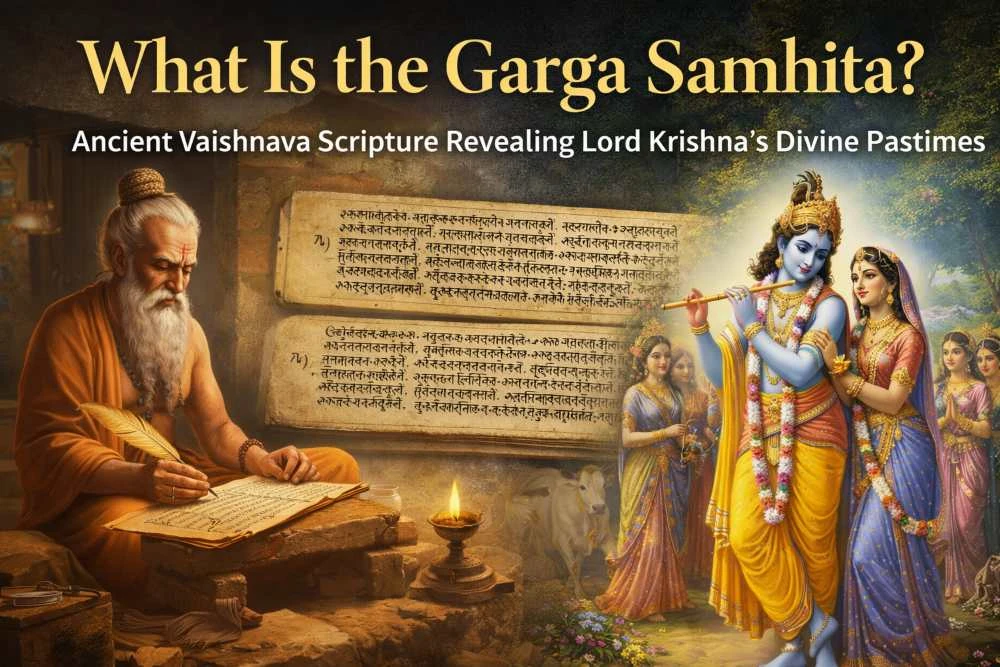
The Garga Samhita is a sacred Vaishnava scripture that occupies a special place in Vedic devotional literature. Although not as widely known as the Bhagavad Gita or Srimad Bhagavatam, the Garga Samhita is deeply respected among devotees for its intimate descriptions of Lord Krishna’s divine pastimes and its strong emphasis on pure devotional service (bhakti).
For spiritual seekers, students of Vedic philosophy, and readers interested in authentic Krishna literature, understanding what the Garga Samhita is opens the door to a deeper appreciation of Krishna consciousness and timeless Vedic wisdom.
Understanding the Meaning of Garga Samhita
The word “Samhita” means a systematic compilation or collection of sacred teachings. The Garga Samhita is therefore a structured devotional scripture that brings together narratives, teachings, and philosophical conclusions centered on Lord Krishna.
Unlike historical records that focus on dates or political events, the Garga Samhita focuses on spiritual truth, divine love, and the eternal relationship between the soul and the Supreme Lord.
Who Authored the Garga Samhita?
The Garga Samhita is traditionally attributed to Garga Muni, a highly revered sage in Vedic history. Garga Muni was the family priest of the Yadu dynasty, the royal lineage into which Lord Krishna appeared.
Because of his intimate spiritual connection with Krishna and His family, Garga Muni’s words are considered authoritative, realized, and free from speculation. His role was not merely scholarly; it was devotional and experiential, making the Garga Samhita a deeply trusted text in Vaishnava tradition.
What Is the Garga Samhita About?
At its heart, the Garga Samhita is a devotional scripture dedicated to Lord Krishna. Its primary focus includes:
- Krishna’s divine pastimes in Vrindavan and Mathura
- The supremacy of Krishna as the Supreme Personality of Godhead
- The importance of pure devotion over ritual or speculation
- The eternal nature of the soul and its loving relationship with Krishna
Rather than presenting Krishna as a mythological or historical figure, the Garga Samhita establishes Him as the ultimate source of all incarnations and spiritual energies.
Core Themes of the Garga Samhita
1. Lord Krishna’s Supremacy
The Garga Samhita clearly presents Krishna as Svayam Bhagavan, the original form of Godhead, from whom all other divine manifestations emanate.
2. Bhakti as the Highest Path
The scripture repeatedly emphasizes that bhakti, or loving devotional service, is the highest and most natural spiritual path.
3. Vrindavan as the Spiritual Center
Vrindavan is described not merely as a geographical place but as a transcendental realm, where divine love reaches its highest expression.
4. Intimate Divine Pastimes
The text highlights Krishna’s childhood and youth pastimes, revealing their deep spiritual meaning rather than treating them as ordinary stories.
READ ALSO:- Mahabharata Story
How the Garga Samhita Differs from Other Vedic Texts
While many Vedic scriptures include devotion alongside philosophy or ritual instruction, the Garga Samhita is exclusively devotional in tone.
- It does not focus on warfare or royal politics
- It does not emphasize ritual complexity
- It does not promote impersonal philosophy
Instead, it centers entirely on loving remembrance and glorification of Krishna.
Is the Garga Samhita a Purana?
The Garga Samhita is often classified as a Vaishnava Purana-style text, though it is distinct in its focus and presentation. Unlike major Puranas that cover cosmology, genealogy, and universal creation, the Garga Samhita is narrowly focused on Krishna bhakti, making it especially valuable for devotees.
Language and Transmission of the Garga Samhita
Originally composed in Sanskrit, the Garga Samhita was preserved through:
- Oral recitation
- Guru-disciple transmission
- Careful manuscript copying
This traditional method ensured that the teachings remained unchanged in essence, even as physical manuscripts appeared centuries later.
Modern English editions allow global readers to access this ancient wisdom while maintaining scriptural integrity.
When Was the Garga Samhita Written?
According to Vaishnava tradition, the Garga Samhita was composed during the Dvapara Yuga, the same era in which Lord Krishna appeared on Earth. This places its origin over 5,000 years ago.
Although surviving manuscripts are much later, the teachings themselves originate from Krishna’s own time, preserved through disciplined oral tradition.
Spiritual Authority of the Garga Samhita
The authority of the Garga Samhita rests on three foundations:
- Its author, Sage Garga Muni, a realized devotee
- Its theological consistency with Srimad Bhagavatam
- Its acceptance within Vaishnava traditions
Together, these make the Garga Samhita a trusted source of Krishna theology.
Why the Garga Samhita Is Less Known
Despite its depth, the Garga Samhita is less popular than other scriptures because:
- It contains confidential devotional topics
- It was traditionally shared among qualified devotees
- It was preserved carefully to prevent misunderstanding
This limited circulation protected its purity but reduced its public visibility.
Relevance of the Garga Samhita Today
In the modern world, many people struggle with stress, confusion, and lack of purpose. The Garga Samhita addresses these issues by reminding readers that:
- The soul is eternal
- Love for God is natural
- Material success is temporary
- True fulfillment comes from devotion
Its message is as relevant today as it was thousands of years ago.
Who Should Read the Garga Samhita?
The Garga Samhita is suitable for:
- Devotees of Lord Krishna
- Students of Vedic philosophy
- Readers of spiritual literature
- ISKCON followers
- Anyone seeking deeper meaning in life
Both beginners and advanced practitioners of bhakti can benefit from its teachings.
Relationship with Krishna Consciousness
The teachings of the Garga Samhita align naturally with Krishna consciousness, encouraging practices such as:
- Hearing about Krishna
- Chanting the holy names
- Remembering divine pastimes
- Living a devotion-centered life
Because of this alignment, the Garga Samhita is often studied alongside Bhagavad Gita and Srimad Bhagavatam.
Common Misunderstandings About the Garga Samhita
- ❌ It is not a fictional storybook
- ❌ It is not a later sectarian invention
- ❌ It is not symbolic mythology
It is a classical devotional scripture rooted in Vedic authority.
Why Devotees Value the Garga Samhita
Devotees cherish the Garga Samhita because it:
- Strengthens faith in Krishna
- Reveals intimate devotional moods
- Deepens spiritual understanding
- Encourages pure love for God
Final Answer: What Is the Garga Samhita?
The Garga Samhita is an ancient Vaishnava devotional scripture authored by Sage Garga Muni that glorifies Lord Krishna’s divine pastimes and supreme position. Rooted in Vedic tradition and preserved through disciplic succession, it teaches that pure bhakti is the highest spiritual path.
Conclusion
Understanding what the Garga Samhita is goes beyond defining a book. It is about recognizing a living spiritual tradition that connects the soul with the Supreme through love, remembrance, and devotion. For anyone seeking authentic Krishna literature, the Garga Samhita stands as a timeless spiritual treasure that continues to guide hearts toward divine love.

























Sign in to leave a comment.