

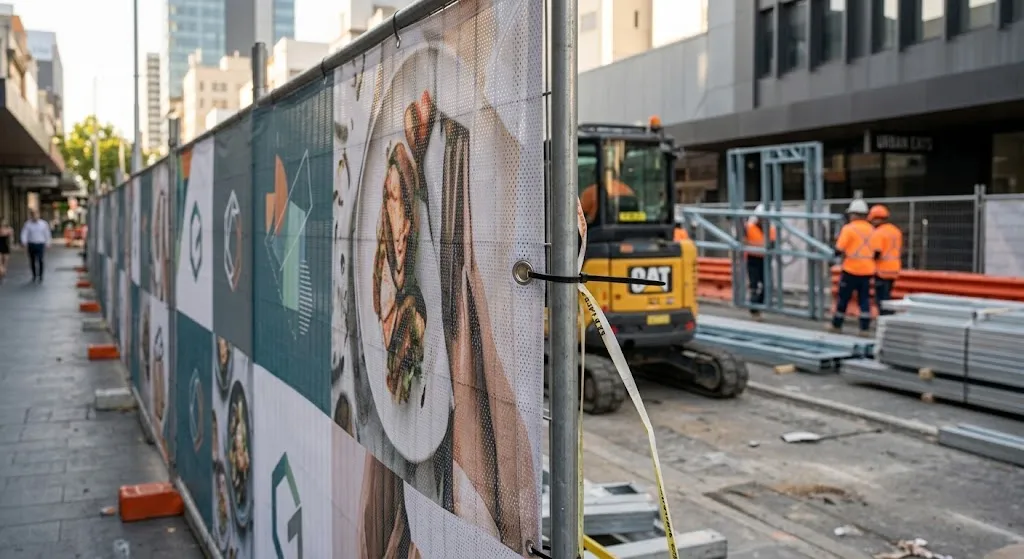
Key Takeaways
- Temporary fence banners can turn suitable temporary fencing into a surface for branding, project information, event messaging, or approved advertising.
- Mesh construction contains openings that allow some air to pass through the banner.
- Banner size, mesh material, attachment points, fence stability, and local weather conditions should be considered before installation.
- Good banner design should account for viewing distance, readability, and the amount of information being displayed.
- Temporary fence banners should complement site safety requirements and must not obstruct access, warning signs, emergency routes, or essential site information.
Introduction
Temporary fence banners are commonly used because they provide a practical way to add printed information or branding to temporary fencing without requiring a permanent sign structure. Mesh banner material contains small perforations that allow some airflow through the surface, making it relevant to certain outdoor applications such as construction sites, events, infrastructure projects, and temporary work areas.
For builders, contractors, event organisers, property developers, and site managers, temporary fencing often occupies a significant visible area. Using temporary fence banners can make this space useful for project identification, company branding, directional information, or other approved communication. However, suitability depends on the fence structure, banner dimensions, installation method, weather exposure, and site requirements.
What Are Temporary Fence Banners?
Temporary fence banners are printed displays designed to be attached to temporary fencing or another suitable supporting structure.
They are commonly produced using mesh materials when airflow is an important consideration. The banner can contain company logos, project information, event graphics, photographs, or other approved content.
The intended purpose should be established before production. A construction site may require project branding, while an event may need sponsor information or directional messaging.
Why Is Mesh Often Used?
Mesh material contains a pattern of openings across its surface.
These openings allow some air to move through the banner rather than presenting a completely solid surface. This characteristic can be useful for certain temporary fencing applications.
However, temporary fence banners are not completely unaffected by wind. Their behaviour depends on the material, banner size, attachment method, fence type, installation location, and weather conditions.
How Does Mesh Work on Temporary Fencing?
When mesh is attached to a suitable fence, air can pass through the perforated sections of the material.
This differs from a solid banner, which presents a more continuous surface to moving air.
Airflow and Outdoor Exposure
Airflow is one of the main reasons mesh is considered for outdoor fencing applications.
The amount of air that passes through depends on the mesh construction and open area. A larger banner may still experience substantial movement or loading even when it is made from perforated material.
For temporary fence banners, the supporting fence is also important. The banner and fence should be considered as an installation system rather than two completely separate components.
Wind Does Not Eliminate Installation Requirements
A common misunderstanding is that perforated mesh cannot be affected by strong winds.
In reality, wind conditions can still place forces on both the banner and temporary fence. The effect depends on factors such as banner dimensions, fence stability, attachment points, installation height, and local weather.
Temporary fence banners should therefore be installed according to appropriate site practices and manufacturer recommendations.
What Are Temporary Fence Banners Used For?
The application can vary considerably depending on the site.
Construction Site Branding
Construction companies and developers may use temporary fence banners to display project names, company identities, development imagery, or approved project information.
This can provide a consistent visual treatment along suitable sections of a construction boundary.
The banner should not cover required safety information or interfere with access and site operations.
Event Branding
Outdoor events often use temporary fencing to establish boundaries and control movement.
Banners can be used to display event names, sponsor graphics, venue information, or other approved content.
Because events can have high pedestrian movement, banner placement should be planned carefully to avoid creating obstructions.
Infrastructure and Maintenance Projects
Temporary fencing may also be used around roadworks, maintenance areas, utilities projects, and infrastructure works.
Temporary fence banners can provide project identification or public-facing information where appropriate.
Any required government, council, safety, or traffic-related signage should remain clearly visible.
What Makes Temporary Fencing Suitable for Banners?
Not every temporary fence is automatically suitable for a banner.
Fence Condition
The temporary fence should be in appropriate condition before a banner is attached.
Damaged, unstable, or poorly positioned fencing may require attention before additional material is installed.
The supporting structure should be able to accommodate the intended installation without compromising its purpose.
Fence Configuration
Temporary fencing can vary in height, panel dimensions, construction, and anchoring method.
The banner should be sized and finished according to the actual fence configuration.
Accurate measurements are important because a banner that is too large or incorrectly positioned may create installation difficulties.
How Should Temporary Fence Banners Be Designed?
Design should consider both the physical material and the viewing environment.
Keep Important Information Clear
A banner may contain a logo, headline, project information, contact details, or imagery.
Trying to fit too much information into a limited space can make the design harder to understand.
For temporary fence banners, important information should have a clear visual hierarchy so viewers can identify the main message quickly.
Consider Viewing Distance
A banner positioned beside a footpath may be viewed from only a few metres away.
A banner along a large construction boundary may be viewed from much farther away.
Text size, image detail, and overall layout should therefore reflect the expected viewing distance.
Account for Mesh Perforations
Because mesh contains openings, it does not have the same continuous surface as solid banner material.
Very small text and fine details may therefore require additional consideration.
Artwork should be prepared according to the printer's specifications and reviewed at the intended physical size.
What Finishing Options Are Used?
Finishing prepares temporary fence banners for installation.
Hemmed Edges
A hem involves folding and securing the banner edge.
Depending on the material and application, this can provide a finished edge and support the attachment system.
The appropriate finishing method depends on banner dimensions and intended use.
Eyelets
Eyelets are reinforced openings positioned around the banner edge.
They can provide attachment points for suitable ties, clips, ropes, or other fixing systems.
Eyelet spacing should be selected based on the banner size and installation requirements.
How Should Temporary Fence Banners Be Installed?
Installation should be planned before the banner is produced.
Identify Attachment Points
The attachment points should align with suitable areas of the temporary fencing.
The banner should be secured appropriately without damaging the fence or creating unnecessary stress on the material.
For larger temporary fence banners, attachment planning becomes particularly important because the banner can experience movement from wind and other environmental conditions.
Check the Installation Area
Before installation, identify gates, access points, pedestrian routes, emergency areas, equipment zones, and required signage.
The banner should not interfere with these functions.
Site managers should also consider whether the banner could create visibility problems for vehicles, workers, or pedestrians.
What Are the Safety Considerations?
Temporary fencing is often used around active work areas, which means safety should remain the primary consideration.
Do Not Cover Required Signage
Branding should never obscure safety warnings, emergency information, access instructions, or other required signs.
Temporary fence banners should be planned around these existing communication requirements.
Inspect After Severe Weather
Outdoor installations can change after strong winds, heavy rain, or other severe weather.
Banners and their attachment points should be inspected according to appropriate site procedures.
Visible damage, loose fixings, torn material, or changes to the fence should be addressed before continued use.
Maintain Clear Access
Banners should not block gates, emergency routes, walkways, vehicle access, or other areas needed for site operations.
The exact requirements will depend on the project and location.
What Are the Limitations of Temporary Fence Banners?
Temporary fence banners are useful for selected applications, but they have limitations.
The perforated material means that the printed surface is not completely solid. This can influence the appearance of detailed graphics and small text.
Wind exposure remains an important consideration. Mesh allows some airflow, but it does not make an installation completely windproof.
The condition and stability of the temporary fence also matter. A suitable banner cannot compensate for an unsuitable supporting structure.
Local rules may also apply to temporary signage, construction fencing, advertising, public spaces, or event installations. These requirements should be checked before installation.
How Can Temporary Fence Banners Be Maintained?
Regular inspection can help identify problems with the banner or its attachment system.
Check for torn edges, damaged eyelets, loose fixings, excessive dirt, and changes to the supporting fence.
Cleaning methods should be appropriate for the specific mesh and printing system. Manufacturer recommendations should be followed when selecting cleaning products or equipment.
If temporary fence banners are intended for reuse, they should be removed carefully, cleaned where appropriate, dried fully, and stored in suitable conditions.
How Long Can Temporary Fence Banners Be Used?
There is no universal period for banner use.
The practical lifespan of temporary fence banners depends on factors such as material quality, printing system, sunlight exposure, weather, handling, installation, and storage.
A banner used outdoors in a highly exposed location may experience different conditions from one installed in a sheltered environment.
Rather than relying on a fixed timeframe, the banner should be inspected periodically and its condition assessed.
Conclusion
Temporary fence banners can provide a practical way to use suitable temporary fencing for branding, project information, event graphics, and other approved visual communication.
Mesh is relevant to these applications because its perforated structure allows some airflow through the material. However, mesh does not eliminate wind forces or the need for appropriate installation.
The most important considerations include the condition of the supporting fence, banner size, material, artwork, finishing, attachment method, weather exposure, and viewing distance.
Temporary fence banners should also be integrated with the site's wider safety and communication requirements. They should never obstruct essential signage, access routes, emergency areas, or site operations.
By considering these factors before production and installation, businesses and site managers can make more informed decisions about whether mesh banners are appropriate for their particular temporary fencing application.
Book a Strategy or Discovery Call
If you are considering temporary fence banners and need help understanding the practical requirements, a strategy or discovery call can provide an opportunity to discuss the intended fence type, banner dimensions, material, artwork, finishing, and installation environment.
The discussion is informational and designed to support an informed decision, with no pressure and no guarantees.
Considering temporary fence banners for your site? Book a no-pressure discovery call to discuss your fencing setup, banner specifications, artwork, and installation considerations.
Frequently Asked Questions
1. What are temporary fence banners?
Temporary fence banners are printed banners designed to be attached to suitable temporary fencing. They can be used for branding, project information, event graphics, advertising, or other approved communication.
2. Why are mesh banners used on temporary fencing?
Mesh contains perforations that allow some air to pass through the material. This characteristic can make mesh relevant to selected outdoor fencing applications.
3. Are temporary fence banners windproof?
No. Mesh allows some airflow, but temporary fence banners can still be affected by wind. Banner size, fence stability, attachment methods, location, and weather conditions should all be considered.
4. Can temporary fence banners be used at construction sites?
Yes, when the fencing and installation are suitable. They can display project branding, company information, development graphics, or other approved content without interfering with required site signage.
5. Do temporary fence banners need eyelets?
Eyelets are a common finishing option because they provide attachment points. The appropriate number and spacing depend on the banner dimensions and installation system.
6. Can temporary fence banners be reused?
Some banners may be reused if they remain in suitable condition. Reuse depends on the material, weather exposure, handling, installation, and storage conditions.
7. What should be checked before installing a temporary fence banner?
Check the fence condition, banner dimensions, attachment method, wind exposure, access points, required signage, pedestrian routes, and relevant site or local requirements.






















Sign in to leave a comment.