

People often imagine that danger produces immediate action.
They picture themselves moving away, calling for help, protecting another person, or physically defending themselves without hesitation. Then something frightening happens, and their body does not respond the way they expected.
They freeze.
The experience can be confusing. A person may know they need to move but feel unable to begin. They may hear what is happening without processing it clearly. They may become unusually quiet, lose track of time, or feel disconnected from their surroundings.
Afterward, many people judge themselves harshly. They ask why they did nothing or assume that freezing means they are weak.
It does not.
The freeze response is an automatic survival reaction. It can happen to strong, confident, intelligent, and physically capable people. Understanding it is important because shame does not improve the response. Preparation can.
Freezing Does Not Always Look Like Complete Immobility
Some people imagine freezing as being physically unable to move at all. That can happen, but the response is not always so obvious.
A person may continue standing or walking while becoming mentally stuck. They may answer questions automatically even though they want the interaction to end. They may laugh nervously, become unusually agreeable, or wait for the other person to make the next decision.
In other situations, the delay lasts only a few seconds.
Those seconds still matter. Someone closes distance. A clear exit becomes blocked. A conversation becomes harder to leave. A boundary is crossed without resistance.
The person may understand what is happening, but their ability to turn that understanding into action has temporarily slowed.
Recognizing these quieter forms of freezing helps students understand why self-defense involves more than learning physical techniques.
Why the Body Freezes
The nervous system reacts to perceived threats before conscious reasoning has fully evaluated the situation.
Fight and flight are the responses most people recognize. The body prepares either to confront the threat or escape from it. Freezing is another possible response. The nervous system may pause movement while trying to collect information and determine what is happening.
In some circumstances, that brief pause can be useful. It may prevent impulsive action or help someone avoid attracting attention.
The problem occurs when the pause continues while the situation becomes more dangerous.
Uncertainty can make freezing more likely. If someone behaves aggressively, the problem is clear. If the interaction is confusing, socially uncomfortable, or gradually escalating, the brain may struggle to decide which response is appropriate.
This is why many people freeze during situations that do not initially look dramatic. They are still trying to determine whether they are allowed to treat the behavior as a threat.
Social Pressure Can Strengthen the Freeze Response
People do not make decisions in isolation. Social expectations influence how they respond.
A woman may not want to appear rude. An employee may hesitate to challenge someone with more authority. A teenager may fear embarrassment in front of friends. A passenger may worry about creating a scene on the subway.
These concerns can keep a person in an uncomfortable interaction longer than they intended.
The body senses pressure, but the mind continues searching for a socially acceptable explanation. Maybe the person did not mean it. Maybe the interaction will end soon. Maybe speaking up will make everything worse.
While that debate continues, action becomes harder.
Self-defense training helps students understand that protecting their safety does not require perfect certainty. Creating distance, ending a conversation, changing seats, stepping into a public place, or calling for assistance can all be reasonable responses to uncertainty.
A Situation Many People Recognize
Imagine standing in a subway car when another passenger begins speaking to you.
At first, the conversation seems harmless. Then the person moves closer. You step back, but they follow. Their tone changes. You want to tell them to stop, but no words come out.
Your mind becomes busy with questions. Are they actually threatening me? Will speaking make them angry? Is anyone else paying attention? Am I overreacting?
This internal activity can look like passivity from the outside. Inside the body, the person may be experiencing intense stress.
Training gives that person practised options.
They can move toward the door before the train stops. They can position themselves near other passengers. They can raise their hands in a protective but non-confrontational position. They can use a short, direct command. They can leave the train and seek assistance.
The goal is not to guarantee a perfect response. The goal is to make the first useful action easier to access.
Training Creates Familiarity With Pressure
Reading about the freeze response can help someone understand it. Physical practice helps them experience a different response.
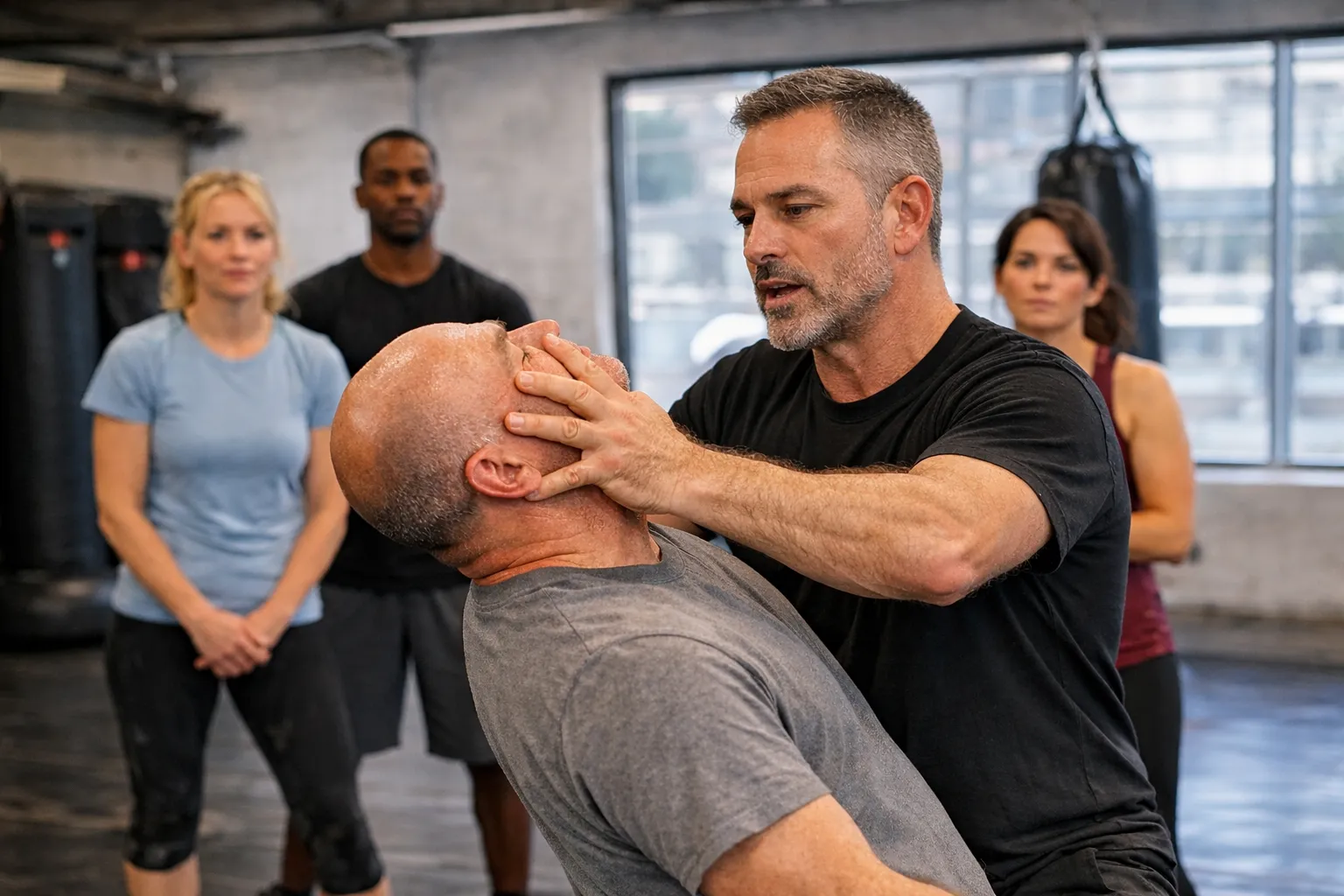
In training, students encounter manageable levels of pressure. A partner moves toward them. Someone raises their voice. A drill begins unexpectedly. A student has to make a decision while their heart rate is elevated.
The conditions are controlled, but the pressure is real enough to produce useful learning.
At first, a student may hesitate. The instructor can pause the drill, identify what happened, and allow them to try again. Through repetition, the student learns that they do not need to wait for the perfect moment.
They can move first. They can create distance. They can use their voice. They can protect themselves while continuing to evaluate the situation.
This does not eliminate the nervous system’s automatic reactions. It gives the body more familiar actions to choose from.
Simple Actions Are Easier to Access
Complex plans often become difficult to remember under stress.
Effective self-defense training therefore relies on direct principles and practical movements. Create distance. Protect vulnerable areas. Use clear commands. Move toward safety. Continue until you can escape.
Simple does not mean easy. These actions still require practice.
A student may understand that they should use their voice but discover that speaking firmly feels uncomfortable. They may understand that they should move but remain planted in place during the first drill.
Repeated practice helps close the gap between understanding and action.
That is one reason realistic Krav Maga training often focuses on decision-making as much as technique. The student needs movements that remain available when concentration, coordination, and time are limited.
Recovery Matters More Than a Perfect Beginning
Even trained people can hesitate. Preparation does not turn someone into a machine.
The important skill is recovery.
A person may lose the first second and still respond in the next one. They may become surprised and then create space. They may initially speak too quietly and then repeat the command more clearly.
Students should not be taught that a delayed response means the situation is already lost. They should learn to restart.
This mindset is valuable inside and outside physical self-defense. People often become stuck because they believe they have missed the correct moment. Training teaches them to work with the position they are in now.
The first response does not need to be perfect. It needs to begin.
Preparation Replaces Shame With Practice
People who have frozen during a frightening situation often carry shame about what happened. They replay the moment and imagine a stronger version of themselves responding differently.
A more useful question is not, “Why was I weak?”
It is, “What made action difficult, and what can I practise now?”
For people considering realistic Krav Maga classes in NYC, learning to function under pressure can be as important as learning the physical techniques themselves. Training provides a controlled place to hesitate, adjust, recover, and try again.
Freezing is a human response. It does not define what someone is capable of becoming.
Frequently Asked Questions
Is Freezing During Danger Normal?
Yes. Freezing is an automatic nervous-system response that can happen to anyone. It does not mean a person is weak or unwilling to protect themselves.
Can Self-Defense Training Eliminate the Freeze Response?
Training cannot guarantee that someone will never freeze. It can help them recognize the response sooner and develop practised actions that make recovery easier.
What Does Freezing Feel Like?
People may feel physically stuck, mentally confused, unusually quiet, disconnected, or unable to turn their thoughts into action. The experience varies from person to person.
Why Is Realistic Practice Important?
Realistic practice introduces manageable stress in a controlled environment. It helps students make decisions, use their voice, move, and recover while experiencing pressure.
What Should Someone Do If They Hesitate?
Begin with the simplest useful action available. Move, create distance, protect yourself, use your voice, or seek help. A delayed response can still become an effective response.



























Sign in to leave a comment.