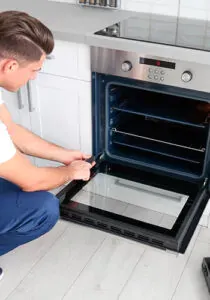

If your oven is not turning on, you are not alone. It is one of the most common appliance problems homeowners face, and in many cases, the cause is simpler than you think. Before you call a technician or start looking at new ranges, there are a few things you can check yourself.
This guide walks you through the most likely reasons your oven won't turn on, what to look at first, and when it is time to bring in a professional.
How Long Do Ovens Usually Last?
Ranges and ovens average 13 to 16 years of service life, according to industry data. Repair costs for most oven issues fall between $130 and $310, with most homeowners spending around $200 (HomeAdvisor, 2025). With repair costs often being a fraction of replacement, fixing the issue is almost always worth exploring first.
The appliance repair industry in the U.S. was valued at $6.5 billion in 2024 (IBISWorld), and demand continues to grow as new appliance prices rise each year.
Why Is My Oven Not Turning On? The Most Common Causes
Here are the most frequent reasons an oven stops turning on, starting with the simplest checks.
1. Tripped Circuit Breaker
This is the first thing to check. Electric ovens require 240 volts of alternating current to operate. If one leg of that power supply trips at the breaker, the oven will not power on.
Go to your electrical panel and look for any breaker that is in the middle or OFF position. Flip it fully off, then back on. If it trips again immediately, stop and call a professional. A breaker that keeps tripping signals a wiring issue.
2. Blown Thermal Fuse
Ovens have a thermal fuse as a safety feature. If the oven overheats (this often happens after a self-cleaning cycle), the fuse blows and cuts power to the unit.
A blown thermal fuse will not reset. It needs to be replaced. You can test it with a multimeter. If it shows no continuity, replace the fuse or contact an appliance repair technician.
3. Faulty Bake or Broil Element (Electric Ovens)
For electric ovens, the bake element sits at the bottom of the oven cavity and the broil element sits at the top. If either one burns out, the oven will not heat.
Open the oven door and visually inspect both elements. Signs of damage include visible breaks, blistering, or burn marks. A healthy element should look uniform with no obvious damage.
4. Broken Igniter (Gas Ovens)
If you have a gas oven and it won't turn on, the igniter is the most likely culprit. The igniter draws electrical current to open the gas valve and light the burner. When it weakens or breaks, the oven gets no heat.
You may notice the igniter glowing but no flame appearing. This is a common sign the igniter has weakened past the point of opening the gas valve properly. Igniter replacement is a standard repair that a technician can handle quickly.
5. My Oven Won't Turn On But the Stove Works
This is a specific and very common situation. The stove burners and the oven run on separate internal components, even though they share the same power or gas supply.
If your electric stove is not turning on for the oven only, the issue is usually one of the following:
- A burned-out bake element
- A faulty temperature sensor
- A failed control board
- A blown internal fuse
The stove working confirms your power supply is active. The problem is isolated to an oven-specific component.
6. Control Board Failure
The control board manages every function of the oven. A failed or shorted control board can cause the oven to appear completely dead. Look for visible burn marks or damaged areas on the board. Control board replacement is a job for a technician since incorrect installation can create safety hazards.
7. Faulty Door Latch or Door Sensor
Many ovens will not turn on if the door sensor does not register a fully closed door. If the latch is bent or the sensor is damaged, the oven treats the door as open and refuses to start.
Check that the door closes firmly and the latch engages properly. If it does not, the latch or sensor likely needs replacement.
8. Temperature Sensor Problem
The temperature sensor monitors heat inside the oven. If it is faulty, the oven may not turn on at all because the control board cannot get an accurate reading. At room temperature, the sensor should read approximately 1,100 ohms on a multimeter. A reading significantly outside that range means the sensor needs replacement.
My KitchenAid Oven Won't Turn On / My Whirlpool Oven Won't Turn On
If you have a KitchenAid or Whirlpool oven that won't turn on, the troubleshooting steps above apply to both brands. These are the most commonly serviced oven brands in Atlanta-area homes.
One brand-specific note: some KitchenAid and Whirlpool models go into a demo or lockout mode that prevents the oven from operating. Check if the display shows any error code or a lock icon. A simple factory reset (unplugging the unit for one to two minutes) can clear this in some cases.
If you see an error code, note it down before calling for service. Technicians can diagnose the problem faster when they know the error code in advance.
Quick Troubleshooting Table
| Symptom | Most Likely Cause | DIY or Professional? |
| Oven completely dead, no display | Tripped breaker or blown fuse | Check breaker yourself first |
| Oven display on but won't heat | Bake/broil element or sensor | Professional recommended |
| Gas oven clicks but won't light | Weak or broken igniter | Professional |
| Stove works, oven does not | Element, sensor, or fuse | Professional |
| Oven shuts off after self-clean | Tripped thermal fuse | Professional |
| Control panel unresponsive | Control board failure | Professional |
| Error code on display | Varies by code | Note code, call professional |
When to Stop Troubleshooting and Call a Professional
Some situations need a trained technician right away:
- You smell gas at any point
- You see sparks or burn marks near wiring
- The circuit breaker trips repeatedly
- The oven makes unusual sounds or shows no power at all after checking the breaker
- You have a gas oven and are unfamiliar with gas appliance components
Ovens present more safety risk than most other home appliances. Repairs involving gas lines, internal wiring, or control boards are best left to a certified technician.
How Appliance Care of Atlanta Can Help
At Appliance Care of Atlanta, we service all major oven and range brands across the Atlanta area. Whether your electric stove is not turning on, your KitchenAid oven won't turn on, or your Whirlpool oven is completely unresponsive, our technicians diagnose the exact problem and get your kitchen back to working order quickly.
We handle:
- Bake and broil element replacement
- Igniter repair and replacement
- Thermal fuse replacement
- Control board diagnosis and repair
- Temperature sensor testing and replacement
- Full oven and range service for all major brands
If your oven is not turning on and you are in the Atlanta metro area, contact Appliance Care of Atlanta for a service appointment.
Key Takeaways
- Check the circuit breaker first. It is the most common and easiest fix.
- If the stove works but the oven does not, the problem is in an oven-specific component, not your power supply.
- A blown thermal fuse after a self-clean cycle is extremely common and does not reset on its own.
- KitchenAid and Whirlpool ovens may show an error code that tells a technician exactly what failed.
- Repairs involving gas, wiring, or control boards should always go to a professional.
- Oven repair costs average $130 to $310, making repair the smarter financial choice in most cases before considering replacement.
Frequently Asked Questions
Why is my oven not turning on but my stove works?
The oven and stove use separate components. When the stove works but the oven does not, the issue is almost always a burned-out bake element, a failed temperature sensor, or a blown internal fuse. Your power supply is fine. The fault is in an oven-specific part.
What do I check first when my oven won't turn on?
Start at the circuit breaker. Electric ovens need 240 volts and use a two-pole breaker. If the breaker is tripped, reset it. If it trips again right away, call a technician because repeated tripping points to a wiring issue.
Can I fix my oven myself if it won't turn on?
You can safely check the circuit breaker, inspect visible elements for damage, and do a hard reset by unplugging the oven for a minute or two. Repairs involving gas lines, internal wiring, control boards, or component replacement should be handled by a qualified appliance technician.
Why won't my KitchenAid or Whirlpool oven turn on after a self-clean cycle?
Self-clean cycles reach temperatures above 800 degrees Fahrenheit. This extreme heat can trip the thermal fuse, which then cuts power to the oven as a safety measure. The fuse does not reset on its own and needs to be replaced by a technician.
How much does oven repair cost?
According to HomeAdvisor, most homeowners spend between $130 and $310 on oven repairs, with an average around $200. The exact cost depends on which component has failed and the type of oven you have.




























Sign in to leave a comment.