

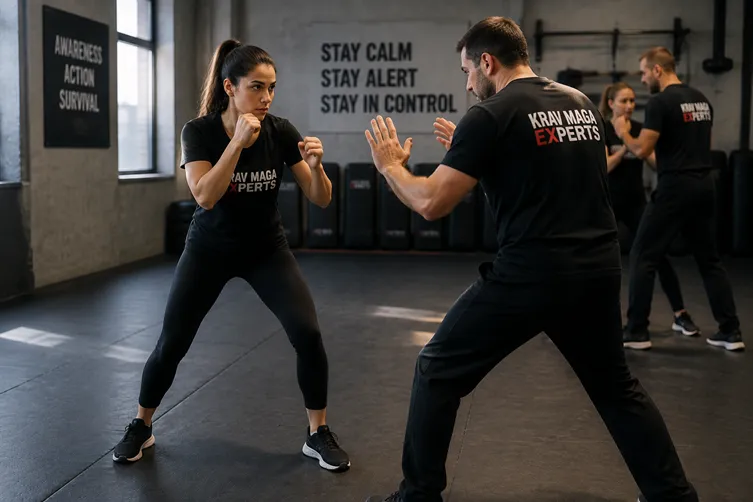
New students spend a lot of energy trying to get their stance to look right. Feet at the right angle, hands at the right height, weight distributed the way the instructor showed. That instinct isn't wrong exactly, but it's aimed at the wrong target. Instructors don't grade a stance as a shape you can hold still and photograph. They grade what it does once something actually happens to you.
A Stance Isn't a Pose, It's a Starting Condition
The mistake most new students make is treating stance as a static thing, a position you get into and then hold. In practice, a stance is the base condition you return to, over and over, every time something disrupts it. You get bumped, you throw a strike, someone grabs your arm, and the question isn't whether you looked correct beforehand. It's whether you got back to a working position afterward.
That distinction shows up directly in how stance actually gets evaluated at the foundational level of training. It isn't tested as “can you stand this way.” It's tested as “can you recover to this position after you've been knocked out of it.” A stance that only exists when nothing is happening isn't functional. It's a photo op.
What a Good Stance Actually Does
A working stance does a few specific jobs at once. It keeps your weight distributed so you're not easy to knock off balance in either direction. It keeps your hands positioned so you can strike or block without a wind-up that telegraphs the move before it happens. It keeps your base narrow enough to move quickly but wide enough that a shove doesn't put you on the ground. None of that is about looking sharp. It's about not being an easy target the moment contact happens.
The most common version of “bad stance” isn't actually bad footwork. It's a stance that looks fine standing still and falls apart the instant something touches it, because the person built a shape instead of a base.
What Your Stance Reveals About Where You Actually Are
Instructors watch stance closely for a reason that has nothing to do with aesthetics. It's one of the clearest windows into whether a student is actually tracking what's happening or just performing a rehearsed position. A student who gets bumped and resets into a stable, guarded position without thinking about it is showing that their attention is actually on the exchange. A student who freezes flat-footed, or drops their hands after throwing a strike because the strike itself felt like the finish line, is showing the opposite: that they checked out the moment the “technique” part was over.
This is exactly what gets tracked at the earliest level of training. Reacting immediately, keeping the guard up throughout, moving with purpose after striking, and recovering the stance correctly after being disrupted are treated as pass conditions. Standing flat and static, dropping the hands after a strike, freezing before responding, and waiting for a clean, comfortable moment before acting are treated as fail conditions. None of that is about how a stance looks in a mirror. It's about whether the person is still present after things stop going according to plan.
The Most Common Stance Mistake Isn't What People Think
Most new students assume the mistake to fix is a footwork detail: feet too square, weight too far forward, hands too low. Those details matter, but they're not usually what separates a stance that works from one that doesn't. The real gap is recovery. Plenty of people can get into a correct-looking stance on command. Far fewer automatically return to a stable, guarded position after getting hit, bumped, or grabbed, because that requires the body to do it without a conscious decision in the moment. That's not a flexibility problem or a strength problem. It's a repetition problem, and it's exactly why stance gets drilled over and over instead of taught once and checked off.
Why This Matters More Than the Shape of Your Feet
Readiness isn't a pose you hold until something happens. It's how fast and how automatically you get back to a working position after something already has. A stance that only exists before contact isn't telling you anything useful about whether someone is prepared. A stance that reappears immediately after a disruption, without the person having to think their way back into it, is telling you something real.
This is the actual reason stance gets so much attention early in structured training rather than being treated as a warm-up detail to rush through. It's foundational precisely because everything else, striking, defending, moving under pressure, depends on having a base to come back to. Anyone curious what that actually looks like in practice can see it firsthand in the Krav Maga class schedule at Krav Maga Experts, where stance recovery is drilled as a specific, trainable skill rather than assumed to happen on its own.
The Real Question to Ask About Your Own Stance
Don't ask whether your stance looks right standing still. Ask what it does the moment someone bumps you, grabs you, or you throw your first strike. If it holds, resets, and comes back stable without you having to think about it, that's readiness. If it only existed before anything happened, there's still work to do, and that's completely normal this early in training.
Frequently Asked Questions
What is a Krav Maga stance supposed to do?
It keeps you balanced, mobile, and hard to knock down, while positioning your hands so you can strike or block without telegraphing the move. Its real job isn't to look correct standing still, it's to hold up the moment something disrupts it.
Why do instructors focus so much on stance for beginners?
Because stance is the base everything else is built on. Striking, defending, and moving under pressure all depend on being able to return to a stable position after contact, and that's a specific skill that has to be drilled rather than assumed.
What's the most common stance mistake?
It's usually not a footwork detail like foot angle or hand height. The bigger gap is recovery, the ability to automatically reset into a stable position after being hit, bumped, or grabbed, instead of only holding a correct-looking stance when nothing is happening.
How do I know if my stance is actually working?
Watch what happens after contact, not before. A working stance resets on its own after a disruption. If you have to consciously think your way back into position every time, that's a sign it still needs repetition.
Is a "perfect" stance the same thing as being ready?
No. A stance that only exists before anything happens doesn't tell you much about readiness. What matters is whether it holds up and recovers automatically once something actually happens, which is a different skill than getting the shape right on command.

























Sign in to leave a comment.