

The Confusing World of Official Paperwork
If you have ever had to deal with international bureaucracy, you know exactly how it feels to hit a brick wall made of paper. One minute you are planning an exciting move abroad, a wedding in a sunny destination, or an application for a foreign passport, and the next, you are staring at a checklist of requirements that make absolutely no sense. You see terms like "certified," "sworn," "legalised," and "notarised" thrown around like confetti. It is enough to give anyone a headache.
Most of us assume that a simple translation of our birth certificate should be enough. After all, if the words are correct, what is the problem? But when it comes to legal matters, the authorities aren't just looking at the words; they are looking for a specific level of trust. If you are currently trying to figure out which "stamp" you actually need, finding a professional birth certificate translation service UK is the best place to start. They can help you navigate the maze, but it helps to understand why these different levels of certification exist in the first place.
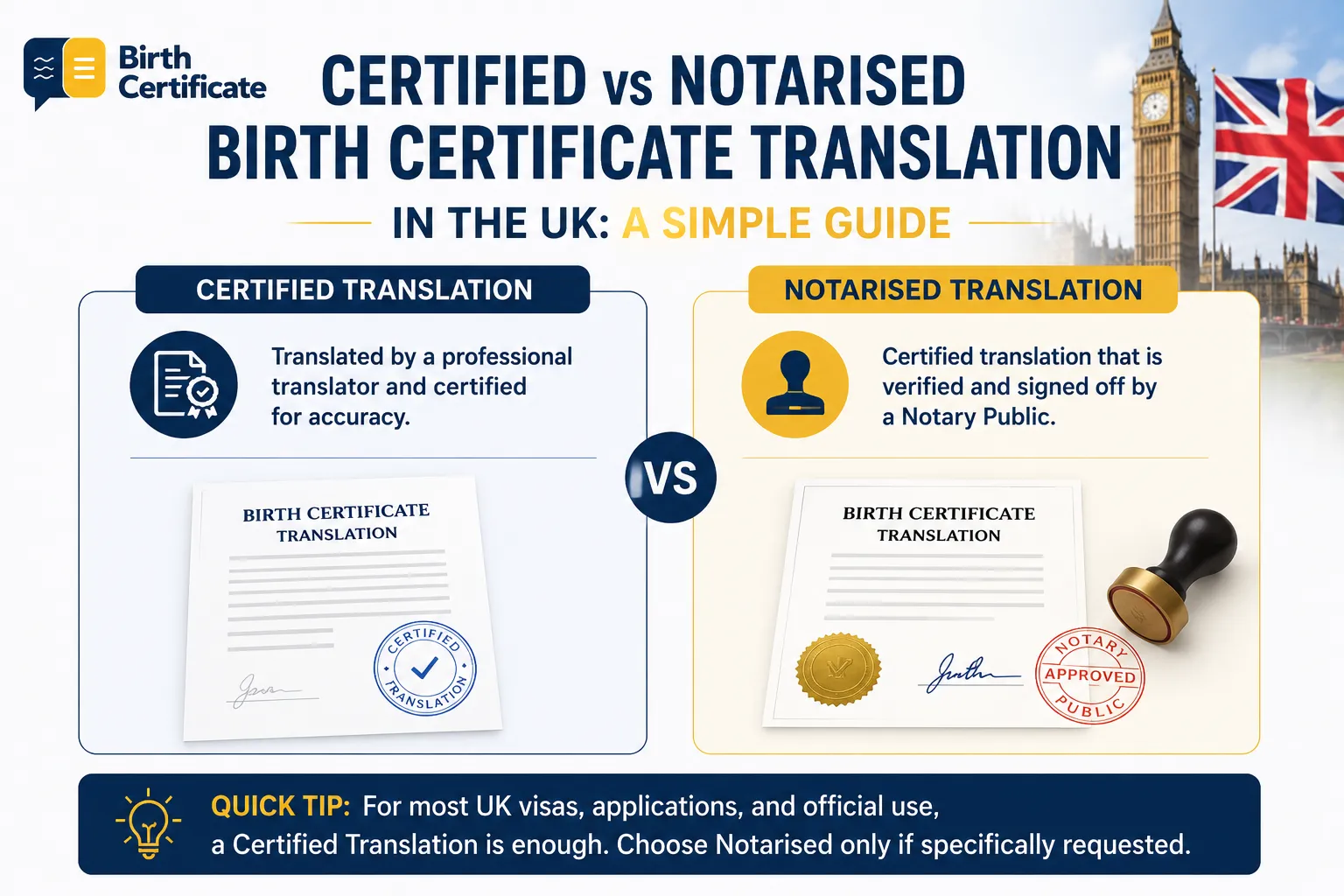
Certified vs. Notarised: What is the Difference?
This is the question that trips almost everyone up. In the UK, a "Certified Translation" is the standard for most internal things. If you are dealing with the Home Office, the NHS, or a UK university, they usually just want a signed statement from a professional translator. This statement basically says, "I am a professional, and I promise this translation is a true and accurate mirror of the original." It’s straightforward and usually does the trick for life within the British Isles.
However, a notarised translation is like a certified translation on steroids. It involves an extra person: a Notary Public. The translator has to go in front of the Notary and swear under oath that the translation is accurate. The Notary isn't checking the language—they likely don't speak the foreign tongue—but they are verifying the identity of the translator and witnessing their signature. This adds a heavy layer of legal weight to the document. It’s no longer just a translator’s word; it’s a document that has been officially witnessed by a high-level legal officer.
When Do You Actually Need the Notary?
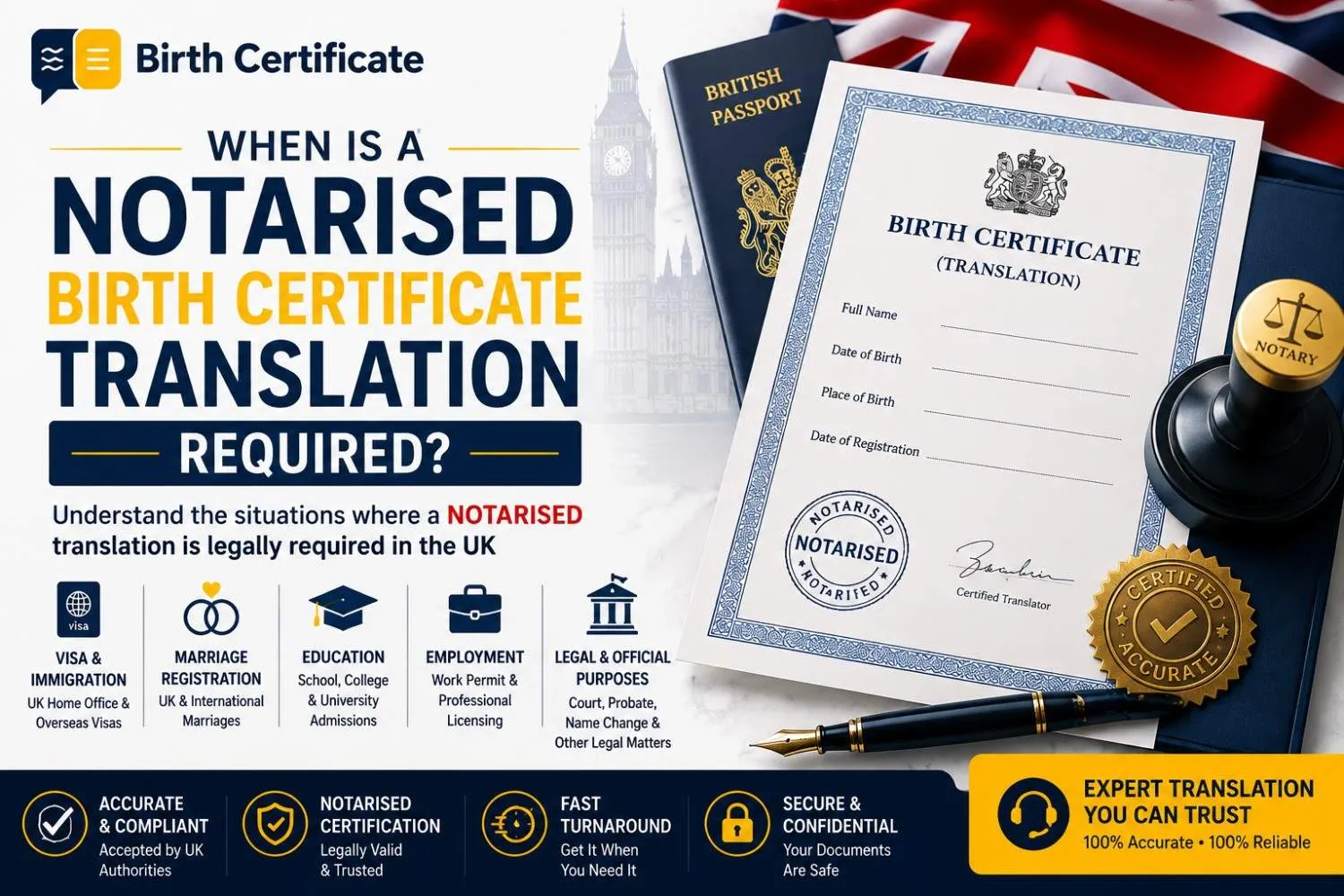
You might be wondering, "If it's more expensive and takes more time, why would I ever want a notarised version?" The truth is, you usually don't choose to get a notarised translation; the person receiving the document chooses it for you. Most of the time, this requirement pops up when you are sending your documents outside of the UK.
For example, if you are applying for a residency visa in certain European or South American countries, their administrative systems often demand a higher level of "proof" than a standard UK agency can provide on its own. They want to see that a legal official has put their seal on it. If you are in this position, you will specifically need a notarised birth certificate translation UK to ensure your paperwork isn't rejected the moment it hits a foreign desk. It’s better to get it right the first time than to have your documents mailed back across the ocean because you missed a single stamp.
Dealing with Foreign Embassies and Consulates
Embassies are notoriously strict. They are essentially a little piece of a foreign country on UK soil, and they play by their home country’s rules. Many consulates in London will insist on notarised translations for things like marriage registrations or claiming dual citizenship for your children.
I’ve heard so many stories of people who spent hours in a queue at an embassy, only to be told that their "certified" translation wasn't "legal" enough for their home country's standards. It is heartbreaking to see. If the checklist mentions a "notary" or "legalisation," do not ignore it. They won't make an exception for you. The notary's seal is a universal language of trust that helps these foreign officials feel confident that the document is legitimate.
The Role of the Apostille and "Legalisation"
Sometimes, even a notary isn't the final step. If you are sending a birth certificate to a country that is part of the Hague Convention, they might ask for an "Apostille." This is a certificate issued by the UK Foreign, Commonwealth & Development Office (FCDO) that goes on the back of the document.
The catch? The FCDO will only Apostille a translation if it has been notarised first. So, the chain goes like this: Translation -> Notarisation -> Apostille. It feels like a lot of hoops to jump through, but each step is essentially a "vouch" for the step before it. It builds a chain of evidence that proves your birth certificate is 100% real and the translation is 100% honest.
Why You Can't Just Ask a Local Solicitor
A lot of people think they can just take a translation to their local high-street solicitor and have them sign it for five pounds. While some solicitors are also notaries, most are not. A solicitor’s signature is often not enough for international use.
Notaries have a very specific legal status in international law that standard solicitors don't always carry. If you are using a translation for anything involving a foreign government, always double-check if they specifically require a Notary Public. Using a specialist agency that has a relationship with a Notary will save you a lot of running around. They can handle the whole process—from the actual translation to the meeting with the Notary—so you don't have to find one yourself.
Trusting a Human over a Machine
In the world of notarised documents, there is zero room for error. If a machine translation messes up a date or a place name, and you then get that mistake notarised, you have just officially "sworn" to a lie. It sounds dramatic, but it can cause massive legal problems.
A human translator who specialises in these documents understands the nuances. They know that a birth certificate from 1980s Spain looks different from one from 2020s Mexico. They ensure the formatting is a mirror image of the original, so when a foreign official looks at both papers, they can easily see that everything matches up. That human eye is what ensures the Notary is signing something that is actually true.
How Long Does the Process Take?
Because there is an extra person involved (the Notary), this isn't a "while-you-wait" service. Usually, you are looking at a few days. The translation has to be finished first, and then an appointment has to be made with the Notary. If you also need the Apostille from the government, you should probably add another week to your timeline.
The biggest mistake people make is leaving this until the last minute. If your flight is on Friday, don't start looking for a notarised translation on Tuesday. Give yourself a buffer. These are legal professionals who have busy schedules, and the post can sometimes be slow. Starting a few weeks early is the best gift you can give your future self.
Final Thoughts: Peace of Mind is Worth It
Administrative work is rarely fun, especially when it involves legal terms and expensive stamps. But look at it this way: your birth certificate is the most important document you own. It proves you exist! When you are asking a foreign country to give you a visa or recognize your marriage, you are asking them for a huge amount of trust.
Providing a properly notarised translation shows that you are taking the process seriously. It removes all doubt from the mind of the person reviewing your file. Once those stamps are on the page, you can breathe a sigh of relief knowing that part of the journey is over. You’ve done it right, and you are one step closer to whatever exciting adventure comes next. Good luck with your application—don't let the paperwork get you down!























Sign in to leave a comment.