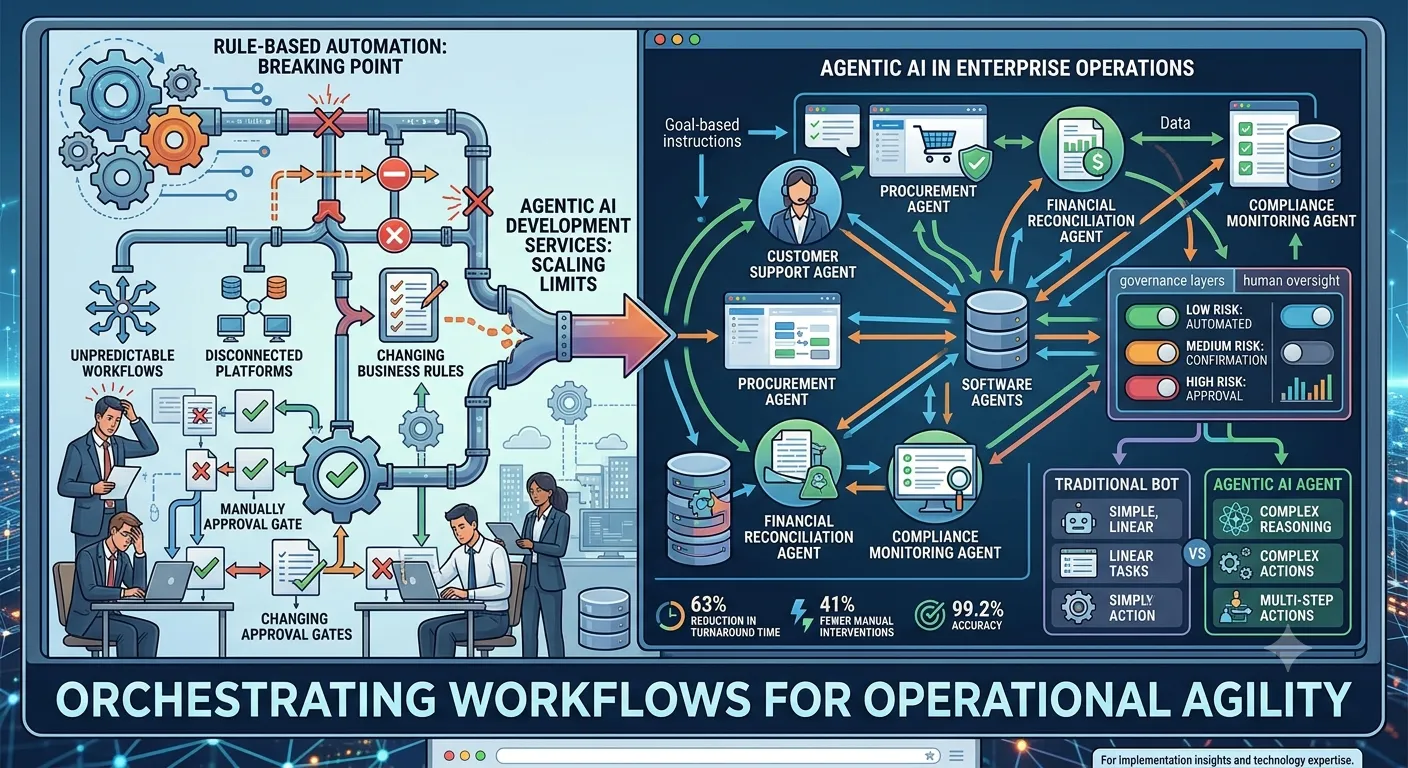

Enterprise AI has reached an interesting crossroads. Many organizations have already invested in automation, predictive analytics, and generative AI, yet operational bottlenecks remain. Teams still spend hours moving information across disconnected systems, managers continue approving routine decisions, and customer service staff often intervene when automated workflows reach their limits.
This growing gap explains why Agentic AI Development Services are becoming part of strategic technology discussions. Unlike traditional AI applications that respond to prompts or generate content, AI agents are designed to execute tasks, coordinate workflows, and make context-aware decisions within predefined business boundaries. According to McKinsey (2024), organizations capturing measurable value from AI are increasingly integrating AI into core business processes rather than isolated use cases. That shift is driving interest in enterprise Agentic AI solutions, especially among companies looking beyond simple automation.
The question is no longer whether AI can assist employees. The real question is whether enterprises are prepared to let AI complete work autonomously while maintaining governance, compliance, and operational control.
Why This Is Happening Now
The current wave of enterprise AI is less about model capability and more about execution capability.
Traditional enterprise software follows predefined business logic. Human users still perform validation, decision-making, and coordination between departments. Modern AI agents introduce something fundamentally different by combining reasoning, memory, planning, and action.
Where traditional ERP systems rely on static workflows, modern approaches allow intelligent agents to determine the next action based on changing business conditions.
Several industry trends are accelerating this transition.
Gartner (2025) predicts that by 2028, approximately 33% of enterprise software applications will include agentic AI, compared with less than 1% in 2024. The firm also expects AI agents to automate a growing share of day-to-day business decisions.
At the same time, Deloitte's State of Generative AI report (2024) found that organizations are increasingly moving beyond experimentation toward enterprise-scale AI deployments focused on measurable operational outcomes instead of isolated productivity improvements.
Together, these trends indicate that enterprises are entering an implementation phase rather than an experimentation phase.
How Agentic AI Development Services Change Enterprise Operations
Agentic AI Development Services for Cross-Department Decision Making
The biggest misconception is that AI agents replace employees.
In practice, successful implementations remove repetitive coordination work rather than human expertise.
Consider procurement. A purchasing request often travels across inventory teams, finance, suppliers, and operations before approval. Multiple systems exchange information, while employees manually verify exceptions.
With Agentic AI Development Services, intelligent agents can gather supplier data, compare inventory levels, validate purchasing policies, prepare approval recommendations, and trigger downstream workflows automatically. Human teams intervene only when unusual situations arise.
The outcome is faster execution without removing governance.
Building AI Agents Around Existing Enterprise Systems
Many executives assume adopting AI requires replacing existing ERP or CRM platforms.
That assumption often delays transformation.
Most enterprises already possess valuable operational systems. The challenge lies in connecting them intelligently rather than rebuilding them.
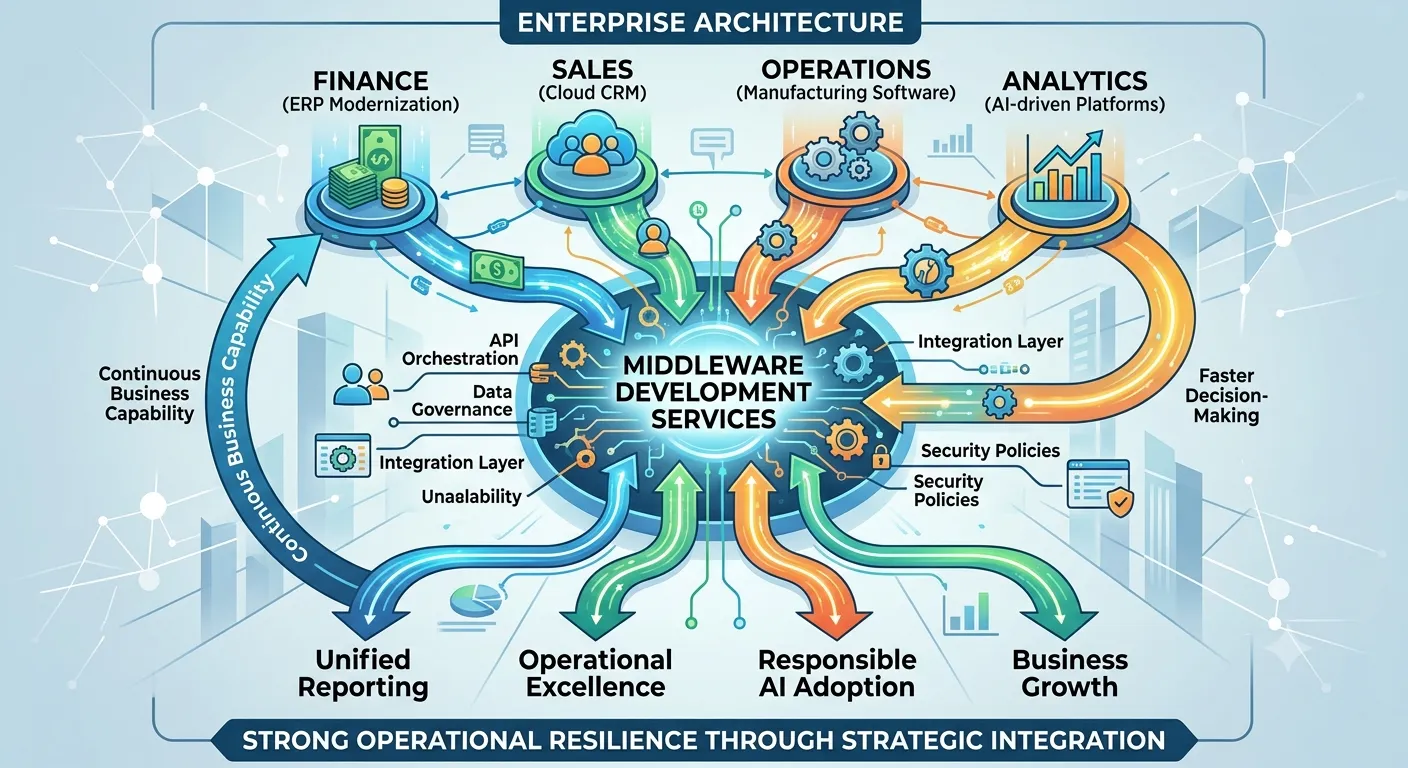
Agentic architectures interact with ERP, CRM, finance platforms, HR systems, APIs, and external databases simultaneously. Instead of creating another application layer, AI agents orchestrate information across existing infrastructure.
This approach reduces implementation risk while extending the value of prior technology investments.
Why Governance Determines Long-Term Success
Technical capability is rarely the biggest obstacle.
Governance is.
As AI agents begin making operational decisions, organizations need clear accountability for every recommendation, approval, and automated action.
Successful implementations define decision boundaries before deployment. High-value activities such as compliance reviews, financial approvals, and contractual obligations continue involving human oversight, while repetitive operational decisions become increasingly autonomous.
This balance allows organizations to increase efficiency without sacrificing transparency or regulatory compliance.
What Oodles Has Seen in Practice
From our experience working with manufacturing, logistics, healthcare, and enterprise technology organizations on Agentic AI Development Services, the technology itself is rarely the limiting factor.
More commonly, businesses struggle with fragmented workflows spread across ERP platforms, custom applications, CRM systems, and manual approval chains.
One enterprise client faced procurement delays averaging five business days because information required manual validation across multiple departments. Rather than replacing existing systems, Oodles integrated AI agents that coordinated supplier verification, inventory validation, purchase approvals, and workflow notifications while maintaining existing governance policies.
The implementation was completed over approximately twelve weeks. Manual processing time decreased by nearly 60%, procurement turnaround improved significantly, and operational teams redirected their efforts toward supplier strategy rather than administrative coordination.
Projects like these reinforce an important lesson. Organizations achieve stronger outcomes when AI becomes an orchestration layer across business systems instead of another isolated application.
Learn more about Oodles.
Conclusion
Enterprise AI is moving beyond assistants that answer questions or generate documents. Organizations increasingly expect AI to execute work responsibly, coordinate business processes, and support operational decision-making.
That transition requires more than powerful language models. It demands thoughtful architecture, governance, integration with enterprise systems, and clearly defined business objectives.
The organizations that benefit most from agentic AI will not necessarily deploy the largest number of AI agents. They will identify operational friction, establish clear decision boundaries, and implement intelligent automation where measurable business outcomes justify the investment. As enterprise software continues evolving, AI agents are likely to become standard participants in digital operations rather than experimental technologies operating on the sidelines.
If your organization is evaluating how autonomous AI can improve operations without disrupting existing business systems, explore Agentic AI Development Services and start a conversation with the consulting team at Oodles.
Frequently Asked Questions
1. What are Agentic AI Development Services?
Agentic AI Development Services involve designing AI systems that can plan tasks, interact with enterprise software, make controlled decisions, and execute workflows with minimal human intervention while following business rules and governance requirements.
2. How are AI agents different from generative AI?
Generative AI primarily creates text, images, or code based on prompts. AI agents go further by reasoning through objectives, interacting with multiple business systems, completing tasks, and coordinating workflows autonomously.
3. Which industries benefit most from AI agents?
Manufacturing, logistics, healthcare, financial services, retail, and enterprise SaaS companies often benefit because they manage complex workflows involving multiple applications, approvals, and operational dependencies.
4. Are Agentic AI Development Services suitable for ERP modernization?
Yes. Agentic AI Development Services often complement ERP modernization by connecting existing ERP platforms with intelligent automation instead of requiring complete system replacement. This allows businesses to improve operational efficiency while preserving existing investments.
5. What should enterprises prepare before adopting AI agents?
Organizations should identify high-value business processes, define governance policies, assess data quality, establish security controls, and determine which operational decisions should remain under human supervision before deploying AI agents.























Sign in to leave a comment.