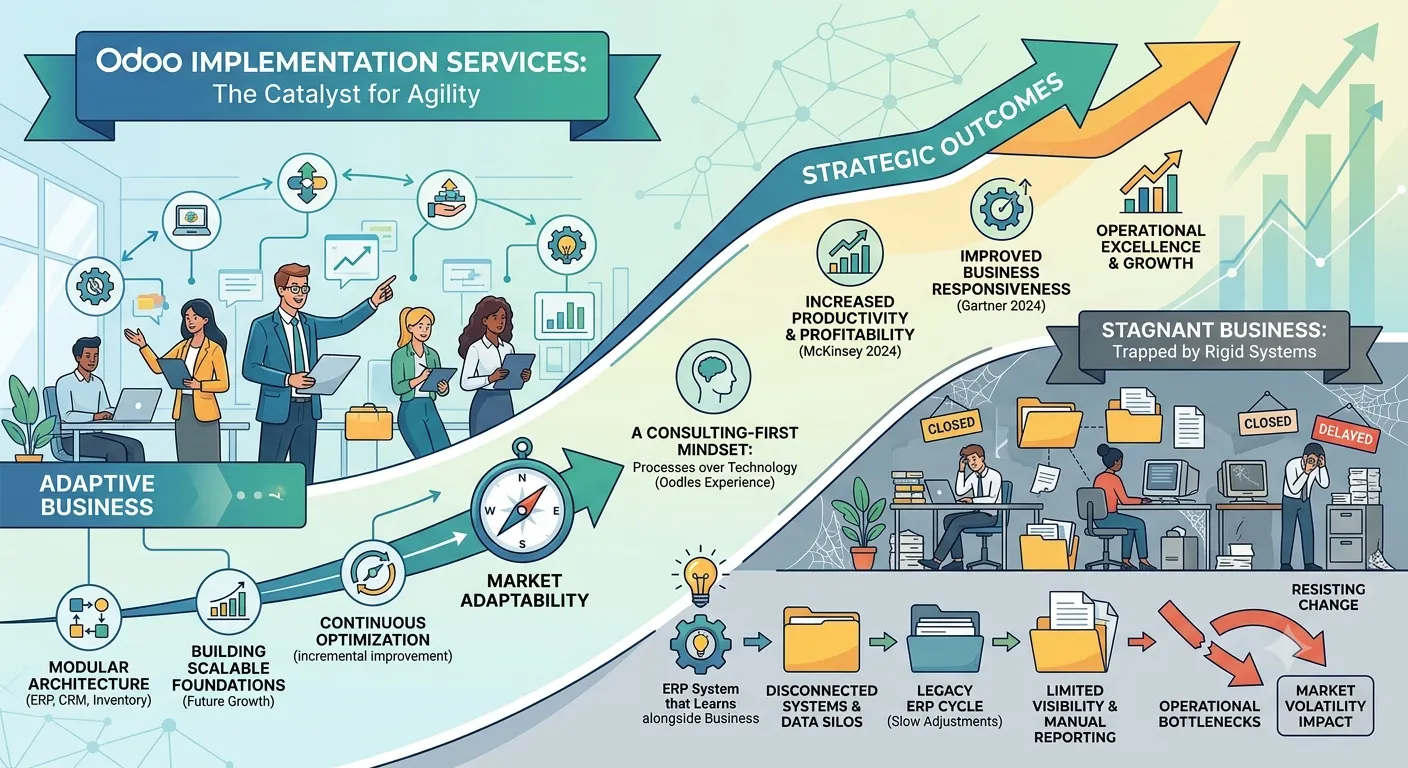

Enterprise software is no longer just about digitizing processes. It is about building organizations that can adjust to market changes without rewriting their operating model every few years. That shift explains why Odoo Implementation Services have moved from being an IT initiative to a boardroom discussion. Companies expanding into new markets, managing hybrid workforces, or consolidating disconnected systems are finding that ERP decisions now shape business agility as much as financial control.
According to McKinsey (2024), organizations that successfully integrate digital technologies into core operations are significantly more likely to outperform peers in productivity and profitability. At the same time, ERP implementation failure continues to be linked less to software capability and more to planning, adoption, and execution. This is why many organizations are evaluating a structured approach through Odoo implementation consulting instead of viewing ERP as a software purchase alone.
The real conversation is no longer about selecting the best ERP platform. It is about building an implementation strategy that continues creating value long after deployment.
Why This Is Happening Now
Businesses are operating in an environment where change happens faster than traditional ERP cycles were designed to handle.
Supply chain volatility, AI-driven automation, distributed teams, evolving compliance requirements, and customer expectations all require businesses to modify workflows frequently. Legacy ERP implementations often assumed processes would remain relatively stable for years. That assumption no longer reflects reality.
Gartner (2024) reports that organizations increasingly prioritize composable enterprise architectures because they improve business responsiveness when markets change. Instead of rebuilding systems from scratch, companies prefer configurable platforms that evolve with operational needs.
Odoo fits naturally into this direction because its modular architecture allows organizations to expand functionality as business priorities evolve rather than committing to every capability on day one.
The implementation strategy, however, determines whether that flexibility becomes an advantage or another source of complexity.
Why Modern Odoo Implementation Services Focus on Business Adaptability Instead of Software Deployment
Looking Beyond Module Configuration
Traditional ERP projects often revolve around installing modules and migrating data.
Modern Odoo Implementation Services begin with a different question:
"What business capabilities should improve over the next three to five years?"
That shift changes every implementation decision.
Instead of configuring isolated workflows, implementation teams build scalable process foundations that accommodate future acquisitions, product launches, additional business units, and changing compliance requirements. The ERP becomes an operating platform rather than a collection of applications.
Designing for Continuous Improvement
Many ERP projects are considered complete once users begin working in production.
In practice, deployment marks the beginning of operational optimization.
Companies continuously discover opportunities to automate approvals, reduce manual reporting, integrate new business applications, and simplify customer interactions. Organizations that anticipate this evolution during implementation experience fewer disruptions as they grow.
Rather than forcing business processes into rigid structures, successful implementations create room for incremental improvements without expensive redevelopment.
Making Data a Strategic Asset
Business leaders increasingly rely on real-time visibility instead of monthly reporting cycles.
Sales forecasts, procurement planning, production scheduling, customer service performance, and financial management all depend on accurate operational data.
An effective implementation connects these functions into a single operational picture rather than creating isolated reporting environments.
When leadership decisions rely on consistent enterprise-wide information, ERP becomes a management system rather than simply a transaction system.
What Oodles Has Seen in Practice
From our experience working with manufacturing, retail, logistics, and professional services organizations on Odoo Implementation Services, one pattern appears repeatedly.
Most implementation challenges do not originate from technology.
They begin with fragmented business processes.
One mid-sized manufacturing organization approached Oodles after multiple disconnected applications had created inconsistent inventory records, duplicate procurement activities, and delayed financial reporting.
Instead of replacing every existing process immediately, the engagement focused on identifying operational bottlenecks, prioritizing high-impact workflows, and introducing phased implementation across procurement, inventory, manufacturing, and finance.
Within approximately six months, reporting cycles became substantially shorter, procurement visibility improved, and manual reconciliation efforts were significantly reduced. More importantly, business teams became comfortable expanding automation because the ERP foundation had already been structured for future growth.
This consulting-first mindset has become central to Oodles engagements, where implementation is measured by operational outcomes rather than deployment milestones.
The Future Belongs to ERP Systems That Learn Alongside the Business
Artificial intelligence, predictive analytics, low-code customization, and workflow automation will continue changing how ERP platforms operate.
Yet technology alone will not determine competitive advantage.
Organizations that continuously adapt processes, improve data quality, and refine operational decisions will gain more value than those simply installing additional software features.
Future ERP success will depend on implementation strategies that anticipate change instead of resisting it.
This is where thoughtful Odoo Implementation Services become increasingly valuable.
Rather than asking whether the ERP can support future business models, leaders should ask whether today's implementation decisions leave enough flexibility for tomorrow's opportunities.
That question may ultimately matter more than the software selection itself.
If your organization is evaluating modernization or preparing for ERP transformation, exploring professional Odoo Implementation Services can help define an implementation roadmap aligned with long-term business objectives instead of short-term deployment goals.
Frequently Asked Questions
1. What are Odoo Implementation Services?
Odoo Implementation Services include business process assessment, ERP planning, module configuration, customization, data migration, integrations, testing, user training, deployment, and ongoing optimization to ensure the platform supports long-term operational goals.
2. How long does an Odoo implementation usually take?
Implementation timelines vary based on business size and project complexity. Small deployments may take a few weeks, while enterprise-wide implementations involving multiple departments often require several months with phased rollouts.
3. Why do some ERP implementation projects fail?
Projects often struggle because organizations prioritize software installation over process alignment, stakeholder involvement, change management, and user adoption. Successful implementations balance technology with operational transformation.
4. Can Odoo scale with a growing business?
Yes. Odoo's modular architecture allows businesses to introduce additional applications, automate workflows, and support expanding operations without replacing the entire ERP environment, making it suitable for long-term growth.
5. Is Odoo suitable for manufacturing and distribution companies?
Yes. Odoo supports manufacturing, inventory management, procurement, warehouse operations, quality control, CRM, accounting, and supply chain management, making it a practical option for organizations seeking integrated operational visibility.
























Sign in to leave a comment.