
A growing enterprise rarely has a single system problem. It has a coordination problem.
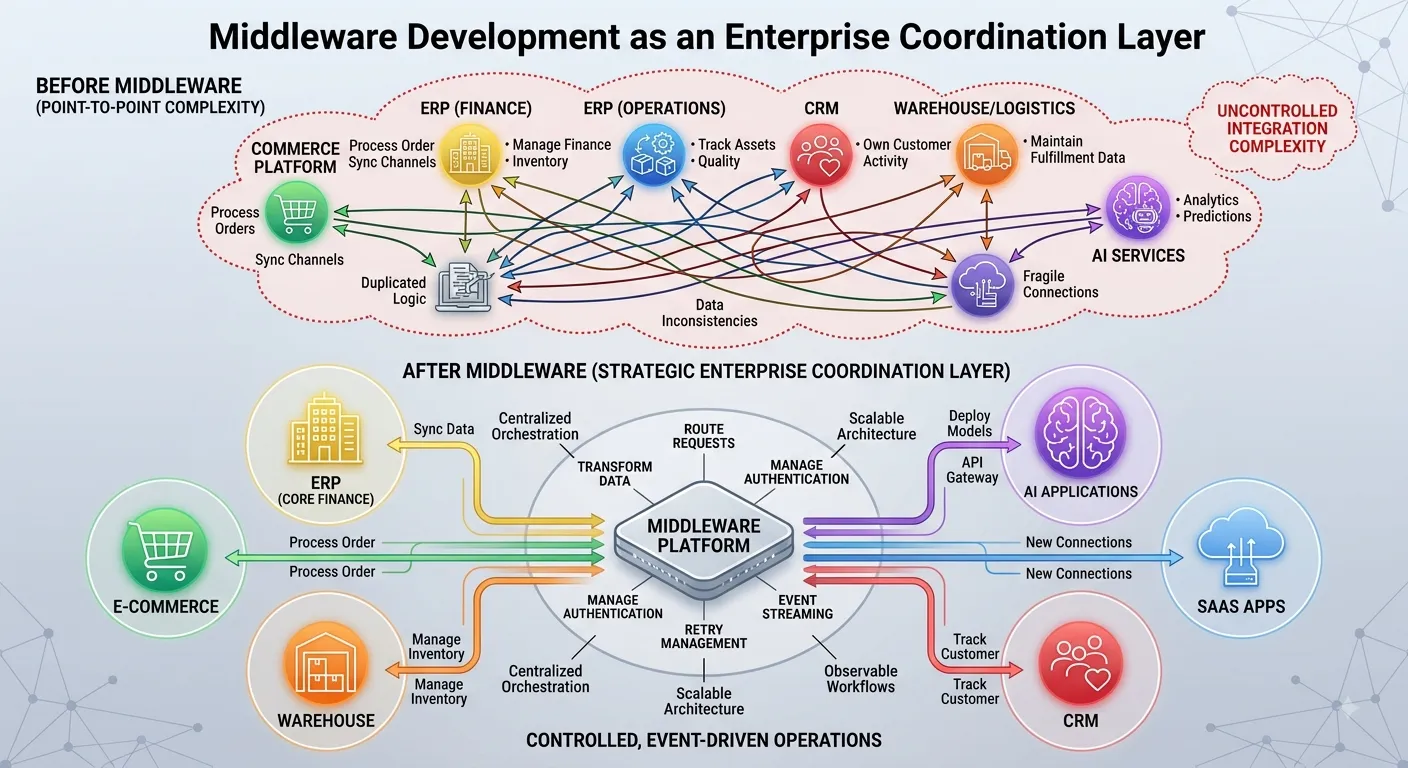
An ERP manages finance and inventory. A CRM owns customer activity. Commerce platforms process orders. Warehouses maintain fulfillment data. New AI applications introduce another layer of services, APIs, and data flows. The challenge is no longer whether these systems can communicate, but whether they can communicate reliably as the business changes.
This is where Middleware Development becomes strategically important. Middleware provides the integration layer that connects applications, transforms data, orchestrates workflows, and isolates systems from one another. For organizations evaluating an ERP middleware development approach, the real question is not "Do we need another technology layer?" It is "Can our operating model scale without one?"
The pressure is increasing. Gartner reported that the worldwide ERP market grew 11.3% to $66 billion in 2024, showing continued investment in enterprise systems. More ERP deployments mean more integration dependencies, particularly when organizations add commerce, logistics, analytics, SaaS, and AI applications around the core ERP.
For CIOs and CTOs, middleware is therefore moving from an implementation detail to an architectural decision with direct consequences for speed, reliability, and operating cost.
Why This Is Happening Now
Enterprise architecture is becoming more distributed.
Where traditional ERP systems rely on tightly controlled internal workflows, modern approaches connect ERP platforms with cloud applications, APIs, event streams, mobile applications, marketplaces, and AI services. Each additional connection creates another dependency that must be governed.
AI is accelerating this trend. McKinsey's 2024 research found that 65% of organizations were regularly using generative AI in at least one business function, nearly double the previous year's level. That means AI is increasingly becoming another participant in enterprise workflows rather than an isolated experiment.
Yet more applications do not automatically create better operations. Without an integration architecture, companies can end up with dozens of point-to-point connections, duplicated transformation logic, inconsistent data definitions, and difficult-to-trace failures.
The architecture problem is systemic: enterprises are adding digital capabilities faster than they are redesigning how those capabilities communicate.
Middleware Development as the Enterprise Coordination Layer
When ERP integration becomes an operational dependency
Middleware becomes valuable when integration stops being a one-off connection and becomes part of daily operations.
Consider an order flowing from an ecommerce storefront into an ERP, then into inventory, payment, warehouse, shipping, and customer notification systems. A direct integration can work when there are only two or three systems. As the number of dependencies grows, however, each application begins carrying integration responsibilities that do not belong to its core purpose.
Middleware introduces a dedicated coordination layer. It can validate incoming data, transform schemas, route requests, manage authentication, publish events, handle retries, and maintain transaction visibility.
The business benefit is architectural independence. Changing a warehouse platform does not necessarily require rewriting every system that consumes warehouse information.
From batch synchronization to event-driven operations
Traditional integration often depends on scheduled jobs: extract information, transform it, and load it somewhere else.
That model remains appropriate for certain reporting and bulk-processing scenarios. It becomes restrictive when operations require current information.
Modern Middleware Development can introduce event-driven patterns in which a business event triggers downstream actions. An inventory update can initiate synchronization across sales channels. A completed payment can trigger fulfillment. A shipment event can update customer-facing systems.
Oodles' ERP modernization work illustrates this transition. In one engagement, the architecture moved from batch ETL flows toward event-driven integrations and webhooks, while middleware was standardized around REST connectors, schema validation, and message queues. The resulting design targeted near-instantaneous synchronization rather than waiting for scheduled data transfers.
This is particularly important for operations leaders because latency in integration can become latency in decision-making.
The hidden value: reducing dependency between systems
The third implication is less visible but often more important.
Middleware creates boundaries.
Where a direct integration makes two systems dependent on each other's implementation details, a middleware layer can establish contracts around APIs, events, schemas, authentication, and error handling. That allows individual systems to evolve without forcing simultaneous changes across the technology estate.
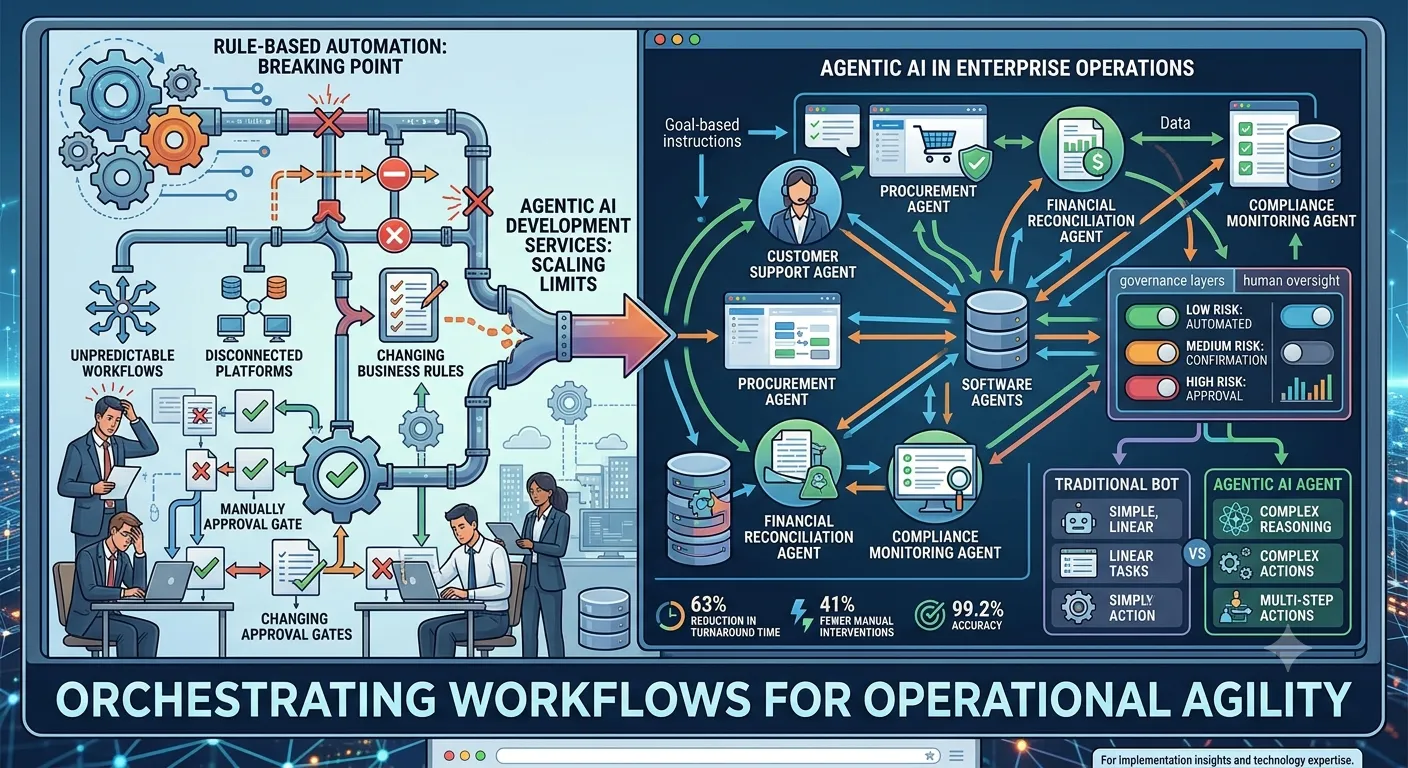
This matters as AI applications enter the enterprise. McKinsey found that organizations using AI were reporting adoption across an average of three business functions, rather than keeping AI confined to one isolated area. As AI expands into operations, customer service, finance, and software workflows, the integration layer becomes part of the control mechanism for how AI interacts with enterprise data.
What Oodles Has Seen in Practice
From our experience working with enterprise and multi-system environments on Middleware Development, the recurring problem is rarely a lack of APIs. The deeper issue is uncontrolled integration complexity.
One example comes from a global logistics environment where an existing monolithic middleware platform was struggling with scalability, interoperability, and real-time data reliability as operations expanded across multiple locations. Oodles redesigned the platform as a cloud-native, microservices-based logistics middleware architecture using Apache Camel, Spring Boot, Docker, and cloud infrastructure.
The important outcome was architectural rather than cosmetic. Instead of treating every integration as an isolated connection, the platform became an integration backbone capable of supporting distributed logistics operations.
A similar principle appears in Oodles' ERP integration work for ecommerce inventory synchronization. The architecture used webhook-driven event pipelines and microservices-based middleware to synchronize inventory between commerce systems and ERP infrastructure, addressing the bottlenecks created by high-traffic events.
This is the consulting lesson: middleware should be designed around business events, ownership boundaries, failure scenarios, and future system changes, not simply around today's list of APIs.
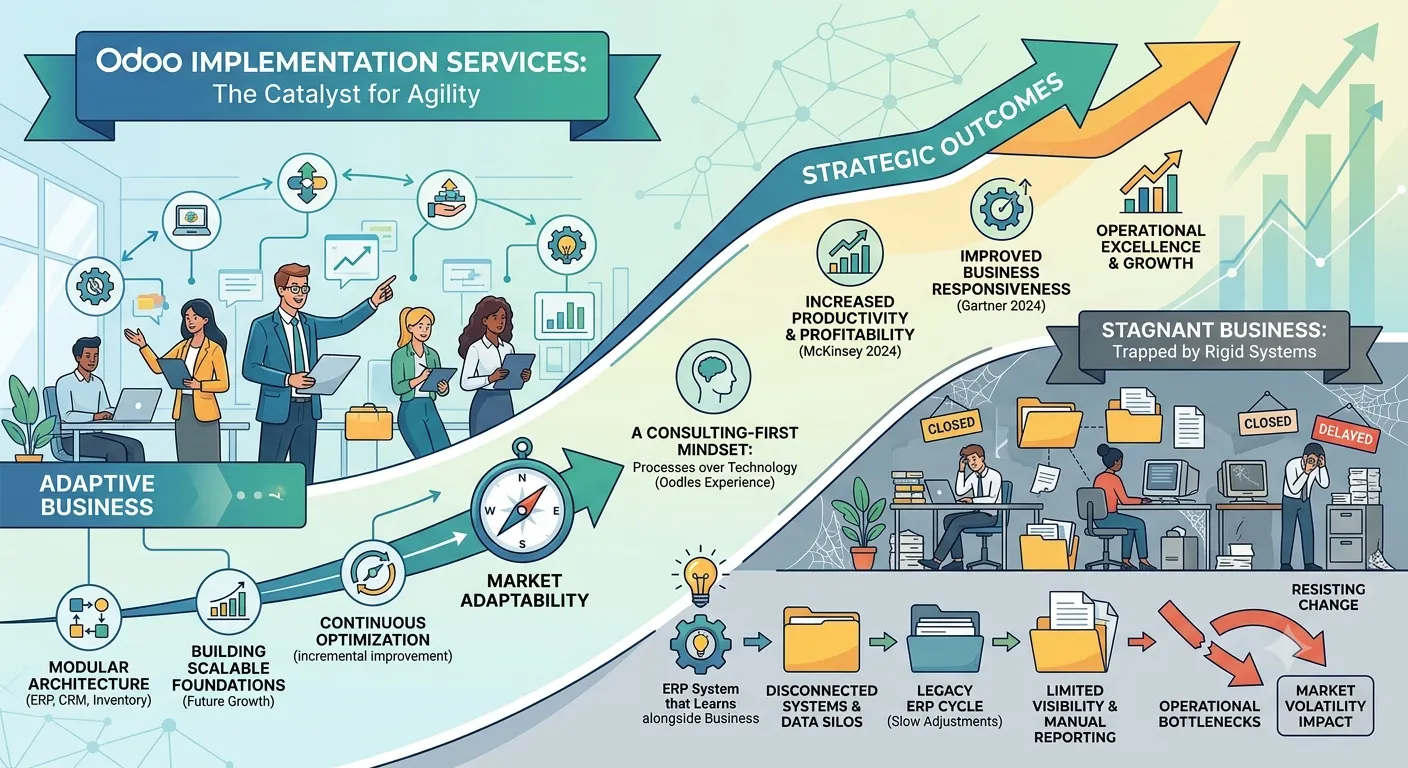
Organizations working with Oodleserp can also treat integration architecture as part of their broader ERP modernization roadmap rather than as a separate technical project.
The Strategic Test for CIOs and CTOs
The right question is not whether middleware is technically impressive.
The better question is whether the organization has reached the point where integration complexity is affecting business performance.
If engineering teams repeatedly rebuild similar connectors, operations teams reconcile data manually, application changes require coordinated releases across multiple systems, or failures are difficult to trace, the integration architecture may already be limiting growth.
A useful principle is simple: the more frequently systems change, the more valuable a well-designed coordination layer becomes.
Middleware does not remove complexity. It gives that complexity a defined architectural home.
Conclusion
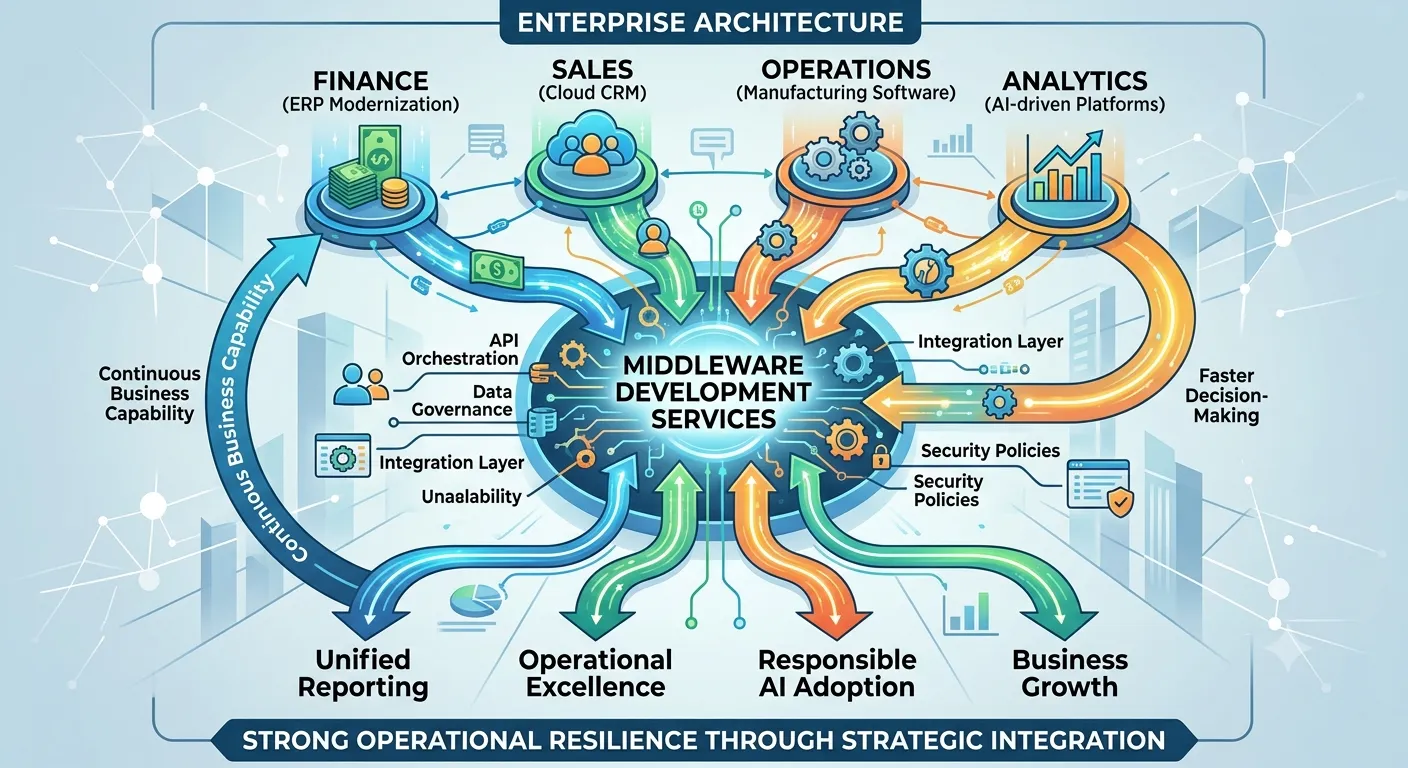
The strongest case for Middleware Development is not that enterprises need another software component. It is that modern businesses already operate as interconnected software ecosystems, whether their architecture formally recognizes that fact or not.
ERP, CRM, commerce, logistics, SaaS, analytics, and AI systems increasingly need to exchange information continuously. The organizations that handle this well will treat integration as an architectural capability, with clear contracts, observable workflows, controlled transformations, and deliberate failure handling.
For CIOs and CTOs, the forward-looking decision is therefore not simply which systems to buy next. It is how those systems will continue working together five years from now.
A Practical Next Step
If your ERP landscape has accumulated point-to-point integrations, manual reconciliation, or fragile data flows, it may be time to reassess the integration layer before adding another application.
To discuss your architecture and identify where Middleware Development can create measurable operational value, Middleware Development can be the starting point for a technical conversation with Oodles.
FAQ
What is middleware development?
Middleware development is the design and implementation of software that connects applications, databases, APIs, and enterprise platforms. It can handle data transformation, routing, authentication, messaging, workflow orchestration, monitoring, and error management between otherwise independent systems.
Why is middleware important for ERP integration?
Middleware provides a controlled integration layer between ERP systems and external applications. Instead of maintaining many direct connections, organizations can centralize transformation, validation, routing, authentication, and monitoring, making the overall architecture easier to evolve and operate.
When should a company consider Middleware Development?
A company should consider Middleware Development when integrations have become difficult to maintain, systems exchange data frequently, manual reconciliation is increasing, or adding one application requires changes across several existing platforms. These are signs that integration complexity has become an architectural concern.
What is the difference between APIs and middleware?
An API defines how one system exposes functionality or data to another system. Middleware manages the broader interaction between systems, including routing, transformation, authentication, messaging, retries, orchestration, and monitoring. APIs can therefore operate as components within a larger middleware architecture.
Is middleware suitable for legacy ERP systems?
Yes. Middleware can provide an abstraction layer around legacy ERP platforms without requiring immediate replacement. It can translate older protocols or data structures into modern APIs and event-based interfaces, allowing organizations to modernize surrounding applications while retaining critical legacy capabilities.


























Sign in to leave a comment.