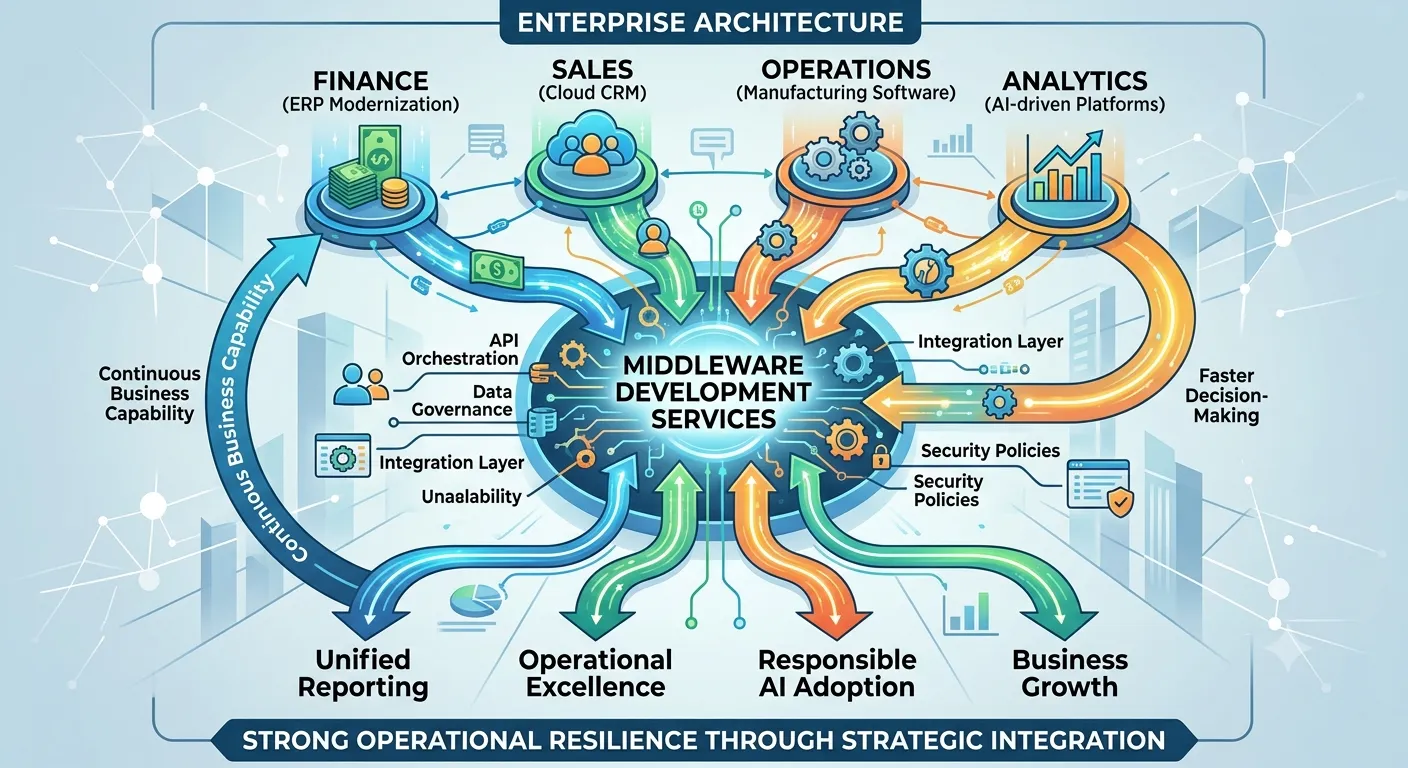

Enterprise technology failures rarely begin with software. They begin with disconnected decisions. A finance team invests in a new ERP, operations adopt specialized manufacturing software, sales move to a cloud CRM, and analytics shift to AI-driven platforms. Months later, executives discover that data moves slowly, reports conflict, and automation breaks across departments. This is where Middleware Development Services become a strategic priority rather than a technical afterthought.
Why This Challenge Exists
Enterprise architecture has evolved faster than organizational operating models. Businesses no longer rely on a single ERP or centralized database. They depend on ecosystems of cloud applications, industry-specific platforms, IoT devices, AI services, and external partner systems.
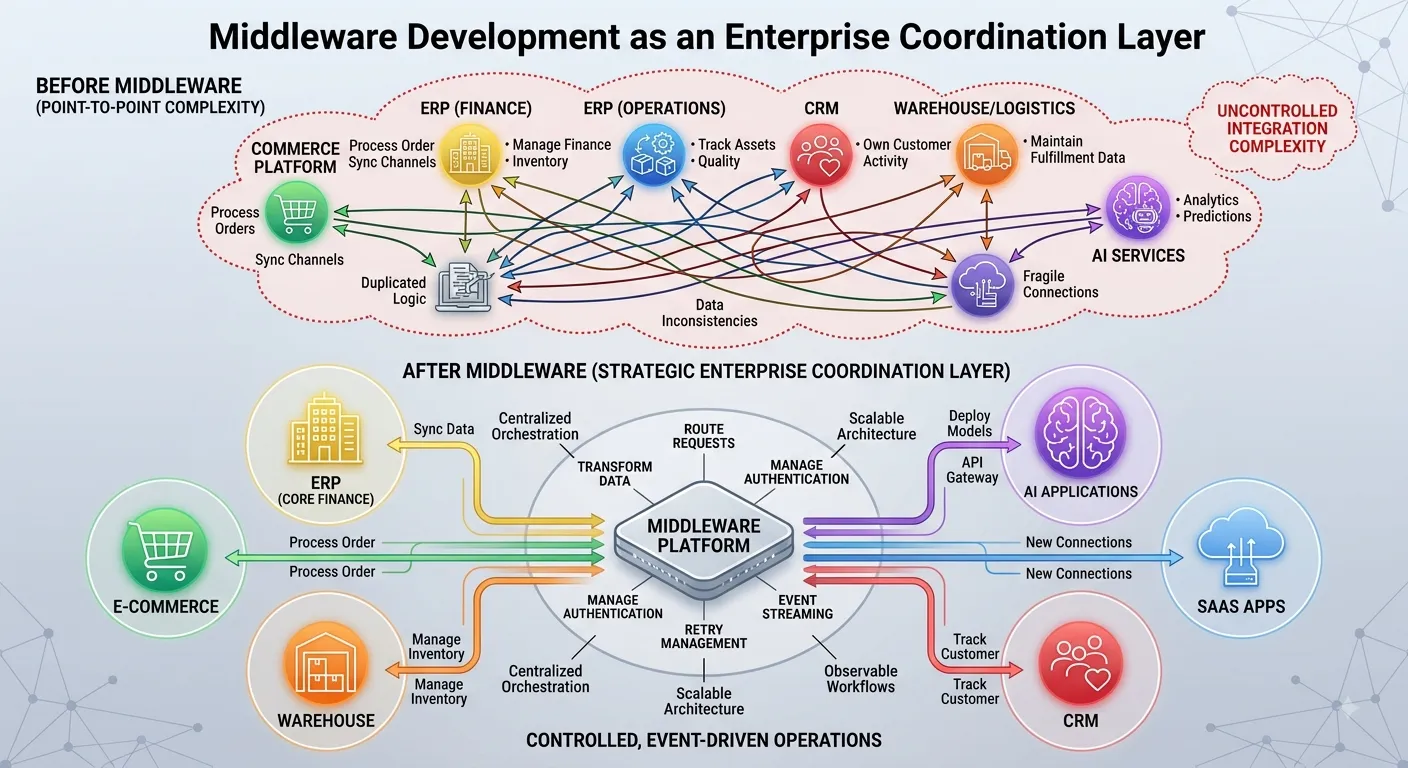
The problem is not the number of applications. The problem is the lack of coordination between them.
McKinsey research has consistently shown that digital transformation programs achieve stronger financial outcomes when technology initiatives are aligned with operating model changes rather than isolated IT deployments. Yet many organizations still treat system integration as the final implementation activity instead of an early architectural decision.
This creates familiar business consequences.
Customer data exists in multiple systems with different definitions. Procurement teams work from outdated inventory information. Finance spends weeks reconciling reports. AI initiatives struggle because source systems provide inconsistent data.
Technology complexity grows gradually until operational complexity becomes the bigger business risk.
A Better Approach to Middleware Development Services
Successful enterprises view integration as an ongoing business capability instead of a project milestone. That shift changes investment priorities and creates greater flexibility as organizations expand.
Organizations pursuing ERP modernization often focus on replacing legacy applications while overlooking the integration layer that connects business processes. At Oodles, we have seen this challenge surface repeatedly during enterprise transformation initiatives. According to IBM, more than 70% of organizations now operate in hybrid cloud environments, making integration a defining factor in operational performance rather than an infrastructure concern. That reality has changed how executives evaluate technology investments.
Understanding the Business Context Before Middleware Development Services
Integration discussions often begin with APIs, connectors, or cloud infrastructure. Experienced transformation leaders start somewhere else.
They begin with business outcomes.
Which operational decisions require real-time visibility? Which departments depend on shared information? Which processes create the greatest financial exposure when data is delayed?
Answering these questions shapes middleware architecture far better than selecting technology first.
For example, a manufacturing organization may prioritize production scheduling accuracy, while a healthcare provider may focus on regulatory reporting and patient data consistency. The integration strategy should reflect those business priorities rather than applying the same architecture everywhere.
This perspective also supports ERP modernization because process redesign and system connectivity evolve together.
Building a Sustainable Strategy
A sustainable integration strategy requires governance as much as engineering.
Every connected application introduces decisions about data ownership, security policies, version control, monitoring, and lifecycle management. Without clear governance, integrations multiply faster than organizations can maintain them.
Enterprise architects should define common data standards, establish reusable integration patterns, and create approval processes before expanding the integration landscape.
AI adoption also changes the conversation.
Predictive planning, intelligent automation, and conversational assistants depend on trusted enterprise data. Poor integration reduces AI accuracy regardless of model quality.
Organizations that invest early in scalable middleware architectures often discover that future initiatives become easier to implement because reliable information already flows across the enterprise.
This creates flexibility that supports acquisitions, cloud migration, regulatory changes, and evolving customer expectations without repeated architectural redesign.
Measuring Business Outcomes
Executive teams rarely ask whether middleware performs technically.
They ask whether it improves business performance.
Meaningful KPIs include shorter order processing cycles, reduced reconciliation effort, faster executive reporting, improved data accuracy, lower integration maintenance costs, and higher application availability.
Trade-offs also deserve attention.
Real-time integration may increase infrastructure costs while batch processing reduces operational expense but delays decision-making. Event-driven architecture improves responsiveness but requires stronger governance and monitoring.
The right balance depends on business priorities rather than technical preference.
Successful leadership teams evaluate Middleware Development Services through measurable operational impact instead of implementation complexity.
Lessons from Enterprise Consulting
During one enterprise transformation engagement, our consulting team worked with a rapidly expanding distributor operating multiple regional ERP environments alongside independent warehouse and CRM systems.
The organization planned another ERP rollout, believing the existing platform was the primary limitation.
After conducting an enterprise architecture assessment, we identified a different issue. Critical business processes depended on manual data movement between applications, creating duplicate customer records, inconsistent inventory visibility, and delayed financial reporting.
Instead of recommending immediate platform replacement, we designed an integration roadmap focused on standardized middleware services, master data governance, and phased API orchestration.
Implementation was completed in stages to reduce operational disruption while maintaining business continuity.
Within eight months, the organization achieved a 55% reduction in manual workflows, 40% faster financial reporting, and significantly improved inventory accuracy across regional operations.
Perhaps the most valuable outcome appeared later.
When the company introduced AI-based demand forecasting, the implementation accelerated because reliable enterprise data was already available across connected systems. The integration strategy supported future innovation without requiring another major architectural redesign.
Organizations exploring middleware development services often discover that strengthening enterprise connectivity creates value well beyond system integration itself.
Conclusion
Enterprise modernization is becoming less about replacing applications and more about connecting business capabilities with confidence. Organizations that recognize integration as a strategic discipline build stronger operational resilience, improve executive decision-making, and create a foundation for responsible AI adoption.
The conversation around Middleware Development Services should therefore extend beyond technology selection. It should address governance, business priorities, data quality, and long-term architectural flexibility.
As enterprises continue expanding across cloud platforms, intelligent automation, and digital ecosystems, the organizations that succeed will be those that invest in integration with the same discipline they apply to ERP strategy. Working with Oodles experts can help establish that foundation while supporting sustainable enterprise growth.
FAQs
1. Why are Middleware Development Services important during ERP modernization?
Middleware Development Services connect ERP systems with existing business applications, allowing information to move consistently across departments. This reduces manual effort, improves reporting accuracy, and supports future technology initiatives without creating isolated systems.
2. How does middleware support AI initiatives?
AI depends on accurate and connected enterprise data. Middleware ensures information from ERP, CRM, finance, and operational systems is synchronized, allowing AI models to generate more reliable insights and business recommendations.
3. Should organizations modernize ERP before improving integration?
Not always. Many enterprises gain greater business value by improving integration first. Stable data exchange often reveals opportunities to optimize existing processes before investing in large-scale ERP replacement.
4. What executive metrics indicate a successful integration strategy?
Leaders should monitor reporting speed, data consistency, operational efficiency, integration maintenance effort, customer response times, and system reliability. These indicators demonstrate business value more effectively than technical performance metrics alone.
5. How can organizations reduce integration complexity as they scale?
Establishing enterprise architecture standards, clear data governance, reusable APIs, phased implementation plans, and ongoing monitoring helps organizations expand digital ecosystems without creating unnecessary operational complexity.
























Sign in to leave a comment.