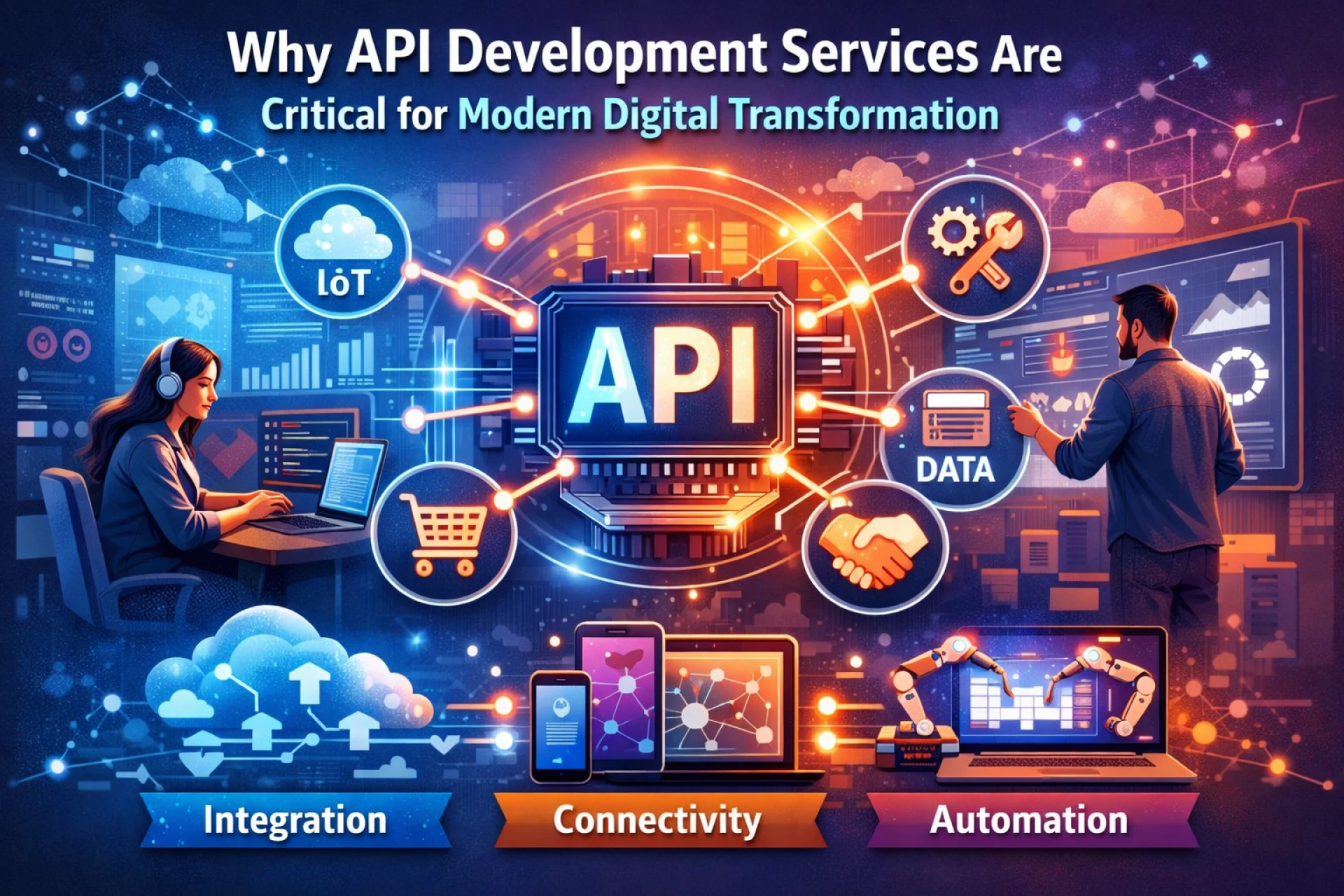
The adoption of disconnected technologies is no longer the main focus of digital transformation. Rather the main focus is the establishment of digital ecosystems that are interconnected, scalable, and secure, and can grow along with the business requirements. A strong API development service lies at the center of this transformation the solid ground that opens the way for the easy communication between the systems, applications, and data.
APIs have the same value as power for organizations that are modernizing their legacy platforms, and are developing new digital products, or are making their SaaS solutions bigger. APIs have become such important and valuable elements that their characteristics directly affect one’s speed, agility, and ROI.
The Role of API Development Services in Digital Transformation

The integration is the most important aspect of modern digital transformation initiatives. Businesses now have to deal with different cloud platforms, automation tools, mobile applications, data analysis systems, and partners in one place. An API development service helps to bring these different parts together in a way that is non-disruptive to the daily operations.
Professional API development services help organisations to:
- Enable seamless data exchange between the different applications
- Modernization of legacy applications without complete down times
- Microservices and cloud-native architectures are maintained
- Product innovation and market entry are accelerated.
Digital transformation projects often result in disjointed systems, bottlenecks in processes, and increased maintenance costs if not complemented with a proper API layer.
How APIs Directly Improve Return on Investment

A well-executed API development service delivers measurable business value by improving efficiency, reducing costs, and enabling faster innovation key drivers of long-term return on investment.
1. Faster Time-to-Market
APIs allow development teams to build, test, and deploy features independently. This modularity shortens release cycles, helping businesses respond quickly to market changes and customer demands.
2. Lower Development and Integration Costs
Instead of building custom integrations repeatedly, APIs enable reusable services across teams and platforms. This reduces development effort, minimizes duplication, and lowers long-term operational costs.
3. Extended Lifecycle of Legacy Systems
API-driven modernisation allows enterprises to expose legacy system functionality without replacing them entirely. This approach reduces transformation risk while maximizing the value of existing technology investments.
4. Scalability Without Re-Architecture
APIs support horizontal scaling and cloud-native deployments, enabling systems to handle growth without costly redesigns protecting ROI as transaction volumes increase.
API Development Services as a Foundation for Scalable Architectures

Microservices, cloud platforms, and distributed systems are the backbone of digital-first companies. The continuous smoothness, security, and scalability of these infrastructures are guaranteed by a professional API development service.
The major architectural benefits are:
- Independent scaling for decoupled services
- Uniform communication among applications
- Increased system durability and fault isolation
- New technologies and platforms easier to adopt
To the CTOs and engineering heads, this flexibility in architecture means less technical debt and better ROI in the long run directly.
Security, Governance, and Compliance at Scale

Security and compliance are absolutely essential in digital transformation mainly for organizations in regulated industries. A skilled API developer maturing one embeds security and governance into the whole API usage.
This embraces:
- Authentication and authorization (OAuth, JWT, SSO)
- Rate limiting and traffic management
- Data encryption and secure payload delivery handling
- Versioning and backward compatibility
- Centralized monitoring and auditability
By obviating breaches, outages, and compliance infractions, API development service secures not only constancy of business but also financial gains.
Enabling Ecosystems, Partners, and New Revenue Streams

APIs are no longer only used internally but rather they have become the enablers of digital ecosystems. Companies can disclose APIs to their partners, suppliers, and customers in order to open up the new business models.
A professional API development service can assist companies in the following ways:
- Accelerate the delivery of integrations for partners
- Facilitate the creation of ecosystems around third-party apps
- Turn APIs into marketable products
- Make the customer experience better across all channels
Evidently, all these capabilities augment revenue as well as the return on investment from digital transformation projects.
Why Enterprises Choose API Development Services Over In-House Builds

In-house teams are capable of creating APIs, but a majority of the businesses still rely on specialized API development services to minimize the risk and speed up the process.
The main reasons are as follows:
- Experienced API architects and engineers available for work
- Use of frameworks and best practices that have been proved
- Quicker delivery with fixed costs
- Support, optimization, and maintenance on a continuous basis
To a large extent, the decision-makers view outsourcing API development as the quickest route to getting the maximum return on investment while still being able to concentrate on their main business goals.
Conclusion
The digital transformation journey of an organization is successful when it integrates, connects, and equips "future-proof" systems. A sound API development service is the backbone of such a transformation supporting agility, security, and giving measurable return on investment.
For those organisations that really care about their long-term growth, API development is not simply a technical expense but rather a business investment that indicates the level to which technology helps in innovation, efficiency, and gaining a competitive edge.






























Sign in to leave a comment.