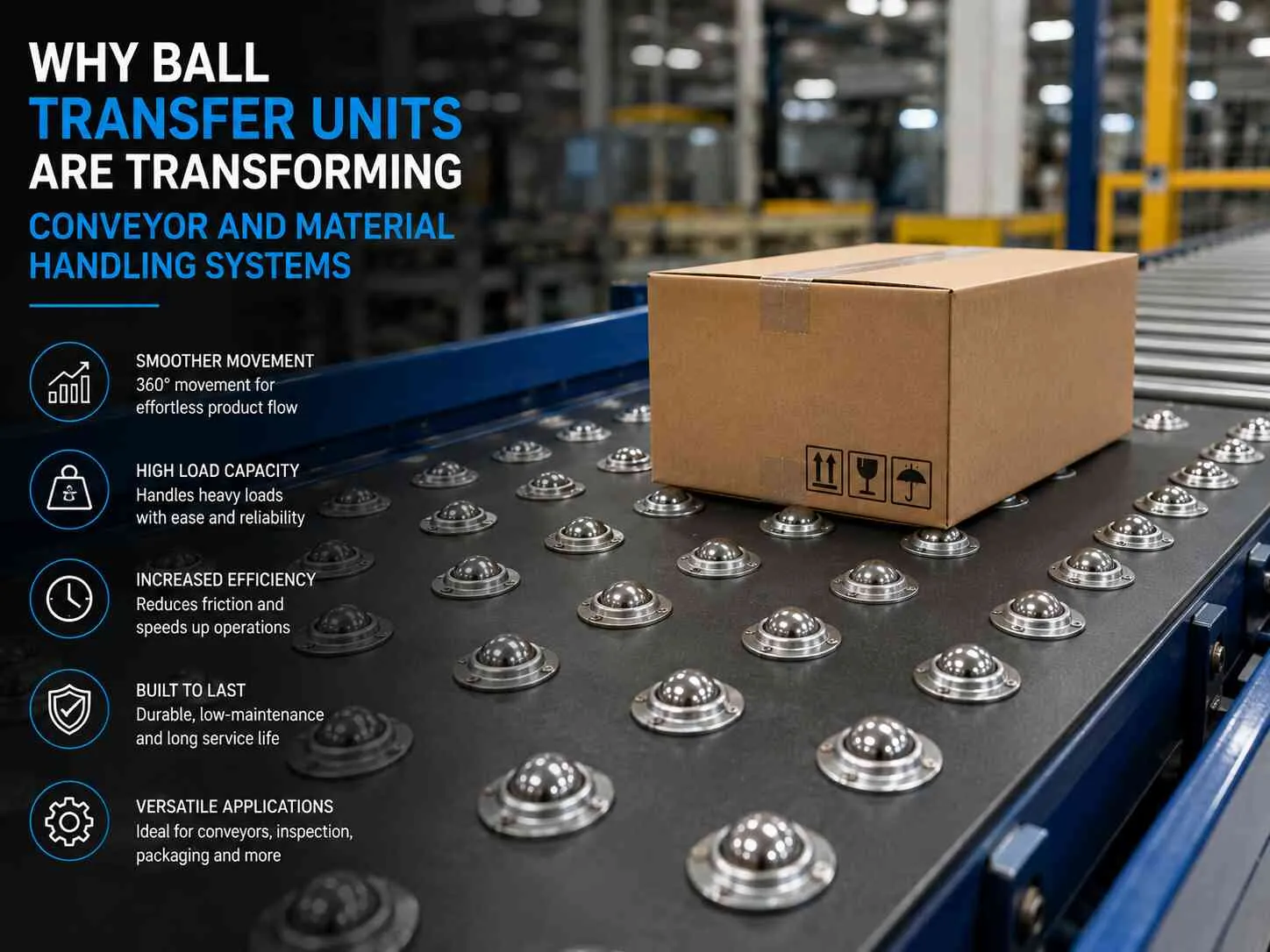

What if moving heavy and bulky loads across a production floor could become smoother, faster, and more flexible? Why are industries increasingly looking for equipment that can simplify load transfer without redesigning an entire production line? These questions explain the growing demand for ball transfer unit manufacturers in India. Precision Conveyors operate in a material-handling environment where manufacturers need reliable movement solutions for different production requirements.
A ball transfer unit can allow loads to move in multiple directions with less effort, making it useful across manufacturing, packaging, warehousing, and logistics. But what makes this seemingly simple conveyor component so valuable? Its combination of omnidirectional movement, load capacity, friction reduction, and practical installation makes it an important part of modern material handling systems.
How Ball Transfer Units Improve Material Movement
Traditional conveyor arrangements often move products along a predetermined path. That approach works well when material follows a fixed route, but some production processes require greater flexibility. A ball transfer system addresses this need by allowing loads to move forward, backward, sideways, or diagonally.
A typical ball transfer unit contains a Main Ball supported by smaller Support Balls within a housing. The arrangement allows the primary ball to rotate freely, reducing rolling resistance between the load and conveyor surface.
This omnidirectional movement makes it easier for operators to reposition heavy or bulky products. Instead of lifting and carrying an item repeatedly, workers can push it across a transfer surface with comparatively less physical effort.
Multiple units can be installed together to create a ball transfer table. The table provides a flexible working surface for cartons, sheets, pallets, containers, and other loads that require frequent repositioning.
Supporting Efficiency Across Conveyor Systems
Modern material handling systems need to balance speed, flexibility, and reliability. Conveyor ball transfer units can complement conventional conveyor equipment by providing transfer points where loads need to change direction.
For example, a production line may use a Conveyor Roller system for continuous movement and introduce ball transfer units at workstations where operators need to rotate or reposition products. This combination can improve overall material flow without requiring a completely different conveyor arrangement.
A ball transfer conveyor can also support movement between different stages of production. When the appropriate unit size and spacing are selected, the system can handle significant loads while maintaining smooth movement.
This flexibility can improve conveyor efficiency, especially in applications where products do not follow a single linear route.
Load Capacity and Construction Matter
Not every ball transfer unit suits every application. Load capacity remains one of the most important factors when selecting equipment. The weight of the product, unit spacing, surface condition, and expected operating frequency should all be considered.
Heavy products may require heavy-duty ball transfer units with robust housings and stronger internal components. The Bearing arrangement also contributes to smooth rotation and consistent performance.
Material selection can influence durability as well. Steel construction may provide the strength needed for demanding industrial environments, while Stainless Steel can offer better resistance in applications exposed to moisture or corrosive conditions. Carbon Steel can also provide a practical solution for many general industrial applications.
The correct Load Bearing configuration helps distribute weight across multiple units rather than concentrating excessive force on a single component. Proper spacing therefore becomes just as important as the individual unit's rated capacity.
Applications in Modern Material Handling
Where can these systems deliver the most value? Their applications extend across several industries. Manufacturing plants can use them at assembly stations, fabrication areas, inspection points, and packaging lines.
An Assembly Line may incorporate ball transfer units when workers need to rotate components during assembly. In warehouses, they can assist with carton handling and order preparation. In metalworking facilities, they can support the movement of large sheets and fabricated components.
Pallet handling is another useful application. A Pallet can be repositioned across a properly designed transfer surface without relying entirely on manual lifting equipment.
These applications demonstrate how relatively simple material handling equipment can contribute to better productivity and workplace safety. By reducing unnecessary lifting and allowing controlled load movement, transfer units can make certain handling tasks more manageable.
Slat conveyor manufacturers in India
Different production environments require different conveyor technologies. Slat conveyor manufacturers in India serve industries that need continuous movement of products on a series of linked slats. Slat conveyors can handle products that require stable support and a defined transportation route.
Unlike a ball transfer system, a slat conveyor generally provides controlled linear movement. It can therefore work effectively for production lines where products need to travel between fixed processing stations.
Slat conveyor manufacturers in India may also integrate different conveyor components into a broader material-handling layout. Ball transfer units can complement such systems at transfer stations, inspection points, or manual work areas where multidirectional movement becomes necessary.
The choice between technologies should depend on product dimensions, weight, route, speed, handling requirements, and production workflow rather than on one conveyor type alone.
Bucket elevator manufacturers in India
Vertical material movement presents another engineering challenge. Bucket elevator manufacturers in India provide systems designed to transport bulk materials vertically using a series of buckets attached to a belt or chain.
Bucket elevators suit applications where materials such as grains, powders, granules, and other bulk products must move between different elevations. Their operating principle differs significantly from horizontal ball transfer systems.
However, both technologies can form part of a broader Material Handling System. A facility may use conveyors for horizontal transportation, elevators for vertical movement, and transfer units where operators need flexible positioning.
Bucket elevator manufacturers in India therefore address a different part of the material flow process, while ball transfer technology focuses primarily on flexible load transfer across horizontal or workstation surfaces.
Reducing Friction and Improving Productivity
One of the strongest advantages of ball transfer technology is friction reduction. When a load moves across rotating balls rather than sliding directly across a fixed surface, less force may be required to reposition it.
This can improve smooth movement and reduce physical effort during repetitive handling tasks. For businesses handling heavy components throughout the day, even small improvements can contribute to better productivity and operational efficiency.
The result becomes particularly useful when a facility combines ball transfer equipment with other conveyor systems. Strategic placement can create flexible transfer zones without interrupting the primary transportation route.
Selecting the Right Ball Transfer Solution
Choosing the right system requires more than checking the maximum load rating. Buyers should consider the product's weight and dimensions, operating environment, transfer direction, unit spacing, mounting method, and expected usage frequency.
The surface material also matters. Stainless steel components may suit environments where corrosion resistance is important, while carbon steel or standard steel configurations can work well in general manufacturing applications.
Businesses should also evaluate whether they need individual industrial ball transfer units, a complete ball transfer table, or an integrated transfer section within a larger conveyor layout.
Precision Conveyors work with these practical considerations when addressing material handling requirements. If you are planning a new transfer system or upgrading an existing production line, contact us to discuss load requirements, conveyor configuration, and application conditions.
Conclusion
Ball transfer technology has become an important part of flexible material handling because it enables multidirectional movement, smooth load transfer, and practical repositioning of heavy products. From pallets and sheet materials to manufacturing components and packaged goods, these systems can improve the way products move through workstations and production areas.
As demand for efficient material handling solutions continues to grow, ball transfer unit manufacturers in India are helping industries develop more adaptable conveyor layouts. Precision Conveyors recognizes the value of combining dependable conveyor systems with practical transfer technologies. With the right load capacity, construction material, spacing, and configuration, ball transfer units can support safer handling, better material flow, and improved operational efficiency across modern industrial environments.
























Sign in to leave a comment.