
Water is involved in almost every industrial process, from food manufacturing and pharmaceuticals to cooling towers, textile production, beverage processing, and wastewater treatment. Yet, even after conventional treatment, water can still carry microorganisms, dissolved organic compounds, unpleasant odours, or contaminants that affect product quality and operational efficiency.
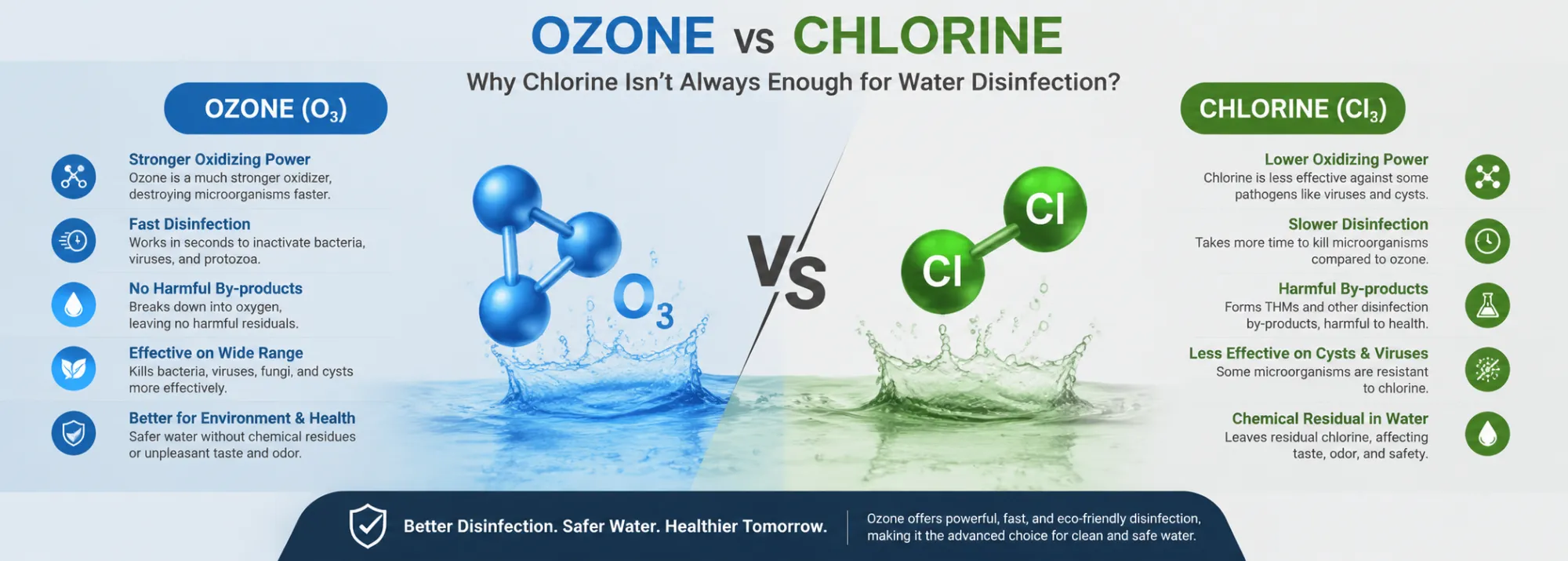
For decades, chlorine has been the most common disinfectant because it is economical and provides residual protection. However, industries with stricter hygiene standards are increasingly looking beyond traditional methods. The challenge is no longer just disinfecting water, but achieving rapid microbial control without introducing unwanted chemical residues or affecting taste, odour, or downstream processes.
This is where industrial ozone technology has become an important part of modern water treatment.
Why Does Industrial Water Become Contaminated?
Water contamination does not originate from a single source. Even treated water can become contaminated during storage, transportation, or industrial use.
Common sources include:
- Surface water containing bacteria, algae, and suspended solids
- Groundwater with dissolved iron, manganese, or sulphur compounds
- Organic matter from leaves, soil, or agricultural runoff
- Biofilm formation inside pipelines and storage tanks
- Process water is recycled within industrial facilities
Many of these contaminants not only affect water quality but can also reduce equipment efficiency, increase maintenance requirements, and create compliance challenges for regulated industries.
Understanding the Limitations of Chlorine
Chlorination remains an effective and widely accepted disinfection method. It continues to play a critical role in municipal and industrial water treatment, particularly where residual disinfection throughout a distribution system is required.
However, chlorine may not always be the ideal solution for every application. Organic matter present in water can consume available chlorine before complete disinfection occurs, reducing its overall effectiveness. In addition, chlorine treatment may produce disinfection by-products under certain conditions, and some industries seek alternative technologies where residual chemicals could interfere with sensitive manufacturing processes.
Rather than replacing chlorine entirely, ozone is often used as a complementary or application-specific treatment technology where rapid oxidation and high water quality are priorities.
How Does an Industrial Ozone Generator Work?
An industrial ozone generator produces ozone (O₃) from oxygen using a high-voltage corona discharge process. During this process, oxygen molecules split into individual oxygen atoms, which then combine with oxygen molecules to form ozone.
The simplified reaction is:
3O₂ + Electrical Energy → 2O₃
Once injected into water, ozone rapidly reacts with microorganisms and oxidizable contaminants. Because ozone is highly unstable, it naturally decomposes back into oxygen after completing its oxidation reactions.
Unlike conventional chemical disinfectants, ozone is generated on-site and does not require long-term chemical storage.
Why Is Ozone So Effective in Water Treatment?
Ozone is one of the strongest commercially used oxidizing agents, with an oxidation potential of approximately 2.07 volts, compared with 1.36 volts for chlorine. This higher oxidation potential allows ozone to react quickly with a broad range of contaminants.
During treatment, ozone disrupts bacterial cell walls, damages viral protein structures, oxidizes organic compounds, and helps control algae and odour-causing substances. Under suitable water conditions, ozone can also generate hydroxyl radicals (•OH), which are highly reactive oxidizing species capable of breaking down many complex organic pollutants.
Because ozone decomposes into oxygen, it leaves no long-lasting chemical residue in treated water.
Where Is Ozone Water Treatment Used?
Industrial ozone systems are used across sectors where water quality directly affects product safety, equipment reliability, or regulatory compliance.
Typical applications include:
- Food and beverage processing
- Pharmaceutical manufacturing
- Bottled drinking water production
- Aquaculture and fisheries
- Cooling tower water treatment
- Textile and chemical industries
- Municipal drinking water facilities
- Industrial wastewater treatment
The ozone dosage, contact time, and system configuration vary depending on water chemistry, flow rate, and treatment objectives.
Engineering and Safety Matter
Successful ozone treatment depends on more than selecting a generator with a high ozone output. Engineers evaluate factors such as water flow, dissolved organic content, contact time, ozone transfer efficiency, and reactor design to achieve consistent disinfection performance.
Safety is equally important. Occupational exposure should remain within recognised workplace limits, with many industrial guidelines using 0.1 ppm as an 8-hour time-weighted average for ozone exposure. Modern industrial systems, therefore, incorporate ambient ozone monitors, automatic shutdown controls, ventilation systems, and off-gas destruct units to help maintain safe operating conditions.
Conclusion
As industrial water quality requirements become more demanding, selecting the right disinfection technology requires understanding both the nature of contaminants and the treatment objective. Chlorine continues to serve many applications effectively, particularly where residual protection is required. However, industries seeking rapid oxidation, improved water quality, and residue-free treatment increasingly incorporate ozone into their water treatment strategies.
An industrial ozone generator is not simply a machine that produces ozone. When properly engineered, it becomes part of an integrated treatment system designed around water chemistry, process requirements, and operational safety. For industries where consistent water quality directly impacts production, compliance, and product integrity, ozone technology offers a scientifically established solution supported by decades of industrial application.
Reference: Ozone Generator Manufacturer | Creative OZ AIR's Best Units
























Sign in to leave a comment.