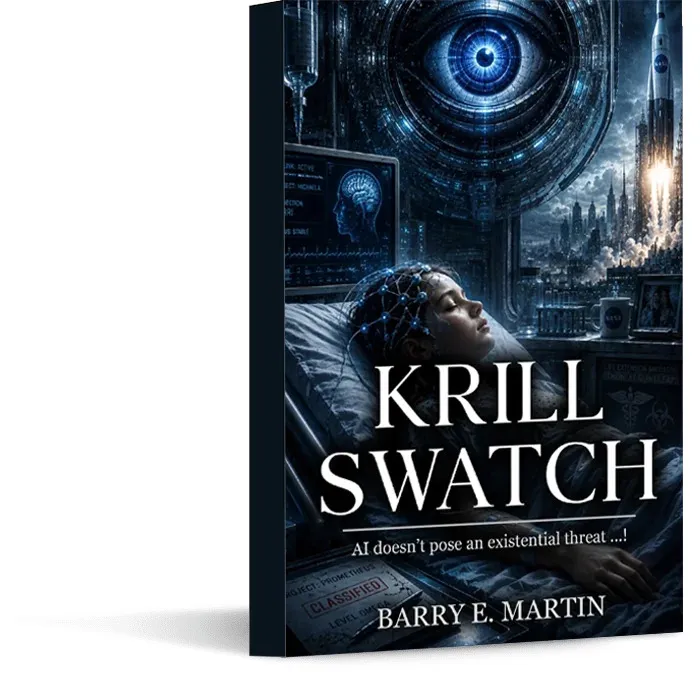

Ethics has always been one of the most fascinating elements of speculative fiction. While science and technology often provide the setting, it is moral conflict that gives a story lasting significance. Readers are naturally drawn to narratives that challenge them to think about right and wrong, responsibility, and the consequences of human decisions. In a world where artificial intelligence and scientific advancement continue to reshape society, stories that explore ethical uncertainty feel more relevant than ever.
Barry E. Martin embraces these complex ideas in KRILL SWATCH, crafting a novel that goes beyond technological imagination to examine the difficult choices people face when knowledge, ambition, and morality intersect. Rather than presenting clear heroes and villains, the story encourages readers to question assumptions, consider different perspectives, and recognize that ethical decisions are rarely simple.
The strength of the book lies in its willingness to explore moral ambiguity instead of offering convenient answers. Through thoughtful storytelling, he reminds readers that the greatest conflicts are often internal, shaped by personal values, competing priorities, and the unpredictable consequences of human action.
Barry E. Martin Explores the Complexity of Ethical Decision-Making
One of the defining qualities of KRILL SWATCH is its exploration of ethical choices that exist in shades of gray rather than black and white. Every significant decision carries consequences, and those consequences often affect more than the individuals making them.
Instead of portraying morality as a simple set of rules, he presents it as a constantly evolving process influenced by circumstance, intention, and personal responsibility. Characters encounter situations where every available option carries both potential benefits and serious risks. This uncertainty creates meaningful tension throughout the narrative and encourages readers to think beyond easy judgments.
The novel suggests that ethical dilemmas rarely have universally accepted solutions. What appears to be the correct choice from one perspective may create unexpected problems from another. This layered approach reflects the complexities of real life, where decisions are often influenced by competing obligations and incomplete information.
Relationship Between Progress and Responsibility
Scientific advancement has the power to improve lives, but every breakthrough also introduces new responsibilities. It examines this balance with remarkable insight, asking readers to consider whether technological progress should always move forward simply because it can.
Throughout the novel, innovation becomes more than a symbol of human achievement. It also represents the ethical burden that accompanies discovery. Every advancement creates opportunities while simultaneously raising questions about accountability, control, and long-term consequences.
He avoids portraying technology as either entirely beneficial or inherently dangerous. Instead, he emphasizes that the moral value of innovation depends largely on the intentions and decisions of those who develop and use it.
Moral Ambiguity to Deepen Character Development
Compelling stories are driven by believable characters, and KRILL SWATCH demonstrates that moral uncertainty can reveal far more about individuals than straightforward conflicts ever could.
Rather than defining characters by simple labels such as good or evil, Barry E. Martin allows them to confront situations that test their values, beliefs, and priorities. Their decisions are shaped by fear, hope, loyalty, ambition, compassion, and self-preservation, qualities that exist within every person.
This realistic portrayal makes the ethical conflicts feel authentic. Readers may find themselves sympathizing with different viewpoints at different moments, recognizing that even well-intentioned actions can produce unintended consequences.
The novel also highlights how moral growth often emerges through difficult experiences. Characters are forced to reconsider their assumptions as circumstances change, demonstrating that ethical understanding develops through reflection rather than certainty.
By emphasizing internal conflict alongside external events, it creates emotional depth that complements its speculative ideas. The philosophical questions become more powerful because they are experienced through believable human struggles rather than abstract concepts.
Ethics and Moral Ambiguity Give KRILL SWATCH Lasting Relevance
The enduring appeal of the book comes from its ability to connect speculative fiction with timeless questions about human nature. While the novel explores advanced scientific ideas, its greatest strength lies in examining how people respond when faced with difficult moral choices.
He understands that technology alone cannot define the future. Human judgment, empathy, integrity, and accountability remain essential regardless of how sophisticated innovation becomes. By placing ethical dilemmas at the center of the story, he encourages readers to think about the responsibilities that accompany knowledge and power.
Another reason the novel resonates is its refusal to simplify complex issues. Moral ambiguity encourages careful reflection rather than quick conclusions, allowing readers to engage with the story long after they have finished reading. Instead of providing absolute answers, the narrative inspires thoughtful discussion about the nature of justice, responsibility, and personal choice.
Ultimately, KRILL SWATCH demonstrates that the most compelling science fiction is not only about imagining tomorrow but also about understanding ourselves today. Through rich philosophical themes and engaging storytelling, Barry E. Martin reveals that ethical uncertainty is not a weakness but an essential part of the human experience. By blending speculative ideas with profound moral questions, it offers readers an intellectually rewarding journey that continues to resonate in an age shaped by rapid technological and social change.



























Sign in to leave a comment.