

An Agentforce partner in Texas helps businesses deploy Salesforce's AI agents correctly the first time, avoiding the costly trial-and-error that sinks most AI projects. Gartner found that over 40% of agentic AI projects get canceled before 2027 due to unclear ROI and poor planning. The right local partner cuts that risk down significantly.
Texas has become one of the fastest-growing tech hubs in the country, and Salesforce customers across Dallas, Houston, and Austin are racing to adopt AI agents before competitors do. This guide explains what an Agentforce partner does, how to evaluate one, what implementation actually costs, and how to avoid the mistakes that derail most rollouts.
What Does an Agentforce Partner Do?
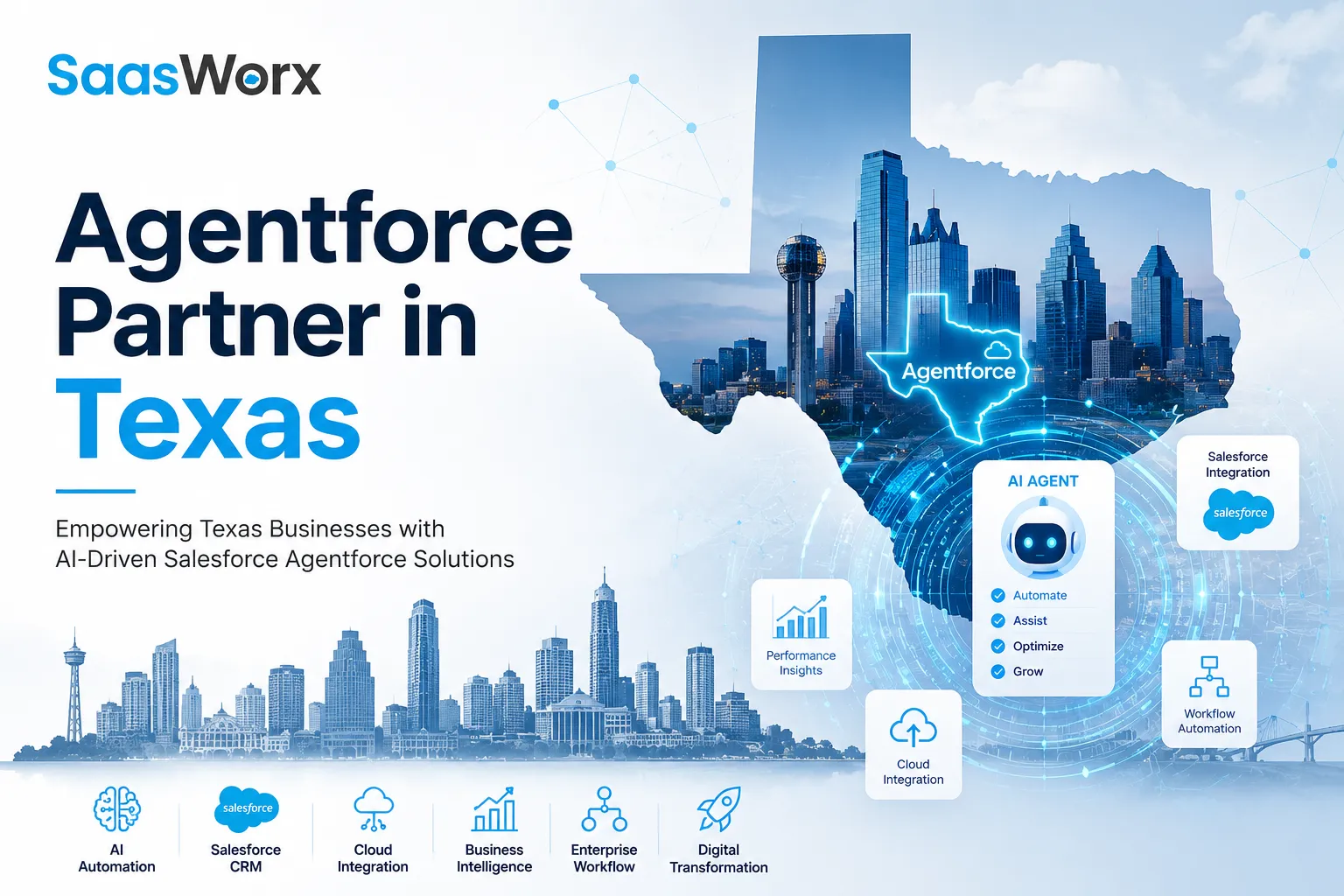
An Agentforce partner configures, trains, and deploys AI agents inside your Salesforce environment so they handle real customer and employee tasks autonomously. They connect your data, define agent actions, and test outcomes before launch. This goes far beyond installing software.
Data and Workflow Mapping
Before any agent goes live, a partner audits your Salesforce org, your Data Cloud setup, and your existing automation. Agentforce only performs as well as the data feeding it. Messy or siloed records produce unreliable agent responses, so this mapping stage usually takes the most time.
Agent Action Design
Partners build the specific actions an agent can take, like updating a case, scheduling a callback, or pulling order history. Each action needs guardrails so the agent doesn't overstep its role. This is where certified expertise matters most, since misconfigured permissions create real business risk.
Testing and Governance
Good partners run agents through structured testing cycles with human oversight before full deployment. Gartner's research shows 80% of enterprise applications shipped or updated in early 2026 already embed at least one AI agent, so governance frameworks are no longer optional extras.
How Much Does Agentforce Implementation Cost?
Agentforce implementation costs vary by scope, ranging from a focused single-agent pilot to a full multi-department rollout. Pricing depends on data complexity, the number of agent use cases, and integration with existing systems. Most businesses start with one use case to prove value before scaling.
Factors that move the price up or down:
- Number of agent use cases (customer service, sales, scheduling)
- Volume and cleanliness of existing Salesforce data
- Integrations with third-party systems outside Salesforce
- Level of custom training versus out-of-box configuration
- Ongoing monitoring and optimization after launch
A narrow pilot for a single department costs far less than an enterprise-wide deployment touching multiple clouds. Most successful projects start small, measure results, then expand.
Is Agentforce Different From Salesforce Einstein?
Yes, Agentforce and Einstein serve different purposes within the same platform. Einstein is Salesforce's predictive and generative AI layer that suggests next steps and drafts content for human review. Agentforce builds autonomous agents that can complete entire tasks independently, with minimal human intervention.
Where the Overlap Happens
Both rely on the same underlying data in Data Cloud, and Agentforce agents often use Einstein-generated predictions as part of their decision-making. A partner who understands both layers builds agents that make smarter, more context-aware decisions rather than agents that operate in isolation from existing AI tooling.
Choosing the Right Layer for Your Use Case
Not every problem needs full autonomy. Simple recommendation tasks may only need Einstein. Tasks involving multi-step resolution, like processing a return or scheduling a service appointment end-to-end, call for Agentforce. A partner who pushes every use case toward full autonomy without weighing this tradeoff is optimizing for complexity, not for your outcome.
Do I Need a Certified Partner for Agentforce?
You don't legally need a certified partner, but deployment risk drops sharply with one. Certified partners have passed Salesforce's technical exams and worked through real implementations, which means fewer configuration errors and faster time to value. Given that IBM found only 25% of AI initiatives delivered their expected ROI in 2025, expertise is not a luxury here.
Texas-based partners add a practical advantage too: shared time zones for live support, in-person workshops when needed, and familiarity with regional industries like energy, healthcare, and logistics that dominate the state's economy. For businesses comparing options, resources that walk through what a regional Agentforce engagement actually involves can help clarify what to expect before signing a contract.
Conclusion
Choosing an Agentforce partner in Texas comes down to data readiness, governance discipline, and local responsiveness. The technology works, but only when configured against clean data with clear guardrails and realistic scope. Businesses that start with one well-defined use case and measure results consistently outperform those chasing full automation on day one.
As more Texas companies move from AI pilots to production agents in 2026, the gap between organizations with strong implementation partners and those without will only widen. The question worth asking isn't whether to adopt Agentforce, but whether your current data and processes are actually ready for it.





























Sign in to leave a comment.