
In today’s dynamic, data-driven business environment, companies are always seeking innovative decision-making methods. Traditional methods of relying on intuition, isolated data, and dashboards are no longer enough. This is where the concept of decision intelligence (DI) comes in, which uses data science, artificial intelligence (AI), and business strategies to transform how businesses operate.
What Is Decision Intelligence?
Decision Intelligence is a framework that combines data, analytics, and artificial intelligence to enable more effective, timely, and consistent decision-making. While business intelligence primarily provides summaries of past events, decision intelligence focuses on actionable insights and decision-making outcomes.
Some of the key benefits of Decision Intelligence include:
- Ability to understand complex business situations
- Forecasting future results
- Recommending optimal actions
- Continuously improving decision-making
The Limitations of Traditional Decision-Making
Many businesses still use fragmented decision-making processes. Data is often stored in different silos, and insights may not be available to decision-makers at all times. Moreover, biases, lack of data, and insufficient context may result in poor decision-making.
Some common challenges include:
- Delays in decision-making due to manual analysis
- Inconsistent decisions across different teams
- Lack of predictive capabilities
- Dependence on past data
Decision intelligence provides an effective solution to these problems.
How Decision Intelligence Is Transforming Enterprise Strategy
1. From Reactive to Proactive Decision-Making
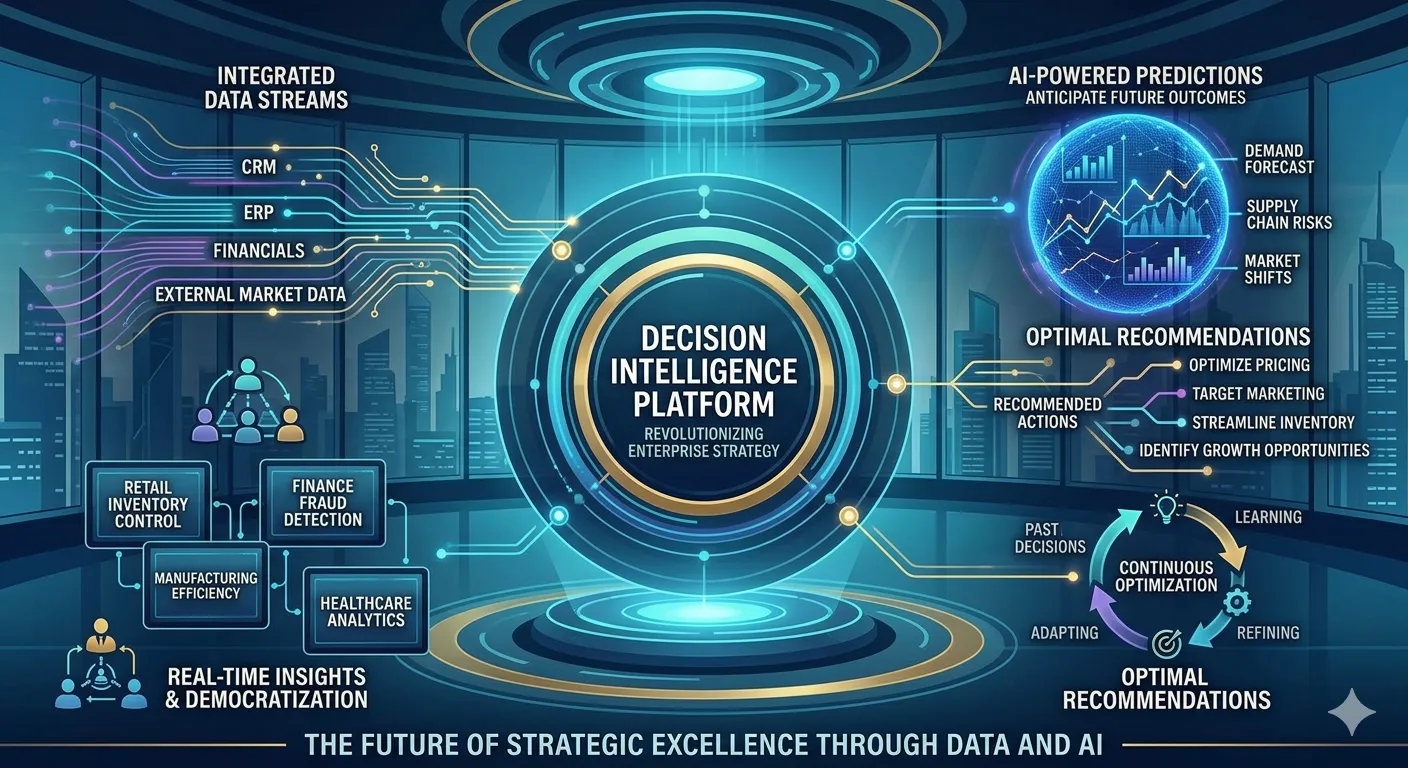
By utilizing decision intelligence, organizations are no longer restricted to adopting reactive approaches. Through predictive analytics and machine learning models, it becomes possible to anticipate future outcomes and take proactive measures accordingly.
For example, organizations can forecast consumer demand, anticipate future supply chain issues, and take appropriate actions to stay ahead of competitors.
2. Enhanced Data Integration and Contextual Insights
DI integrates data from various sources, including CRM applications, financial systems, and third-party systems, and provides businesses with a comprehensive view of their operational environment. This information helps organizations make better decisions.
An artificial intelligence studio enables firms to create tailor-made data models and analytics structures that integrate data from different sources, enabling leaders to assess the effects of their decisions.
3. AI-Powered Recommendations
One of the most useful aspects of decision intelligence is its ability to provide recommendations. Algorithms can identify patterns, analyze large amounts of data, and recommend optimal actions.
Many businesses rely on a decision intelligence company to help them implement these solutions effectively, ensuring their decision models align with their business goals. This significantly reduces the cognitive burden on decision-makers.
4. Continuous Learning and Optimization
Decision intelligence systems analyze past decisions and their results. The feedback loop allows them to continuously improve the algorithms, providing even better results in the future.
It forms a continuous cycle in which each new decision improves the system’s performance over time.
5. Democratization of Decision-Making
DI tools are meant to be user-friendly for both technical and non-technical users. By using dashboards and visualizations, employees can leverage data insights to inform decisions.
This ensures that decision-making not only occurs at the executive level but is embedded throughout the enterprise.
Key Benefits for Enterprises
The adoption of decision intelligence offers several benefits, such as:
- Improved Strategy Execution: Aligns all decisions with the organization’s objectives
- Accelerated Decision Processes: Saves time in data collection and analysis
- Enhanced Accuracy: Reduces errors through data-driven insights
- Risk Reduction: Detects risks and provides recommendations for preventive measures
- Competitive Edge: Provides agility in responding to market shifts
Real-World Applications
Decision Intelligence is being adopted by several industries, which include:
- Retail industry: Improved pricing strategy and inventory management
- Finance industry: Risk assessment and fraud prevention
- Healthcare sector: Improved patient outcomes through predictive analytics
- Manufacturing industry: Improved operational efficiency and minimized downtime
Challenges to Consider
Despite the significant potential of decision intelligence, organizations must address certain challenges during its implementation:
- Data Issues: High-quality and reliable data is needed
- Integration Difficulties: Data from various systems can be complex to integrate
- Change Management: Employees may require training on new software and procedures
- Ethical Concerns: Transparency and ethical decision-making in AI-driven decisions are essential
These challenges will need to be overcome through proper planning and effective leadership.
Best Practices for Implementing Decision Intelligence
1. Begin With Impactful Use Cases
Choose use cases that can quickly generate measurable value, which will make the initiative more compelling.
2. Ensure Strong Data Governance
Maintain data quality, accuracy, and security, as they are crucial for making informed decisions and require strong data governance policies.
3. Stay Aligned with Organizational Objectives
Ensure that decision intelligence efforts are always aligned with the company’s objectives to deliver impactful outcomes.
4. Invest in Training
Proper training enables employees to implement new processes effectively.
The Future of Enterprise Strategy
As data generation continues to grow, the need for sound decision-making will also grow. Decision Intelligence is the next strategic step for businesses.
The companies that adopt DI will be better at:
- Navigating through uncertainty
- Accelerating innovation
- Enhancing customer satisfaction
- Achieving sustainable growth
Conclusion
Decision Intelligence has become a strategic necessity today. The integration of data, analytics, and AI into a coherent framework enables companies to make better decisions.
As competition and challenges rise, companies that embrace Decision Intelligence will have a distinct advantage over their counterparts. As a result, organizations should prioritize integrating decision intelligence into their operations to achieve greater success in the future.




























Sign in to leave a comment.