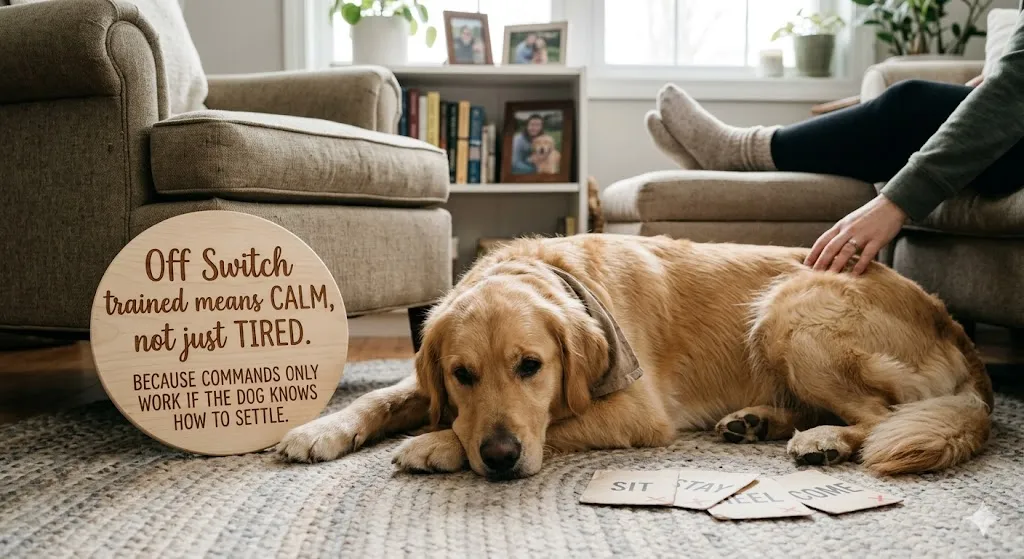

Most people focus on teaching dogs how to do things. Sit, stay, come, heel. These are important, no doubt. But there is another side that often gets ignored. Dogs also need to learn how to stop doing things. More importantly, they need to learn how to settle.
We call this the “off switch.” It is the ability for a dog to relax, pause, and exist calmly without constant direction. Without it, even well-trained dogs can feel overwhelming.
What Is an “Off Switch” in Dogs
An off switch is not a command. It is a learned behavior. It means a dog can shift from activity to calmness without stress or confusion.
We see many dogs that know multiple commands but still struggle to relax. They pace, jump, bark, or look for constant engagement. This is not because they are disobedient. It is because they were never taught how to settle.
Teaching this skill changes everything. It creates balance between energy and calm behavior.
Why High Energy Dogs Struggle to Settle
Some dogs naturally have higher energy. They are always ready to move, play, or react. Without guidance, that energy has no direction.
We have noticed that these dogs often get more activity but less structure. Owners try to tire them out, thinking it will solve the issue. Sometimes it helps, but not always.
Energy without boundaries leads to restlessness. Structure teaches dogs when to be active and when to relax.
This is one reason people begin exploring a best board and train kennel. Structured environments help dogs experience both movement and stillness in a balanced way.
The Difference Between Tired and Calm
A tired dog is not always a calm dog. Physical activity can reduce energy, but it does not teach behavior.
We have seen dogs that run all day and still struggle to settle. That is because calmness is a learned skill, not just a result of exercise.
We focus on teaching dogs how to relax while they still have energy. This builds control instead of dependence on exhaustion.
Teaching Calm Through Structure
Calm behavior does not happen by accident. It is built through clear routines and expectations.
We start by setting simple boundaries. For example, a dog may need to stay in one spot for a short period. At first, this can be challenging. But with consistency, the dog begins to understand.
Over time, these moments grow longer. The dog learns that calm behavior leads to predictable outcomes.
Many owners looking for the best board and train near me are often dealing with dogs that lack this structure. A consistent routine can help build that missing piece.
Recognizing Overstimulation
Dogs can become overstimulated just like humans. Too much noise, movement, or interaction can make it hard for them to settle.
Signs of overstimulation include pacing, excessive barking, or sudden bursts of energy. These are not random. They are signals that the dog cannot regulate its behavior.
We pay attention to these signs. Instead of adding more activity, we guide the dog toward calm behavior. This helps them learn how to reset.
The Role of Environment in Calm Behavior
Environment plays a big role in how dogs behave. A busy, unpredictable space can make it harder for a dog to relax.
We focus on creating calm zones. These are areas where the dog can settle without distractions. It does not have to be complicated. A quiet corner or a designated spot works well.
For dogs with more complex challenges, people often explore behavioral dog training near me to better understand how environment affects behavior.
Why Constant Attention Can Backfire
It may seem kind to give dogs attention all the time. However, constant interaction can create dependency.
Dogs may start to expect engagement at every moment. When it is not given, they look for ways to get it. This often leads to unwanted behavior.
We balance attention with independence. Dogs learn that it is okay to be calm without constant input. This builds confidence and reduces attention-seeking behavior.
Social Learning and Calmness
Dogs learn from each other. In group settings, calm dogs can influence more active ones.
However, this only works in structured environments. Without guidance, group settings can increase excitement instead of reducing it.
That is why many structured programs, including a well-managed Doggie daycare near me, focus on balanced interaction. Dogs learn when to engage and when to step back.
Small Steps That Build Big Changes
Teaching an off switch does not require big changes. It starts with small, consistent steps.
We might begin with short calm periods. Then we gradually increase the duration. We reward calm behavior at the right moment.
Over time, the dog begins to choose calmness on its own. That is when real progress happens.
Common Mistakes to Avoid
We often see a few patterns that slow down progress.
One is relying only on exercise. While important, it does not replace training. Another is giving in when a dog demands attention. This reinforces the behavior we are trying to reduce.
Inconsistency is another challenge. If rules change often, dogs struggle to understand expectations.
Avoiding these mistakes makes training more effective.
Building Balance in Daily Life
Dogs need both activity and rest. Too much of either can create imbalance.
We aim for a steady rhythm. Active moments followed by calm periods. Clear transitions between the two.
This helps dogs understand what is expected at different times. It reduces confusion and improves overall behavior.
Final Thoughts
Commands are useful, but they are only part of the picture. Dogs also need to learn how to pause, settle, and relax.
We focus on building that off switch through structure, consistency, and clear communication. It is not about doing more. It is about guiding behavior in a balanced way.
When dogs learn how to be calm, everything else becomes easier. Their responses improve, their focus increases, and daily life feels more manageable.




























Sign in to leave a comment.