
A finance team updates an invoice in one system, operations sees a different status in another, and customer-facing teams discover the mismatch only after a transaction has already moved downstream. For CTOs, product heads, and operations leaders, this is rarely a single API problem. It is usually an architecture problem.
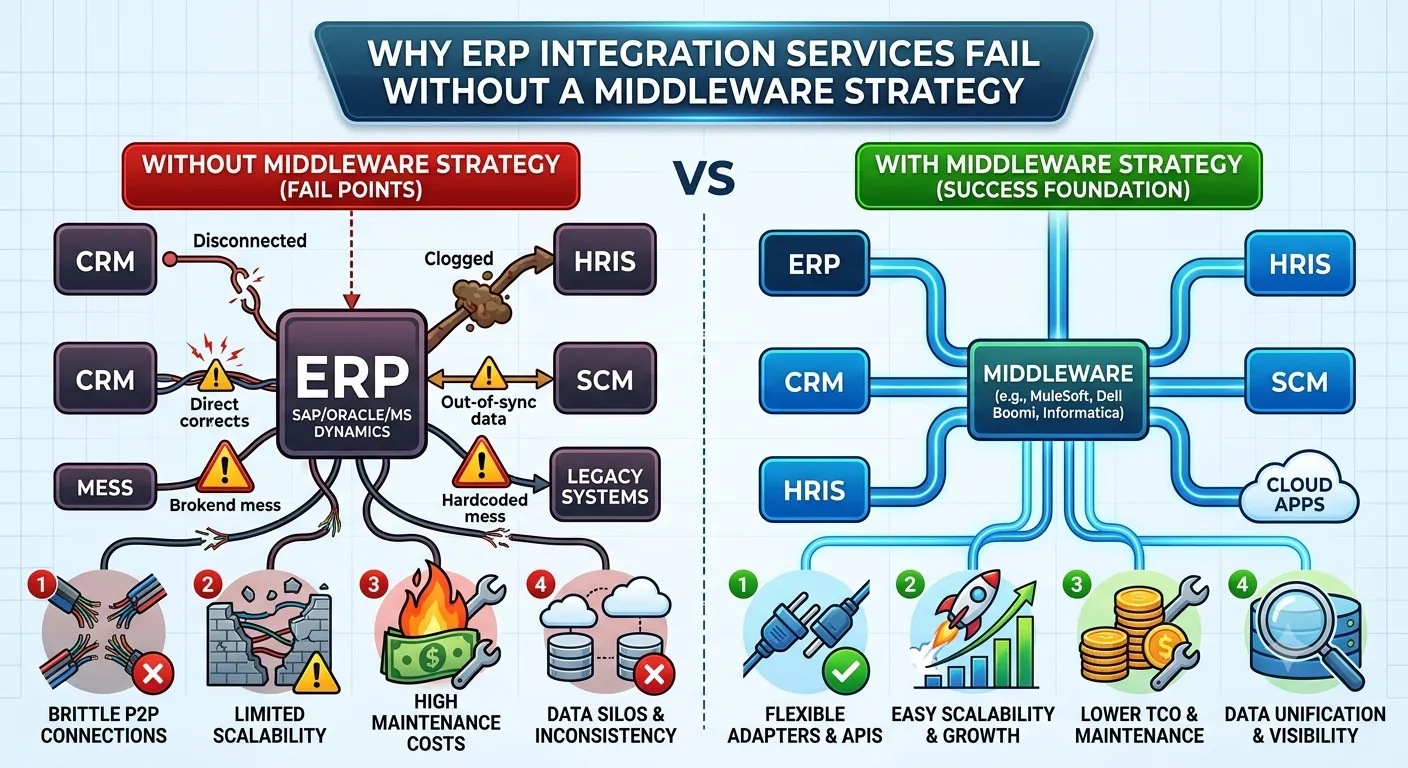
This is where ERP Integration Services become strategic. The objective is not simply to connect an ERP to another application. It is to create a controlled flow of data between ERP, CRM, e-commerce, WMS, payment, logistics, and legacy systems without allowing every connection to become a new maintenance burden.
A middleware layer provides that control point. It can handle transformation, validation, authentication, routing, retries, logging, and business rules independently of the connected applications. For organizations evaluating how ERP Integration Services work in enterprise systems, this distinction matters because direct point-to-point integrations can become difficult to govern as systems multiply.
The issue is becoming more important as ERP environments become more distributed. Gartner reports that more than 70% of recently implemented ERP initiatives are expected to fail to fully meet their original business-case goals by 2027, with up to 25% potentially failing catastrophically.
Why ERP Integration Problems Keep Happening
ERP integration problems persist because organizations often connect applications before defining how enterprise data should move between them.
A typical architecture starts with one ERP and a few surrounding applications. Over time, additional CRMs, marketplaces, warehouses, payment systems, analytics platforms, and regional applications are introduced. Each new connection adds another dependency.
Forrester has previously identified ERP integration as a major obstacle to extracting value from packaged ERP systems, noting that ERP applications are often better at collecting information than distributing it where it is required.
The pattern decision-makers often miss is that integration complexity grows faster than application count. Five systems do not necessarily mean five connections. If each system communicates directly with several others, the number of interfaces, authentication mechanisms, data mappings, and failure scenarios can grow rapidly.
The answer is not always to replace the ERP. In many cases, the better architectural question is whether a dedicated integration layer should sit between business systems.
A Middleware Framework for ERP Integration Services
A middleware strategy should be designed around four responsibilities: data movement, data meaning, operational control, and future change.
1. Start with Data Contracts, Not APIs
The first step is to define what each business object means before building the integration.
For example, an ERP may represent a customer with one identifier while a CRM uses another. Product status, invoice state, tax information, warehouse quantities, and payment status can also use different structures.
An effective middleware design establishes canonical data models and mapping rules. Instead of forcing every application to understand every other application's structure, middleware becomes the translation layer.
This approach also creates a cleaner boundary for future integrations. Adding a new application becomes a mapping exercise rather than a redesign of the entire ERP ecosystem.
2. Separate Transformation From Business Systems
Middleware should own integration-specific transformation logic instead of pushing that logic into every connected application.
Gartner's 2025 research on integration maturity emphasizes the need for organizations to treat integration as a strategic capability because integration spans diverse technical and organizational requirements.
This becomes particularly important in multi-instance environments. Forrester's 2026 research reports that only 7% of enterprise ERP decision-makers operate a single ERP instance. The majority therefore face regional, acquired, or otherwise distributed ERP environments where data definitions can differ.
Unlike direct integrations, middleware can apply consistent validation and transformation rules across these environments.
3. Design for Failure, Not Only Successful Transactions
A production integration must assume that APIs will timeout, credentials will expire, payloads will be rejected, and downstream systems will become temporarily unavailable.
A practical middleware architecture should therefore include:
- Authentication and authorization controls.
- Schema validation before data enters the ERP.
- Transformation and mapping services.
- Retry policies for transient failures.
- Dead-letter handling for failed transactions.
- Idempotency controls to prevent duplicate processing.
- Centralized logs and transaction tracing.
- Monitoring and alerting for operational teams.
The trade-off is architectural complexity versus operational control. A small business with two stable applications may not need a sophisticated middleware platform. A multi-system enterprise usually benefits when integration logic becomes independently observable and maintainable.
4. Choose the Integration Pattern Based on Business Events
Not every ERP transaction needs real-time processing.
Real-time APIs are appropriate for use cases such as order confirmation, inventory availability, payment status, and customer-facing workflows. Batch processing can be more appropriate for historical synchronization, large data migrations, or scheduled financial reporting.
Event-driven patterns become useful when multiple systems need to react to the same business event. Gartner's research on ERP event-driven integration highlights patterns addressing event loss, duplicate processing, and database-event consistency.
The right architecture therefore depends on business criticality, latency requirements, transaction volume, and failure tolerance rather than technology preference alone.
What We Learned from a Real Implementation
In one of our ERP Integration Services projects, Alumicraft Race Inc needed to migrate financial and transactional data from QuickBooks Online into ERPNext. The challenge was not simply moving records. The integration had to maintain data accuracy and consistency while creating an architecture that could support future expansion.
Oodles designed a dedicated middleware layer between the two platforms and implemented an ETL pipeline covering extraction, transformation, and loading. The solution also included field-level data mapping and validation, secure authentication, parallel development and testing, and a scalable integration framework.
The measurable scope was two core business platforms connected through one dedicated middleware layer, with the workflow covering financial and transactional data. The documented outcome was a controlled migration architecture designed for accuracy, consistency, and future integrations rather than a one-off data transfer.
This illustrates an important principle: middleware is most valuable when it becomes an architectural boundary, not merely a connector.
You can explore more of Oodles to see how ERP, API, and enterprise integration work fit into broader digital systems.
Key Takeaways
- ERP Integration Services should address data ownership and integration architecture, not just API connectivity.
- Middleware can centralize transformation, validation, authentication, routing, and monitoring.
- Canonical data models reduce dependency between individual applications.
- Real-time, batch, and event-driven integration patterns should be selected according to business requirements.
- Failure handling and observability should be designed before production deployment.
- Multi-instance ERP environments require stronger governance because regional and legacy systems can introduce conflicting data structures.
If your ERP ecosystem has become difficult to maintain, discuss your integration architecture with the team at Oodles through our ERP Integration Services.
FAQ
Q: What are ERP Integration Services?
A: ERP Integration Services connect an ERP platform with applications such as CRM, e-commerce, WMS, payment, logistics, and legacy systems. They can include APIs, middleware, data mapping, synchronization, automation, monitoring, and migration to maintain controlled information flow across enterprise applications.
Q: Why use middleware for ERP integration?
A: Middleware provides an independent layer for authentication, transformation, validation, routing, retries, logging, and monitoring. It reduces the need for every application to understand every other application's data structure and makes future integrations easier to govern.
Q: Is middleware necessary for every ERP integration?
A: No. A small environment with two stable applications may be adequately served by a direct API connection. Middleware becomes more valuable as system count, transaction complexity, data transformation, failure scenarios, and governance requirements increase.
Q: What ERP integration pattern should enterprises use?
A: Enterprises should select the pattern based on latency, transaction volume, business criticality, and failure tolerance. APIs suit immediate transactions, batch processing suits scheduled or high-volume transfers, and event-driven integration suits workflows where multiple systems must respond to business events.
Q: How do ERP Integration Services improve data consistency?
A: ERP Integration Services can establish shared data models, validation rules, mapping logic, and synchronization policies. This helps prevent conflicting customer, product, inventory, order, and financial records from propagating between connected applications.



















Sign in to leave a comment.