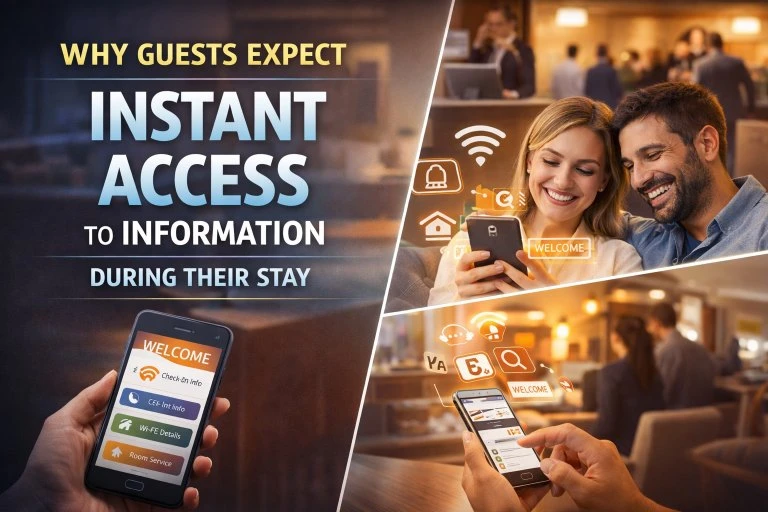

Not too long ago, hotel guests expected to stop by the front desk for almost everything. Directions, Wi-Fi details, breakfast times, service requests—it all required a quick chat with staff. Today, that expectation has changed dramatically.
Modern guests don’t just appreciate quick answers; they expect them. And increasingly, they expect those answers to be available instantly, without waiting, calling, or standing in line.
This shift isn’t about impatience. It’s about how people live, work, and interact with information every day. Understanding this change is key for hotels that want to deliver better guest experiences while keeping operations running smoothly.
The World Guests Live in Is Instant by Default
Outside the hotel environment, instant access to information is the norm.
People check their bank balance in seconds, track deliveries in real time, and find answers to almost any question with a few taps. Whether it’s ordering food, booking transport, or managing work tasks, speed and convenience are baked into everyday life.
When guests arrive at a hotel, they don’t suddenly switch expectations. If anything, travel heightens the need for clarity and quick answers. Guests are in an unfamiliar place, often tired, and eager to settle in without friction.
As the saying goes, time is money. Guests value both.
Waiting Feels Outdated, Not Luxurious
In the past, waiting at the front desk was seen as part of the hotel experience. Today, waiting feels unnecessary.
Guests don’t want to queue to ask:
- What time breakfast starts
- How to connect to Wi-Fi
- Where to park
- How to request extra towels
These are reasonable questions, but they shouldn’t require effort to answer.
When information isn’t immediately available, guests often feel friction before their stay has even begun. That small frustration can color their perception of the entire experience.
Instant Information Equals Confidence
Access to clear, timely information gives guests confidence.
When guests know:
- How things work
- What to expect
- Where to find help
they feel more relaxed and in control. They don’t worry about bothering staff or asking “obvious” questions. Instead, they move through their stay smoothly.
This sense of confidence is a subtle but powerful driver of guest satisfaction. It reduces anxiety, improves mood, and sets a positive tone from arrival to departure.
The Rise of Self-Service in Guest Experience
Self-service doesn’t mean self-sufficiency. It means choice.
Guests want the option to help themselves when it’s faster and easier—and to speak to staff when the situation calls for it. Hotels that offer both strike the right balance.
Digital guest information, mobile-friendly access, and clear communication channels allow guests to solve simple needs on their own. Meanwhile, front desk teams are free to focus on more meaningful interactions.
It’s not about replacing service. It’s about delivering it more intelligently.
Why Front Desks Can’t Be the Only Source of Information
Relying solely on the front desk creates bottlenecks.
During peak times—check-in, breakfast hours, late evenings—staff are pulled in multiple directions. Phones ring, lines form, and response times slow down.
Much of this pressure comes from guests needing basic information. When that information is available instantly elsewhere, front desk teams can breathe a little easier.
As the idiom goes, many hands make light work. In this case, technology shares the load.
Guests Don’t Want Another App
One important detail hotels are learning is that guests don’t want to download yet another app—especially for short stays.
App fatigue is real. Guests are far more likely to engage with tools that work instantly in a browser, without setup or installation. A simple link or QR code feels familiar and effortless.
When access is frictionless, adoption follows naturally. When it feels like work, guests opt out.
Instant Access Improves the Entire Guest Journey
Instant access to information supports guests at every stage of their stay:
- Before arrival: check-in details, parking instructions, arrival tips
- During the stay: amenities, service requests, local recommendations
- After checkout: follow-up information, feedback, and reminders
This continuity matters. Guests don’t think in silos—they experience their stay as one connected journey. Information that’s easy to find at every stage makes that journey feel seamless.
The Operational Side: Why Hotels Are Investing in Better Tools
From an operational perspective, instant information access isn’t just about guest satisfaction. It’s also about efficiency.
Hotels are increasingly investing in browser-based guest solutions and digital guest communication tools that centralize information and service requests in one place.
These platforms allow guests to get answers instantly while giving hotel teams visibility and control over communication. The result is fewer interruptions, faster response times, and a more organized workflow.
Speed Is Now Part of Hospitality Quality
Traditionally, hospitality quality was measured by friendliness, attentiveness, and personalization. Those still matter—but speed has joined the list.
Guests equate fast access to information with professionalism and care. When answers are easy to find, it signals that the hotel understands modern expectations.
On the flip side, slow or unclear communication feels like a step backward.
As the saying goes, you never get a second chance to make a first impression. In today’s hotels, information access is part of that first impression.
Technology Should Feel Invisible
The best guest experience technology doesn’t draw attention to itself. It simply works.
When guests can quickly find what they need without instructions or explanations, technology fades into the background. What remains is a smooth, comfortable stay.
That’s the goal: not more screens, not more complexity, but fewer obstacles.
Instant Information Supports Human Service
Importantly, instant access doesn’t replace human interaction—it supports it.
When guests handle simple needs themselves, staff have more time and energy for moments that truly matter: resolving issues, offering recommendations, and creating personal connections.
This balance strengthens both guest experience and team morale. Staff feel less overwhelmed, and guests feel better cared for.
Meeting Expectations Is the New Baseline
Instant access to information is no longer a “nice to have.” For many guests, it’s the baseline expectation.
Hotels that meet this expectation feel modern and guest-focused. Those that don’t risk appearing outdated, even if their service intentions are good.
In hospitality, perception matters. And today’s guests perceive speed, clarity, and ease as signs of quality.
Final Thoughts
Guests expect instant access to information because that’s how the world works now. Hotels that recognize this shift are better positioned to deliver smoother stays, reduce operational pressure, and create stronger guest satisfaction.
By making information easy to find and communication effortless, hotels don’t lose their personal touch—they protect it.
And in an industry built on experience, that makes all the difference.





























Sign in to leave a comment.