

When organizations face performance issues, integration challenges, or scalability limits, the instinctive reaction is often to replace existing systems. A new CMS, a new CRM, or a new platform promises a fresh start and fewer problems.
In reality, full system replacement is one of the riskiest and most expensive decisions an organization can make. More often than not, the problem is not the system itself—it’s the lack of flexibility, integration, or scalability around it.
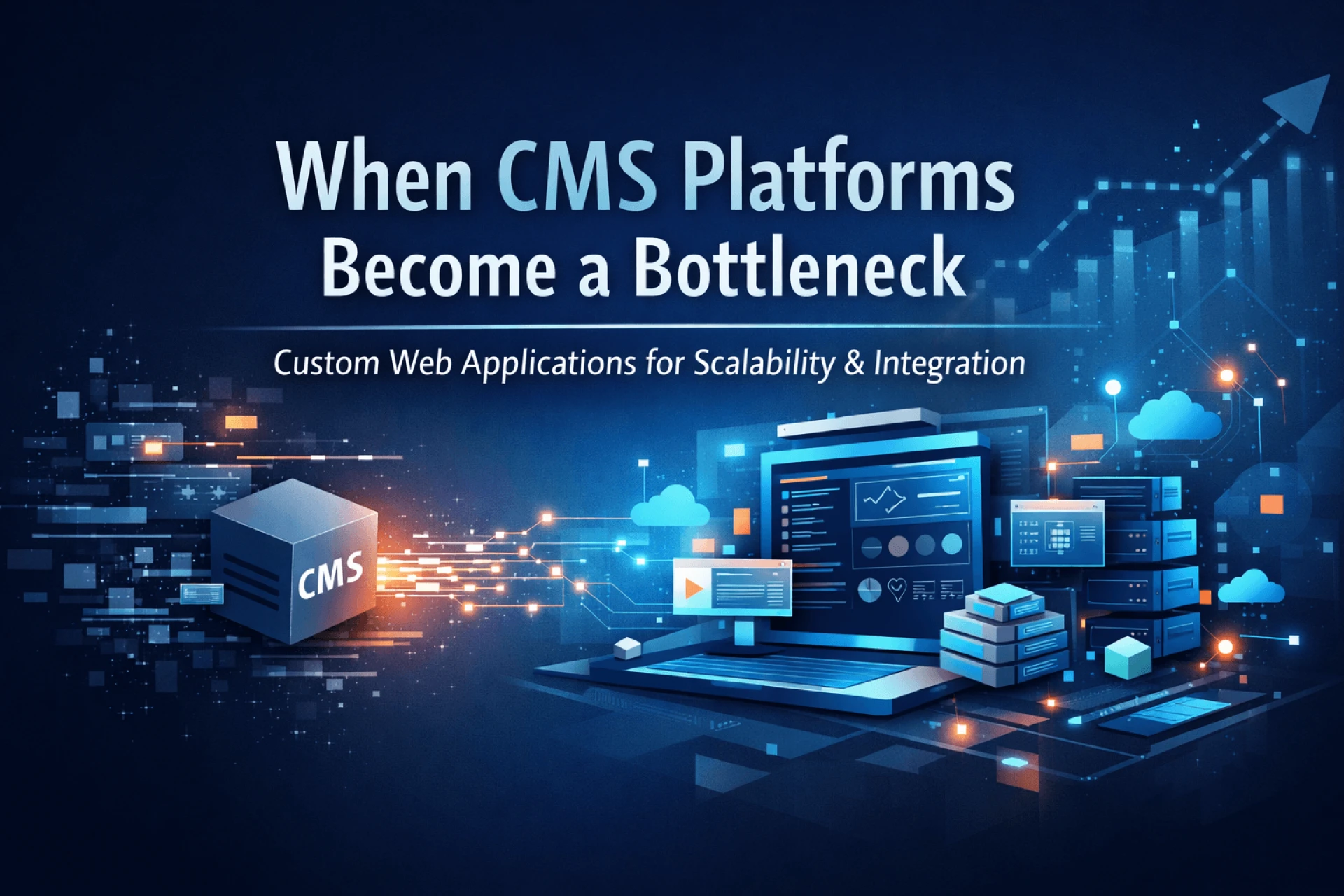
This is why extending existing systems through custom web applications and integrations has become the smarter, more sustainable approach.
The Cost of Replacing Core Systems
Replacing a core digital system is rarely as simple as vendors make it sound. Beyond licensing costs, organizations must consider:
- Data migration risks
- Downtime during transition
- Loss of institutional knowledge
- Retraining teams
- Rebuilding integrations
- Unexpected compatibility issues
Even with careful planning, replacements frequently introduce new limitations while failing to solve the original problems. What starts as a modernization effort can quickly become a long-term disruption.
Also read: How Custom Software Solutions Support Complex Marketing Ecosystems?
Why Most Systems Fail to Keep Up
Many systems fail not because they are poorly built, but because they were never designed to handle growing complexity. Over time, organizations add:
- New integrations and third-party services
- Larger volumes of data and content
- More users and access levels
- Regional or global operations
- Advanced workflows and automation
Legacy systems and traditional CMS platforms struggle under these demands. However, replacing them entirely often discards valuable functionality that still works well.
The Advantage of Extending Existing Systems
Extending an existing system means building custom software layers around it rather than removing it altogether. This approach allows organizations to preserve what works while addressing what doesn’t.
Common extension strategies include:
- Custom web applications that sit alongside a CMS
- API-based integrations connecting multiple platforms
- Middleware that handles complex business logic
- Custom dashboards or management tools
Instead of forcing change everywhere at once, organizations evolve incrementally and safely.
How Custom Web Applications Enable Extension
Custom web applications are purpose-built to fill gaps that off-the-shelf platforms cannot. They handle logic, integrations, and workflows that CMS or packaged systems were never designed to manage.
Unlike plugins or add-ons, custom applications:
- Are built specifically for the organization’s requirements
- Scale independently of CMS limitations
- Provide full control over architecture and data
- Integrate deeply with existing systems
This makes them ideal for extending platforms without disrupting daily operations.
Integration Without Compromise
One of the most common pain points in digital platforms is integration. CRMs, loyalty systems, analytics tools, partner platforms, and marketing systems all need to exchange data reliably.
Replacing a system often breaks existing integrations, requiring costly rebuilds. Extending systems through APIs avoids this problem.
Custom integrations allow organizations to:
- Maintain existing data sources
- Control how and when data is exchanged
- Add new systems without disruption
- Improve performance and reliability
Integration becomes a strength rather than a liability.
Reduced Risk Through Incremental Change
Large-scale replacements carry significant operational risk. Any failure can affect revenue, customer experience, or internal operations.
Extending systems reduces this risk by allowing:
- Gradual rollout of new functionality
- Testing without full platform dependency
- Continuous improvement rather than abrupt change
- Easier rollback if issues arise
Incremental change provides stability while still enabling innovation.
Better Performance at Scale
Performance issues are often the tipping point that pushes organizations toward replacement. However, performance bottlenecks are frequently caused by overloaded CMS platforms handling tasks they were never designed for.
Custom web applications offload complex processing, integrations, and workflows from the CMS. This results in:
- Faster page loads
- Improved reliability during peak usage
- Better handling of high-volume data
- Predictable scalability
Instead of pushing a CMS beyond its limits, the workload is distributed intelligently.
Long-Term Cost Efficiency
While extending systems requires investment, it often proves more cost-effective than replacement over time.
Organizations avoid:
- Ongoing licensing increases
- Repeated migrations every few years
- Continuous retraining
- Rebuilding integrations from scratch
Custom extensions evolve with the organization, reducing the need for frequent platform changes and minimizing long-term technical debt.
Supporting Complex Business Needs
Organizations with complex digital requirements—such as global campaigns, advanced content workflows, or enterprise integrations—rarely fit into standardized software models.
Extending systems with custom solutions allows businesses to:
- Support unique workflows
- Handle specialized data structures
- Meet compliance or operational constraints
- Adapt quickly to changing needs
Instead of adapting the business to the software, the software adapts to the business.
Why Long-Term Collaboration Matters
Extending systems is not a one-time effort. As needs change, extensions must evolve. This is where long-term collaboration becomes critical.
Working with the same development team over time ensures:
- Deep understanding of the system
- Faster enhancements and fixes
- Consistent architectural decisions
- Reduced onboarding costs
Rather than repeatedly starting over, organizations build momentum and stability.
When Extension Is the Right Strategy
Extending existing systems is the right choice when:
- Core systems still function well
- Replacements introduce unnecessary risk
- Integrations are business-critical
- Scalability and flexibility are required
- Long-term stability matters
In these cases, extension delivers better outcomes than replacement.
Conclusion
Replacing digital systems is often seen as a solution to growing complexity, but it frequently creates more problems than it solves. In many cases, the smarter path forward is to extend existing systems with custom web applications and integrations.
By preserving what works and enhancing what doesn’t, organizations gain flexibility, performance, and control—without the disruption of full replacement.
For organizations navigating complex digital environments, extending existing systems is not a compromise. It is a strategic approach to sustainable growth.


























Sign in to leave a comment.