
Introduction: Why Most DeFi Projects Fail Without a Niche Strategy
The DeFi niche selection framework, which outlines how to choose a DeFi niche, is one of the most critical yet underestimated decision-making systems in Web3. Most founders and investors enter DeFi based on hype cycles instead of structured analysis. This leads to overcrowded products, weak token utility, and unsustainable liquidity incentives.
In reality, DeFi is no longer an early-stage experimental space. It has matured into a fragmented financial ecosystem with distinct sectors, competing liquidity pools, and rapidly shifting capital flows. Without a structured approach, it becomes extremely difficult to identify where value actually accumulates.
This article presents a practical, data-driven framework for evaluating niches based on market signals, competition depth, and real demand indicators. It also connects strategy with execution, so you can understand not just what to build or invest in, but why it works. This foundation will help you evaluate the best DeFi sectors to invest in and avoid low-quality opportunities.
Let’s first understand the ecosystem structure before building the framework.
Understanding the DeFi Ecosystem Landscape
The DeFi ecosystem has evolved into a multi-layered financial stack where liquidity, users, and protocols interact across different verticals. A strong DeFi ecosystem breakdown in 2026 shows that capital is no longer concentrated in a single category but distributed across lending, trading, staking, and modular infrastructure layers.
This fragmentation makes niche selection essential because each category behaves like an independent market with its own risk profile, revenue model, and adoption cycle. Builders who fail to understand this structure often misallocate resources or enter saturated segments. Investors also struggle to identify profitable DeFi niches without mapping ecosystem dynamics clearly.
A structured view of DeFi helps identify where growth is accelerating versus where it is stagnating. This sets the foundation for selecting the right sector using a disciplined DeFi market analysis framework. Next, we will break down core and emerging segments shaping this ecosystem.
Core DeFi Categories Explained
Core DeFi segments represent the foundation of decentralized finance. These are the most mature and liquid markets where most capital currently resides. They include lending protocols, decentralized exchanges (DEXs), stablecoins, and derivatives platforms.
Each category solves a specific financial problem. Lending protocols like Aave enable capital efficiency through collateralized borrowing. DEXs such as Uniswap facilitate permissionless trading. Stablecoins provide stability in volatile markets, while derivatives unlock hedging and leverage.
These categories are highly competitive but also structurally stable. Understanding them is essential for evaluating the best DeFi sectors to invest in because they define baseline liquidity flows. However, saturation in these markets means new entrants must differentiate heavily or risk low adoption.
Now that core segments are clear, emerging trends reveal where future opportunities may exist.
Emerging DeFi Segments (2026 Trends)
Emerging DeFi segments are reshaping how capital flows across blockchain ecosystems. These include restaking protocols, intent-based trading systems, AI-integrated DeFi applications, and modular liquidity infrastructure.
Restaking has introduced new yield layers by allowing staked assets to secure multiple networks. AI x DeFi is enabling automated strategy execution and predictive liquidity allocation. Modular DeFi is separating execution, settlement, and data layers for higher scalability.
These innovations represent profitable DeFi niches that are still in early adoption phases. Unlike mature sectors, competition is lower, but technical complexity is higher. This makes niche selection even more critical for builders.
Understanding both core and emerging layers completes the ecosystem view. Next, we analyze why selecting the right niche directly impacts long-term success.
Why Niche Selection Matters in DeFi Success
Niche selection in DeFi is not just a strategic preference; it directly determines survival probability. Capital efficiency, user acquisition cost, and token sustainability vary significantly across sectors. Without a structured approach, even well-funded projects fail due to misaligned market positioning.
A proper DeFi market analysis framework helps identify where demand is organic versus artificially incentivized. It also reveals whether liquidity is sticky or mercenary. Many DeFi protocols collapse after incentive programs end because they never validated true user demand.
Selecting the right niche ensures alignment between product design and market behavior. It also reduces competition pressure and improves tokenomics sustainability. This is why experienced investors and founders always evaluate the best DeFi sectors to invest in before building.
Let’s break down the three key forces that make niche selection essential in DeFi strategy.
Capital Efficiency
Capital efficiency determines how effectively liquidity is used within a protocol. In lending markets, capital can be reused multiple times, while in yield farming, it often circulates without long-term retention.
Efficient niches attract institutional participation because returns are sustainable without constant incentives. For example, Aave’s overcollateralized lending model ensures predictable capital utilization.
Higher capital efficiency directly improves protocol revenue and stability. This makes it a critical factor when analyzing profitable DeFi niches. Next, we examine how competition impacts niche viability.
Market Saturation Risk
Market saturation occurs when too many protocols compete for the same liquidity and users. In such environments, differentiation becomes difficult, and user acquisition costs increase significantly.
For instance, basic AMM-based DEX models are heavily saturated, making it harder for new entrants to gain traction. This is why niche selection must include competitive density analysis.
Avoiding saturated markets is essential for long-term survival. Now we move to liquidity distribution and its impact on ecosystem dominance.
Liquidity Distribution
Liquidity distribution determines where capital naturally concentrates across ecosystems. Ethereum still dominates, but L2 networks and alternative chains are redistributing liquidity.
Protocols that align with liquidity-heavy ecosystems gain faster adoption. Understanding this distribution is a key part of the DeFi ecosystem breakdown 2026 analysis.
With these three factors defined, we can now build a structured selection framework.
DeFi Niche Selection Framework (Core System)
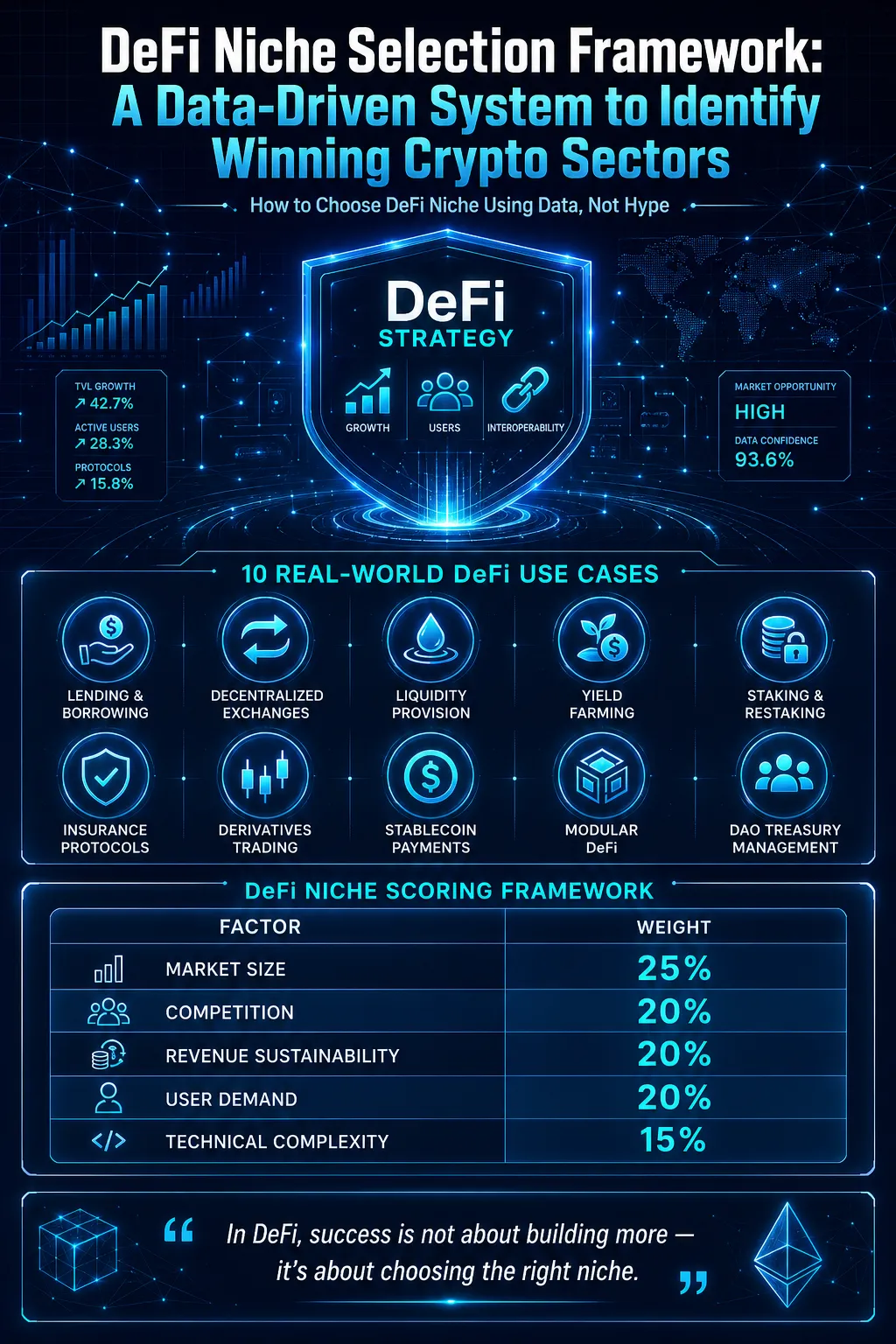
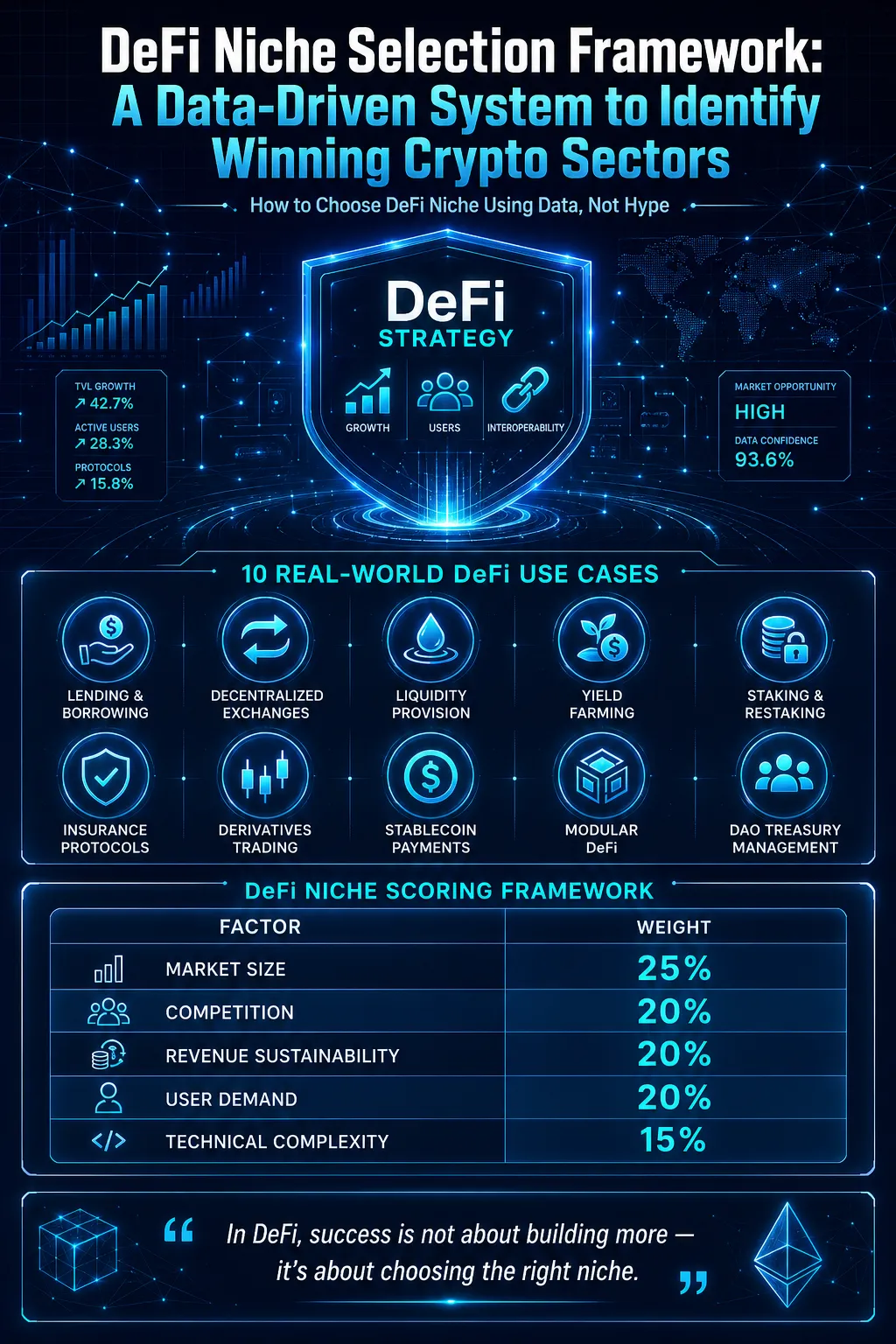
The DeFi niche selection framework, how to choose a DeFi niche, requires a structured, multi-variable evaluation system. Instead of relying on intuition, this framework uses measurable indicators such as market size, competition intensity, revenue potential, user demand, and technical complexity.
This system helps founders and investors filter profitable DeFi niches using objective scoring. It also reduces bias caused by hype cycles. Large institutions like Coinbase and Binance apply similar structured evaluation models when listing or investing in protocols, focusing on liquidity depth and sustainability metrics.
By using this framework, you can systematically identify the best DeFi sectors to invest in and avoid weak-market entry points. Below is the step-by-step breakdown of the model.
Step 1: Market Size (TVL & Growth)
Total Value Locked (TVL) and growth rate indicate how much capital a niche attracts. High TVL sectors show strong adoption and liquidity depth.
However, growth rate matters more than absolute TVL because emerging sectors often outperform mature ones in ROI potential.
Step 2: Competition Intensity
Competition intensity measures how crowded a niche is. High competition reduces margins and increases acquisition costs.
Low-to-medium competition niches often provide better entry opportunities for new protocols.
Step 3: Revenue Sustainability
Revenue sustainability evaluates whether protocols generate real income or rely on incentives. Sustainable fees indicate long-term viability.
Step 4: User Demand Validation
User demand validation checks whether usage is organic. Active wallets, transaction frequency, and retention rates are key indicators.
Step 5: Technical Complexity Score
Higher complexity reduces competition but increases execution difficulty. Restaking and modular DeFi fall into this category.
This structured system leads directly to quantifying niche attractiveness using scoring models.
DeFi Niche Scoring Matrix (Practical Model)
A scoring matrix converts qualitative analysis into measurable decision-making. Each niche is evaluated across five dimensions: market size, competition, revenue, demand, and complexity.
| Factor | Weight | Description |
| Market Size | 25% | TVL & growth rate |
| Competition | 20% | Number of active protocols |
| Revenue Sustainability | 20% | Fee generation strength |
| User Demand | 20% | Active usage metrics |
| Technical Complexity | 15% | Barrier to entry |
Example Calculation
- Lending Protocols: 82/100 (Stable but competitive)
- Restaking Protocols: 91/100 (High growth, moderate competition)
- DEXs: 70/100 (Highly saturated)
This matrix helps identify profitable DeFi niches with clarity and reduces emotional decision-making. Next, we explore high-opportunity sectors for 2026.
High-Opportunity DeFi Niches in 2026
DeFi in 2026 is shifting toward infrastructure-heavy and intent-driven systems. These emerging areas represent the next wave of innovation and are central to any modern DeFi investment strategy guide.
Restaking Protocols
Restaking enables assets to secure multiple networks simultaneously. This increases yield opportunities and capital efficiency.
AI x DeFi Applications
AI is being used for automated trading, risk scoring, and liquidity optimization.
Modular DeFi Infrastructure
Execution, settlement, and data layers are being separated for scalability.
Liquid Staking Derivatives
These allow staked assets to remain liquid while earning rewards.
Intent-Based Trading Systems
Users express intent instead of executing trades manually, improving UX and efficiency.
These categories represent the most promising DeFi sectors to invest in for long-term growth. Next, we examine proven success stories.
Real-World Case Studies
Case studies help validate theoretical frameworks with real outcomes. They show how niche selection determines dominance.
Why Aave Dominated Lending
Aave focused on overcollateralized lending with strong risk controls, ensuring institutional trust and liquidity retention.
Uniswap’s Liquidity Advantage
Uniswap created a simple AMM model that solved liquidity fragmentation, leading to massive adoption.
Curve’s Stablecoin Moat
Curve specialized in stable swaps, creating deep liquidity efficiency for stable assets.
These examples prove that focused niche positioning creates long-term dominance. Now we explore common mistakes.
Common Mistakes in DeFi Niche Selection
Many projects fail not because of poor execution, but due to poor niche selection.
- Entering overcrowded markets without differentiation
- Ignoring tokenomics sustainability
- Chasing short-term hype cycles instead of real demand
Avoiding these mistakes helps to improve survival probability significantly. Next, we explore analytical tools.
Tools to Analyze DeFi Niches
Effective niche selection requires reliable data sources:
- DeFiLlama – TVL and ecosystem tracking
- Token Terminal – Revenue analytics
- Dune Analytics – Custom on-chain dashboards
- Messari – Research and market insights
These tools support structured DeFi market analysis framework development and data-driven decision-making.
Step-by-Step Action Plan for Builders & Investors
- Identify the ecosystem segment
- Analyze TVL and growth trends
- Evaluate competition intensity
- Validate user demand
- Score using the matrix model
- Select the niche with the highest weighted score
- Monitor liquidity and adjust strategy
This ensures systematic entry into profitable DeFi niches.
DeFi Niche Selection Checklist (Downloadable Framework)
- Is TVL growing consistently?
- Is competition manageable?
- Is revenue sustainable?
- Is user demand organic?
- Is the technical barrier optimal?
This checklist simplifies the execution of the DeFi niche selection framework, how to choose a DeFi niche in real-world scenarios.
Conclusion: Building in the Right DeFi Lane
The DeFi niche selection framework, how to choose a DeFi niche, is not just a research concept but a practical decision system for builders and investors. In a fragmented and rapidly evolving ecosystem, success depends on selecting the right sector before execution begins.
DeFi rewards precision, not randomness. By combining market analysis, competition mapping, and demand validation, you can systematically identify the best DeFi sectors to invest in and avoid saturated or unsustainable opportunities.
As DeFi continues evolving toward modular, AI-driven, and intent-based systems, those who adopt structured frameworks will consistently outperform reactive participants.




























Sign in to leave a comment.