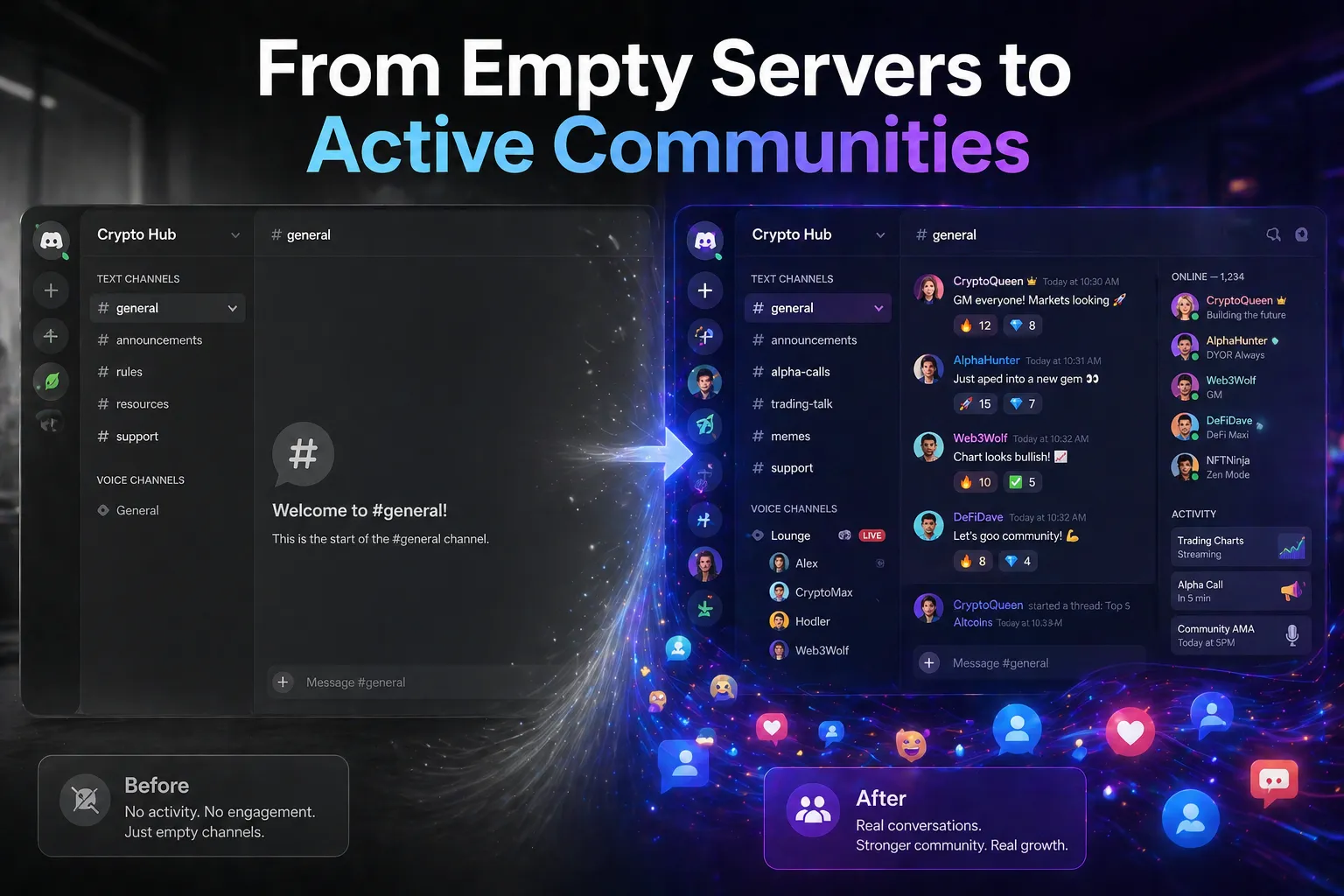

There is a specific kind of dread that comes with launching a Discord server for a Web3 project and staring at zero members, zero messages, and zero momentum. Every founder who has been through it knows the feeling. You have built something you believe in, the server is set up, the channels are named, and then nothing happens.
The jump from empty server to active community is the hardest part of Discord marketing. Not because it requires enormous resources, but because it requires doing the right things in the right order before the network effects kick in and the community starts sustaining itself. Most projects fail at this stage not because their project is weak, but because they skip foundational steps or lose patience before the compound growth begins.
This guide covers the entire journey from day one setup to the point where your community is genuinely alive and growing on its own.
What is Discord Marketing?
Discord marketing is the use of Discord servers as a primary channel to build, engage, and grow a community around a brand, project, or product. In Web3, it refers specifically to the strategies used to attract crypto-native audiences, retain members through structured engagement systems, and convert community participation into meaningful project outcomes like token adoption, product usage, or ecosystem growth.
Stage 1: Build the Foundation Before You Invite Anyone
The single biggest mistake new servers make is inviting people before the server is ready to make a good first impression. A half-built server with empty channels, no pinned context, and no visible activity will lose visitors in under a minute. Build before you promote.
Design a Clean, Purposeful Channel Structure
Keep it simple at the start. New members should immediately understand where to go and what each space is for. A solid early structure includes a welcome and rules channel, a project announcements channel, a general chat, a project discussion space, and a support channel. Resist the temptation to create twenty channels before you have twenty active members. Busy channels feel alive. Empty channels feel abandoned.
Set Up Your Bot Infrastructure
Install MEE6 or Carl-bot for auto-moderation, welcome messages, and role assignment. Set up CollabLand or Guild.xyz if you want token-gated access for holders. Configure a verification gate to filter bots and low-effort joiners before they reach the main community. These systems take a few hours to configure and will save you significant headaches as the server grows.
Write a Clear Welcome Experience
Your welcome channel is the first thing new members read. It should explain what the project is in plain language, what members can expect from the community, the basic rules of engagement, and a clear next step like introducing yourself in the general chat or reading the project overview. A strong welcome converts curious visitors into active members.
Stage 2: Seed the Community With Real People
Before running any growth campaigns, you need a critical mass of real, engaged humans who set the culture. This is manual work and there is no shortcut for it.
Personally invite people from your network who fit the audience. Be direct and specific about why you think they would find the community valuable. Aim for 30 to 50 people who are genuinely interested before doing any broader promotion. When these founding members are active and conversations are happening, the server passes the social proof threshold that keeps new visitors from immediately leaving.
Stage 3: Create Recurring Reasons to Come Back
A community that has nothing consistent to rally around loses members slowly but steadily. Regular events are the most effective retention mechanism because they create calendar commitments and give members something specific to invite others to.
Weekly community calls, biweekly AMAs, monthly guest sessions, regular market discussion threads any consistent format works as long as it happens reliably. The cadence matters more than the production value. Members who block their calendars for a Tuesday call become your most loyal community contributors.
How Does Discord Help Web3 Projects Grow?
Discord helps Web3 projects grow by providing a structured, real-time community hub where token holders, contributors, and interested users can engage directly with the team and each other. Features like role-based access, token-gated channels, voice events, and bot integrations create an ecosystem that rewards participation, builds loyalty, and generates the social proof that attracts new members organically.
Stage 4: Build a Role System That Rewards Loyalty
Roles are the most underutilized retention tool on Discord. A well-designed role progression system gives members a reason to stay active and a sense of earned status that makes leaving feel like a loss.
Create tiers based on activity level, tenure, or contribution. Tie meaningful perks to each tier access to early announcements, private alpha channels, direct feedback sessions with the founding team, or exclusive NFT drops for top-tier members. When climbing a role ladder feels meaningful, members self-motivate to participate more.
Stage 5: Drive Inbound Growth From Outside Discord
Once your server is active and the culture is established, it is time to drive external traffic in. The most effective channels for Discord growth are:
- Twitter threads that end with a specific, compelling reason to join not just a link
- Quest platform campaigns on Zealy or Layer3 that route completions into your Discord
- Cross-server collabs with complementary Web3 projects
- KOL mentions that direct audiences to specific Discord events
- Long-form content on Medium or your project blog that links to the Discord at the end
Each of these channels brings different quality members. Blog-driven members arrive with the most context and tend to become the most engaged long-term contributors. Quest-driven members are often more transactional but can convert into genuine community members if the onboarding experience is strong.
Stage 6: Invest in Moderation as a Growth Strategy
Most founders think of moderation as a maintenance function. The best community builders treat it as a growth strategy. An active, helpful, human moderation team makes new members feel immediately welcomed. That first experience is a massive driver of whether someone becomes a long-term community member or a ghost who joined and never returned.
Find your two or three most engaged community members and invite them to become moderators. Give them access to exclusive information and compensate them in tokens or other project-relevant ways. The ROI on a well-supported mod team is one of the highest in all of community building.
Common Discord Marketing Mistakes to Avoid
- Running giveaways before the community culture is established attracts reward hunters not genuine members
- Creating too many channels too early fragments conversation and makes each space feel dead
- Going quiet between product milestones members disengage fast when the server feels like a ghost town
- Measuring success by member count alone engagement quality matters far more than raw numbers
Ignoring lurkers, a significant percentage of members are watching and never posting; design low-barrier participation activities to surface them
Conclusion
The journey from empty server to active community is not a straight line. There will be weeks where growth stalls and conversations slow down. The projects that push through those periods with consistent events, genuine member investment, and smart cross-platform promotion are the ones that eventually hit the inflection point where community growth becomes self-sustaining.
Build the foundation right, seed it with real people, create recurring reasons to show up, and drive inbound traffic from the right channels. That is the full picture of Discord marketing done well and it works every time it is executed with patience and consistency.


























Sign in to leave a comment.