
The digital asset sector is witnessing rapid interest in asset-backed blockchain platforms. Businesses across real estate, commodities, private equity, invoices, carbon credits, and collectibles are looking at RWA Tokenization as a practical way to digitize ownership and improve liquidity access. Financial institutions, startups, and investment groups are also entering this segment with new products and blockchain-based marketplaces.
Even though the opportunity looks attractive, many projects fail to gain traction because of poor planning, legal gaps, weak infrastructure choices, and unrealistic business expectations. Launching a platform without understanding operational risks can create compliance problems, investor distrust, and technical failures.
A successful rwa tokenization platform development process requires proper legal preparation, asset verification, investor protection measures, security testing, and long-term operational planning. Many companies focus only on blockchain coding while ignoring governance, regulations, and user participation models.
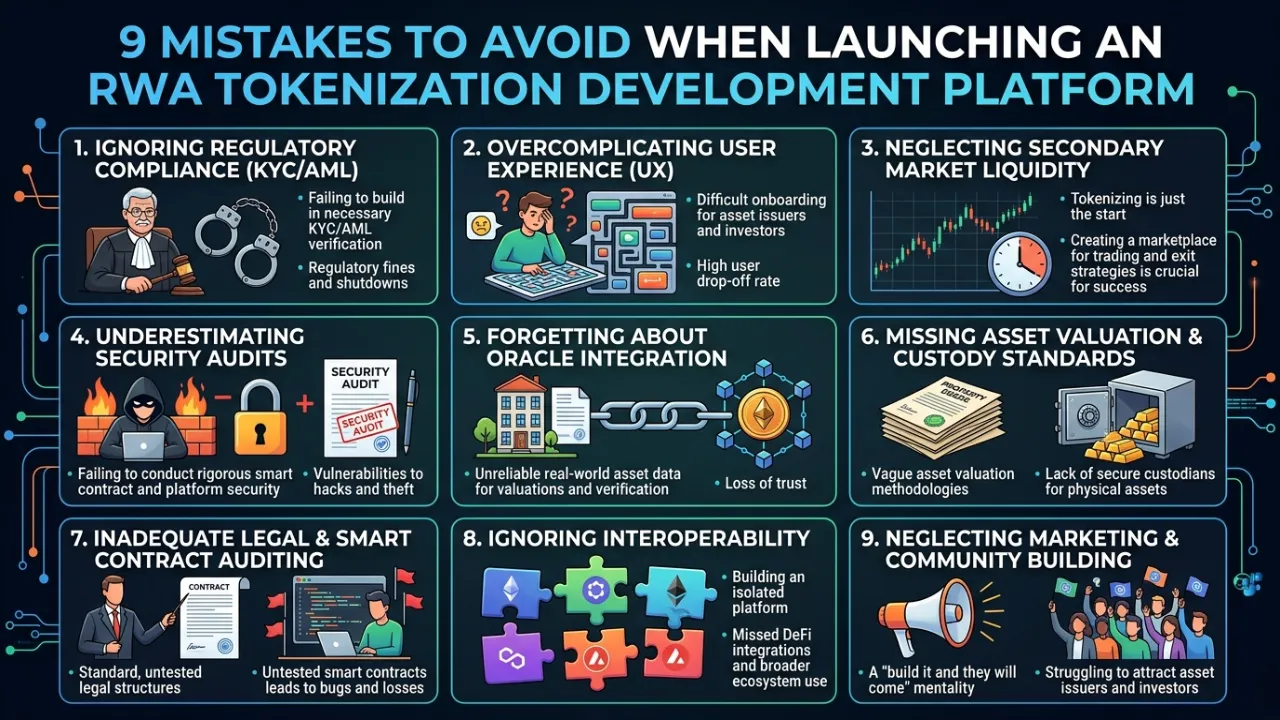
This article discusses nine common mistakes businesses make while launching a Real World Asset Tokenization platform and how those mistakes can affect growth, compliance, and market credibility.
1. Ignoring Regulatory Requirements
One of the biggest mistakes in RWA Tokenization development is entering the market without legal clarity. Real-world assets usually fall under securities, commodities, property laws, or financial regulations depending on the region and asset type. Businesses that ignore these legal structures may face operational restrictions or penalties later.
Many startups assume blockchain technology itself is decentralized enough to bypass regulations. That assumption often creates serious problems once institutional investors or regulators begin reviewing the platform.
Common regulatory mistakes include:
- Launching security tokens without licenses
- Skipping KYC and AML procedures
- Ignoring investor accreditation rules
- Using unclear ownership structures
- Operating across multiple countries without legal review
Before platform deployment, companies should work with legal advisors familiar with digital asset frameworks and financial compliance standards.
A professional RWA tokenization development company usually studies regional regulations before platform architecture begins. This reduces legal uncertainty during fundraising and trading operations.
2. Poor Asset Verification and Due Diligence
Real World Asset Tokenization depends heavily on asset credibility. Investors expect proof that the underlying asset genuinely exists, carries measurable value, and belongs to the issuer. If ownership documents are inaccurate or incomplete, investor confidence declines quickly.
Some businesses rush into token issuance without performing proper due diligence on the asset itself. This creates disputes regarding valuation, ownership rights, and revenue distribution.
Areas often overlooked include:
- Legal ownership validation
- Asset valuation reports
- Insurance documentation
- Debt obligations linked to assets
- Historical revenue records
For example, tokenizing a commercial property without verifying liens or pending legal disputes can expose investors to unexpected financial risks.
RWA tokenization development should include asset auditing frameworks and verification systems before token creation begins.
3. Selecting the Wrong Blockchain Infrastructure
Another major issue in RWA Tokenization projects is choosing blockchain networks based only on popularity rather than operational suitability. Different blockchains offer different transaction speeds, fee structures, governance models, and interoperability options.
Some platforms experience transaction congestion and high costs because they selected networks unsuitable for asset trading activity.
Important infrastructure considerations:
- Transaction cost stability
- Smart contract compatibility
- Institutional acceptance
- Interoperability support
- Security history
- Network decentralization level
A platform dealing with high-frequency asset trading may require faster transaction finality compared to a platform focused only on long-term ownership transfer.
The wrong infrastructure decision can affect user adoption, investor trust, and operational expenses for years.
4. Weak Smart Contract Auditing
Smart contracts handle ownership distribution, revenue sharing, compliance logic, and trading permissions in Real World Asset Tokenization platforms. A single vulnerability can create financial losses or unauthorized transfers.
Many businesses underestimate security auditing because they want faster launch timelines. This becomes dangerous when investor funds and asset ownership records depend entirely on contract logic.
Security mistakes commonly found:
- Untested contract functions
- Improper access permissions
- Weak wallet integrations
- Incomplete upgrade mechanisms
- Lack of emergency controls
Professional RWA token development processes should involve multiple security reviews, penetration testing, and external auditing firms before deployment.
A security failure can damage a platform permanently even if the technical issue itself gets resolved later.
5. Overcomplicating the User Experience
Blockchain platforms often become difficult for regular investors to understand. Complicated onboarding systems, confusing wallet integrations, and technical terminology discourage participation.
Many companies design platforms mainly for blockchain-native users while ignoring traditional investors entering digital assets for the first time.
User experience problems include:
- Complex registration steps
- Difficult wallet setup
- Confusing dashboard layouts
- Lack of transaction guidance
- Technical language overload
Real estate investors, commodity buyers, and institutional participants may not have prior blockchain knowledge. A complicated system reduces user retention and participation rates.
Good rwa tokenization platform development should prioritize accessibility and investor simplicity rather than excessive technical features.
6. Unrealistic Liquidity Expectations
Liquidity is one of the most advertised benefits of RWA Tokenization. However, many projects assume liquidity will appear immediately after token launch. In reality, liquidity depends on investor interest, trading volume, exchange support, and market confidence.
Tokenizing an asset alone does not automatically create active buyers and sellers.
Reasons liquidity problems occur:
- Limited investor awareness
- Weak marketing strategy
- Poor exchange integration
- Restricted trading access
- Low asset demand
Businesses sometimes spend heavily on development while ignoring secondary market planning. Without proper liquidity support, investors may hesitate to participate.
A reliable RWA Tokenization Company usually develops long-term trading strategies instead of relying only on initial token sales.
7. Lack of Asset Governance Structure
Governance plays a major role in Real World Asset Tokenization Services. Investors need clarity regarding voting rights, revenue distribution, asset management responsibilities, and dispute resolution processes.
Some projects fail because governance terms remain vague or inconsistent.
Governance areas requiring attention:
- Investor voting rights
- Asset management authority
- Profit distribution schedules
- Buyback policies
- Asset liquidation rules
For example, if token holders disagree about selling a tokenized property, the platform must already have governance rules explaining decision-making procedures.
Poor governance planning can create internal disputes that damage investor relationships and project credibility.
8. Ignoring Long-Term Operational Costs
A common misconception in RWA Tokenizaion development is assuming that expenses reduce significantly after launch. In reality, maintaining a tokenization ecosystem requires continuous operational spending.
Long-term operational expenses include:
- Legal compliance updates
- Security audits
- Blockchain transaction fees
- Cloud infrastructure
- Customer support
- Asset management services
- Insurance and reporting
Many startups spend most of their budget on platform launch campaigns and underestimate maintenance costs. This creates financial stress within the first year of operations.
Businesses should prepare sustainable revenue models before platform deployment. Transaction fees, subscription models, listing charges, and asset servicing fees are commonly used methods.
9. Choosing Inexperienced Development Partners
Selecting the wrong technical partner is another serious mistake in RWA tokenization development services. Some software firms claim blockchain expertise without actual experience in digital securities, asset compliance systems, or token governance architecture.
A generic blockchain application developer may not understand the legal and operational complexity associated with tokenized assets.
Problems caused by inexperienced vendors:
- Weak security architecture
- Poor compliance integration
- Incomplete smart contract logic
- Delayed deployment
- Unstable platform performance
Before selecting a development partner, businesses should evaluate:
- Previous tokenization projects
- Smart contract auditing practices
- Compliance integration experience
- Blockchain network expertise
- Support and maintenance capabilities
A qualified RWA tokenization development company usually provides legal coordination support, security planning, investor onboarding systems, and multi-chain integration options.
Methods to Reduce Launch Risks in RWA Tokenization Platforms
Avoiding mistakes requires structured planning rather than rushed deployment. Businesses entering the Real World Asset Tokenization market should adopt operational and technical evaluation methods before public launch.
Legal Preparation Method
This approach focuses on regulatory review before token issuance.
Key activities include:
- Regulatory classification analysis
- Securities compliance review
- Licensing consultation
- Jurisdiction mapping
- KYC and AML integration
This reduces legal exposure during fundraising and asset trading.
Asset Validation Method
This method verifies the authenticity and financial standing of underlying assets.
Important steps include:
- Ownership verification
- Third-party valuation
- Insurance review
- Revenue analysis
- Liability assessment
Asset validation improves investor confidence and market credibility.
Technical Security Method
Security-focused development helps reduce blockchain vulnerabilities.
This method includes:
- Smart contract auditing
- Penetration testing
- Wallet security analysis
- Multi-signature implementation
- Access control reviews
Security preparation is critical in RWA token development because financial assets remain connected directly to blockchain infrastructure.
Market Participation Method
Liquidity and adoption depend on user participation planning.
Businesses should focus on:
- Investor education campaigns
- Exchange partnerships
- Institutional onboarding
- Community engagement
- Asset performance reporting
Platforms with active participation strategies generally maintain better trading activity.
Why Planning Matters in RWA Tokenization
The market for tokenized real-world assets is becoming more competitive every year. Financial institutions, property firms, investment groups, and fintech startups are all entering this segment with different asset categories and blockchain models.
Without careful planning, projects face operational breakdowns, investor distrust, and legal challenges. Tokenization platforms involve much more than smart contracts or digital wallets. They combine finance, law, technology, governance, and asset management into one ecosystem.
Businesses that spend time on due diligence, compliance preparation, and infrastructure evaluation usually perform better in long-term market participation. Investors also prefer platforms with transparent governance, verified assets, and consistent reporting practices.
Real World Asset Tokenization Services require coordination between legal teams, blockchain engineers, financial analysts, cybersecurity specialists, and operational managers. Ignoring any of these areas creates avoidable risks.
The Growing Role of Institutional Investors
Institutional interest is increasing in the RWA Tokenization market because tokenized assets provide fractional ownership opportunities and wider investor access. However, institutions demand higher compliance standards than retail participants.
Banks, hedge funds, and private investment firms generally review:
- Custody infrastructure
- Legal enforceability
- Audit systems
- Reporting standards
- Security certifications
- Governance procedures
Platforms lacking institutional-grade preparation may struggle to attract large investment participation.
This is why many businesses work with experienced RWA Tokenization Company teams capable of handling regulatory coordination and enterprise-grade infrastructure planning.
Future Market Expectations
The future of rwa tokenization platform development will likely include broader institutional participation, cross-border asset marketplaces, and increased regulatory oversight. Asset categories are also expected to expand beyond real estate into agriculture, renewable energy, intellectual property, infrastructure, and private credit markets.
As competition increases, poorly prepared platforms may find it difficult to maintain investor confidence. Security, compliance, operational stability, and asset credibility will continue influencing platform success.
Businesses entering this sector should focus on long-term operational models rather than short-term hype-driven launches.
Conclusion
Launching a successful RWA Tokenization platform involves much more than token creation and blockchain deployment. Businesses must carefully evaluate legal requirements, asset verification systems, governance models, infrastructure choices, liquidity planning, operational costs, and cybersecurity practices before entering the market. Mistakes in these areas can affect investor trust, financial stability, and long-term platform operations. Proper planning, experienced technical support, and structured compliance processes help reduce risks associated with Real World Asset Tokenization projects. As institutional participation continues increasing, companies with reliable frameworks and practical execution strategies are more likely to sustain market relevance. Blockchain App Factory provides Real World Asset Tokenization Services for businesses looking to enter the tokenized asset market with structured development and operational support.




















Sign in to leave a comment.