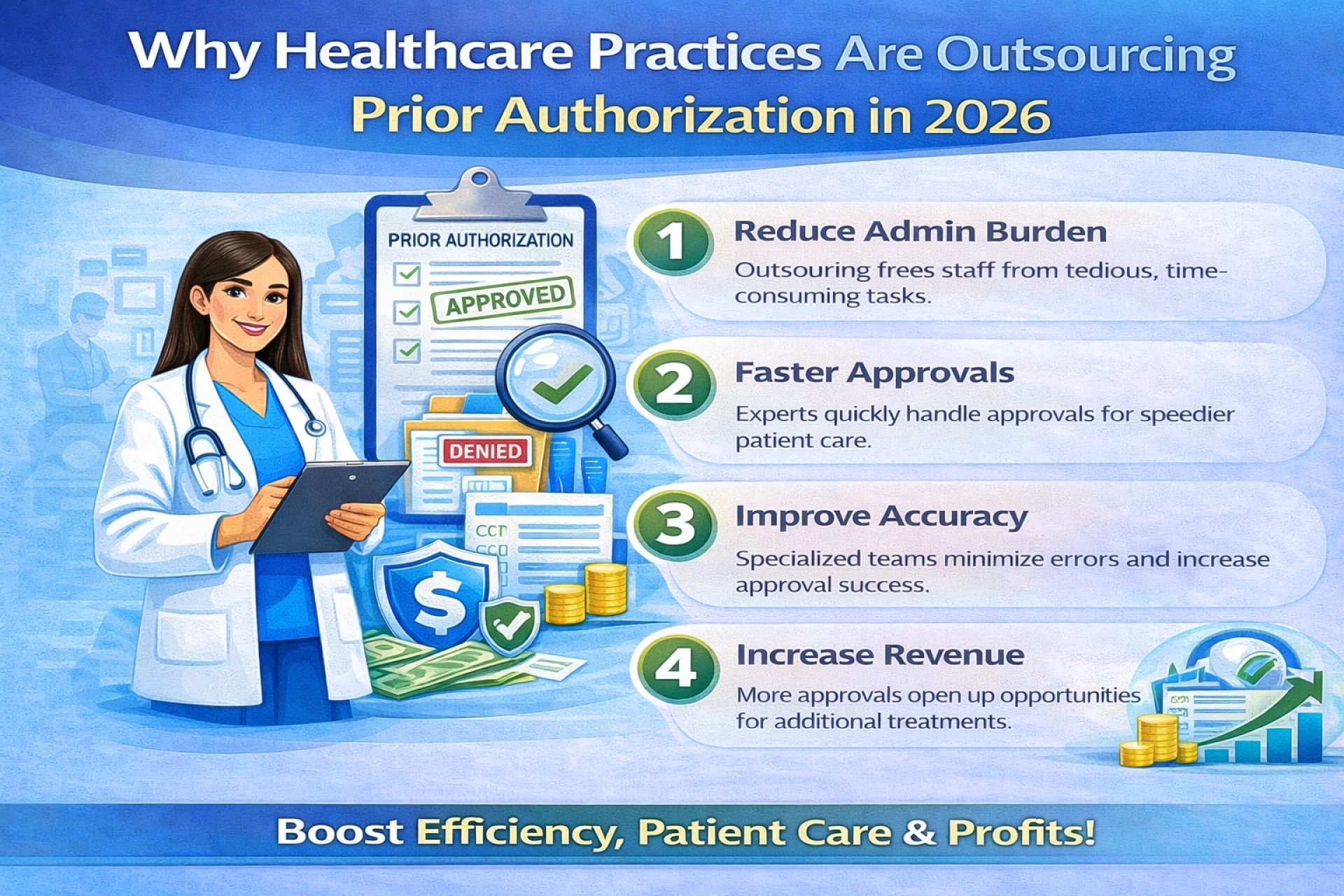

Prior authorization has quietly become one of the most disruptive forces in healthcare operations.
In 2026, it’s no longer just a utilization control mechanism.
It’s a revenue bottleneck, scheduling risk, and patient experience liability all rolled into one.
Across specialties, healthcare practices are reaching the same conclusion: managing prior authorization internally is no longer sustainable. Not because teams aren’t capable, but because the system itself has outgrown traditional workflows.
That’s why outsourcing prior authorization is accelerating and why this shift is likely permanent.
In 2026, healthcare practices are outsourcing prior authorization to reduce denials, prevent scheduling delays, stabilize cash flow, and protect patient experience as payer rules grow more complex and staffing becomes less reliable.
The Prior Authorization Landscape Has Changed Permanently
Prior authorization pressure didn’t spike overnight.
It compounded.
By 2026, practices are operating in an environment defined by:
- Expanding prior auth requirements across payers
- Narrower medical necessity interpretations
- Shorter approval windows with higher documentation demands
- Increased retrospective denials tied to authorization mismatches
What used to be manageable “extra work” is now a continuous operational drain.
The result? Internal teams are stretched thin and revenue feels it.
Why In-House Prior Authorization Is Breaking Down
Most practices didn’t fail at prior auth.
They simply outgrew what internal teams can realistically manage.
1. Staffing Instability Has Become a Financial Risk
Experienced authorization staff are difficult to hire and harder to retain.
When someone leaves, practices face:
- Immediate backlog
- Missed approvals
- Procedure delays or cancellations
- Increased downstream denials
In 2026, staffing gaps don’t just slow operations. They directly impact revenue and patient trust.
2. Payer Rules Are Changing Faster Than Teams Can Track
Prior authorization rules vary by:
- Payer
- Plan type
- Procedure
- Diagnosis combinations
Internal teams often learn about changes after denials appear.
Outsourcing shifts this burden to teams that monitor payer behavior continuously not reactively.
3. Prior Authorization Errors Don’t Show Up Immediately
This is the most dangerous part.
Authorization issues often surface:
- Weeks after the visit
- During claim submission
- Or worse—during payer audits
By then, the damage is already done.
Outsourced prior authorization teams focus on preventing downstream failures, not just pushing requests through.
What Outsourced Prior Authorization Actually Solves
Outsourcing works when it’s done correctly meaning ownership, not delegation.
1. End-to-End Authorization Ownership
High-performing vendors don’t just submit requests.
They:
- Track authorizations to final determination
- Manage follow-ups and payer requests
- Escalate stalled cases
- Document approvals defensibly
This level of ownership dramatically reduces missed or invalid authorizations.
2. Fewer Denials Tied to Authorization Gaps
Authorization-related denials are among the most preventable and most expensive.
Outsourced teams help reduce:
- Missing auth denials
- Expired approval issues
- CPT/diagnosis mismatches
- Retroactive authorization failures
That protection directly improves clean claim rates.
3. Improved Scheduling Reliability
Missed or delayed authorizations are a leading cause of:
- Same-day cancellations
- Rescheduled procedures
- Patient dissatisfaction
Outsourcing aligns authorization timelines with scheduling workflows, creating predictable care delivery.
4. Better Patient Financial Experiences
Patients feel prior authorization failures immediately.
They experience:
- Delayed care
- Confusing bills
- Unexpected balances
By improving authorization accuracy and timing, practices reduce patient frustration even before a bill is generated.
5. Scalability Without Operational Chaos
Growth exposes authorization weaknesses fast.
Adding providers, procedures, or locations increases authorization volume and complexity. Outsourced models scale without requiring constant hiring, retraining, or workflow redesign.
Why 2026 Is the Tipping Point
Several forces are converging:
- Payers are enforcing authorization rules more aggressively
- Audits increasingly reference authorization documentation
- Staffing shortages persist across healthcare operations
- Patient tolerance for billing confusion is lower than ever
In this environment, prior authorization is no longer an administrative function.
It’s a strategic one.
What Practices Should Look for When Outsourcing
Not all prior authorization vendors deliver the same value.
Strong partners:
- Own authorizations end to end
- Understand payer-specific medical policies
- Integrate with billing and scheduling workflows
- Provide outcome-based reporting
- Focus on prevention—not cleanup
If a vendor measures success by “requests submitted,” that’s not enough in 2026.
Frequently Asked Questions
Is outsourcing prior authorization expensive?
Often no. When denials, cancellations, staffing costs, and delayed revenue are considered, outsourcing is frequently more cost-effective.
Does outsourcing reduce control?
No. Most practices gain more visibility through standardized reporting and accountability.
Is outsourcing only for large practices?
No. Small and mid-sized practices often benefit the most because they lack internal redundancy.
Final Takeaway
In 2026, prior authorization is too complex, too variable, and too financially critical to manage casually.
Healthcare practices aren’t outsourcing prior authorization because it’s convenient.
They’re doing it because revenue, scheduling, and patient experience depend on it.
The question for many practices is no longer whether to outsource prior authorization
but how long they can afford to manage it internally without risk.































Sign in to leave a comment.