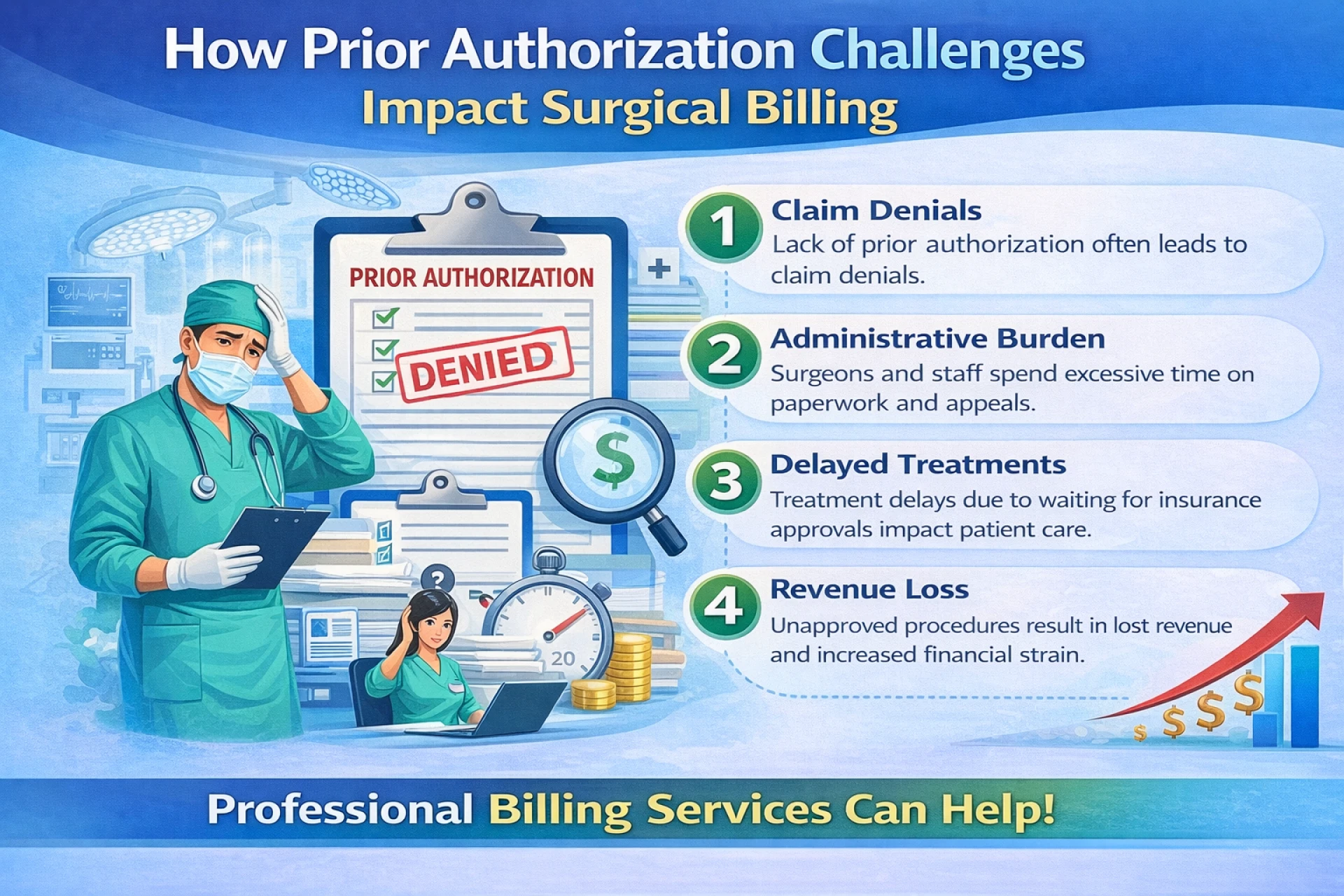

Prior authorization was supposed to control costs. In surgical billing, it has become one of the largest sources of revenue disruption.
For surgical practices and specialty clinics, prior auth failures don’t just delay care they directly impact claim approval, payment timing, audit exposure, and patient satisfaction. And as payer rules tighten, the financial consequences are getting worse. This article breaks down how prior authorization challenges impact surgical billing, why the problem keeps growing, and what practices must do to protect revenue.
Prior authorization challenges impact surgical billing by causing claim denials, delayed payments, increased administrative burden, higher patient balances, and greater audit risk when procedures are performed without proper or well-documented approval.
Why Prior Authorization Is Especially Risky for Surgical Billing
Surgical billing operates differently than evaluation-and-management services.
Once a surgery is performed:
- The cost is high
- The service is irreversible
- Payment depends heavily on prior authorization accuracy
If authorization fails, the claim is almost always denied, regardless of medical necessity.
Unlike minor services, surgical claims don’t get “fixed later.”
The Most Common Prior Authorization Challenges in Surgical Billing
1. Authorization Not Obtained at All
This is the most expensive failure.
It happens when:
- Scheduling moves faster than authorization workflows
- Responsibility between staff is unclear
- Emergency vs elective status is misunderstood
If prior auth is required and not obtained, payment risk shifts entirely to the provider.
2. Authorization Obtained, But for the Wrong Procedure Code
This is more common than practices admit.
Problems occur when:
- CPT codes change after surgical planning
- Additional procedures are performed intraoperatively
- The authorized code doesn’t match the billed code
Payers match claims strictly. Even medically justified changes can trigger denials if authorization isn’t updated.
3. Modifier Mismatch on Authorized Procedures
Modifiers are a frequent failure point in surgical billing.
Common issues include:
- Authorization approved without modifiers
- Claims billed with laterality or multiple-procedure modifiers
- Bundling edits applied differently by payers
If the authorization doesn’t align with the final billed structure, payment is at risk.
4. Authorization Validity Expired or Incorrect
Surgical delays happen. Authorizations don’t always adjust.
Denials occur when:
- Surgery happens outside the approved date range
- Location or rendering provider differs from authorization
- Facility vs professional authorization is mismatched
These technical issues often override medical necessity entirely.
5. Documentation Does Not Support Authorized Services
Authorization approval does not guarantee payment.
Payers still review:
- Operative reports
- Diagnosis alignment
- Medical necessity documentation
If the surgical record doesn’t support what was authorized, claims can still be denied or worse, flagged for audit.
How Prior Authorization Challenges Disrupt Surgical Revenue
1. Claim Denials and Zero-Pay Outcomes
Surgical denials are rarely partial.
When prior authorization fails, the outcome is often:
- Full denial
- No appeal leverage
- Patient balance disputes
This creates immediate revenue loss with limited recovery options.
2. Extended Payment Delays
Even when denials are appealable, surgical claims can remain unresolved for months.
That leads to:
- Higher A/R days
- Cash flow instability
- Increased follow-up labor
Delayed surgical revenue affects staffing, expansion, and financial forecasting.
3. Increased Administrative and Staffing Burden
Prior authorization is labor-intensive.
Challenges force staff to:
- Chase payer approvals
- Manage resubmissions
- Handle patient complaints
- Track payer-specific rules
This administrative overload pulls focus away from other revenue-protecting activities.
4. Higher Patient Financial Risk and Dissatisfaction
When authorization fails, patients are often caught in the middle.
This leads to:
- Unexpected patient balances
- Billing disputes
- Loss of trust
- Delayed future care
Even when the issue isn’t clinical, patient experience suffers.
5. Greater Audit and Compliance Exposure
Repeated authorization failures signal risk to payers.
Patterns such as:
- Consistent mismatches
- High denial ratios
- Weak documentation trails
can trigger payer audits or payment reviews especially for high-cost surgical procedures.
Why Prior Authorization Problems Are Increasing
Several forces are making the problem worse:
- Payers expanding authorization requirements
- More procedures moving to outpatient and ASC settings
- Increasing use of AI-driven payer reviews
- Complex modifier and bundling rules
Surgical billing has become less forgiving, not more.
What Strong Surgical Billing Workflows Do Differently
Practices that minimize authorization-related losses focus on prevention, not cleanup.
Effective workflows include:
- Procedure-specific authorization checklists
- Pre-surgery CPT and modifier validation
- Clear ownership between scheduling, authorization, and billing teams
- Authorization audits before claim submission
- Real-time communication when surgical plans change
The goal is alignment, not assumption.
Key Takeaway for Surgical Practices
Prior authorization is no longer a front-end inconvenience.
It is a core surgical billing risk factor.
When authorization workflows fail, the result is predictable: denied claims, delayed revenue, compliance exposure, and patient frustration. Practices that treat prior authorization as a strategic billing function, not a clerical task are the ones that protect revenue consistently.
In modern surgical billing, what happens before the procedure often determines whether the practice gets paid at all.
























Sign in to leave a comment.