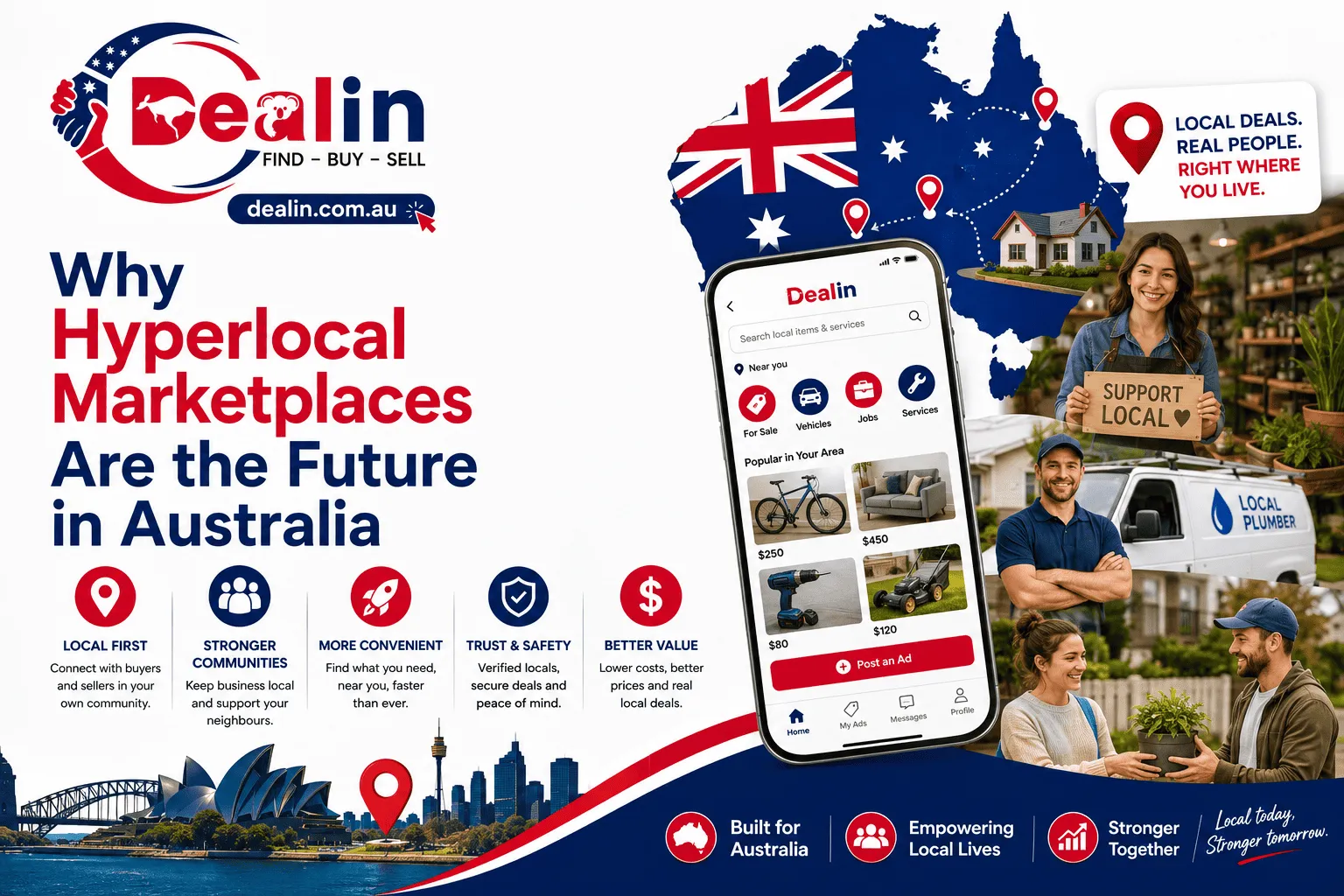

There’s a specific kind of relief in buying something from someone three suburbs away instead of waiting a week and a half for a box from an overseas warehouse. You see the thing, you check it works, you hand over cash or transfer the money, you drive home with it in the boot. No tracking number. No “your item is delayed.” No unboxing anxiety about whether what arrives matches what you saw in the photos. That specific, uncomplicated experience is what a hyperlocal marketplace delivers, and it’s the reason this category of platform has quietly become one of the more interesting shifts in how Australians actually transact.
A hyperlocal marketplace, in practical terms, is a platform that connects buyers and sellers within a specific suburb, city, or region — rather than pooling listings from across an entire country or the entire globe. It’s a meaningfully different model from the eBay or Amazon experience, where you’re buying from a seller who might be interstate or overseas, where the item arrives via freight, and where “local” isn’t really a design principle so much as an occasional coincidence. Local classifieds Australia has always existed in some form, but the current generation of hyperlocal platforms is doing something more deliberate — building the entire experience around geographic proximity rather than treating it as an afterthought.
This piece looks at what actually makes a marketplace hyperlocal, why Australians are shifting toward this model specifically, what it means for buyers, sellers, service providers, and small businesses, the technology underpinning the shift, the genuine challenges these platforms still face, and where this is all likely headed.
What Makes a Marketplace “Hyperlocal”
The word “hyperlocal” gets thrown around loosely, so it’s worth being precise about what actually distinguishes a genuinely hyperlocal marketplace from a national platform that happens to show you some local results.
Geo-targeted listings at suburb or postcode level are the foundation. A hyperlocal platform doesn’t just filter by “state” or “within 500km” — it understands that a buyer in Preston, Melbourne, generally wants to see listings from Preston, Coburg, and Thornbury before it shows them something from Frankston, let alone Brisbane. That granularity matters because it determines whether the platform is actually useful for the kind of transaction where geography drives the whole point — inspecting a couch, test-driving a car, meeting a tradie who can realistically be at your house this week.
Local pickup and delivery emphasis over shipping is the second defining feature. Hyperlocal platforms are built around the assumption that most transactions will complete with an in-person handover, not a courier. That single design choice reshapes everything downstream — pricing, trust mechanisms, the kind of items that make sense to list, and the entire buyer experience.
Community-driven trust signals round out the picture — local reviews, a sense of neighbourhood recognition, sellers who might genuinely cross paths with their buyers again at the local shops. This is a fundamentally different trust dynamic from a national platform where seller and buyer will almost certainly never interact again outside the transaction, and it changes behaviour on both sides in ways that are hard to replicate at national scale.
Why Australians Are Shifting Toward Hyperlocal Buying and Selling
A handful of genuine forces are pushing Australians toward local marketplace trends, and they’re reinforcing each other rather than operating independently.
Shipping costs and delivery delays have made local pickup meaningfully more attractive for anything beyond small, light items. Anyone who’s tried to buy or sell furniture, large appliances, or bulky equipment through a national or global platform knows the freight cost conversation can genuinely change whether a transaction makes sense at all — a $300 item with a $120 freight quote is a very different proposition from the same item available for local pickup at the listed price. That gap has become impossible to ignore for a growing number of Australians, and it’s pushing buying behaviour toward platforms where “local pickup” is the default rather than an occasional option.
There’s a genuine sustainability angle too, even if it’s more of a background motivator than the primary driver for most people. Buying and selling locally reduces the transport footprint of a transaction considerably compared to interstate or international freight, and the broader habit of buying second-hand rather than new — which hyperlocal marketplaces make dramatically easier — extends the useful life of goods rather than sending them to landfill. It’s worth being honest that most people aren’t choosing a hyperlocal platform primarily because of its environmental footprint, but the alignment between “cheaper and more convenient” and “genuinely better for reducing waste” is a real and pleasant coincidence rather than pure marketing spin.
Cost-of-living pressure is arguably the strongest driver of second-hand marketplace growth in Australia right now. When household budgets are tight, buying quality second-hand items rather than new becomes less a lifestyle preference and more a straightforward financial decision — and local platforms make that decision easier by removing freight costs and enabling inspection before you commit your money.
There’s also a genuine post-pandemic shift in how a lot of Australians think about their relationship to local community and small business. The instinct to actively support local sellers and small operators rather than defaulting to the biggest, most convenient national platform has stuck around for a meaningful portion of the population well beyond the period that originally prompted it.
Benefits for Buyers
The practical advantages of buying locally through a hyperlocal marketplace are significant enough that they’re worth spelling out individually rather than treating as a vague general good.
Transactions move faster because there’s no shipping wait built into the process. What you see today, you can often own today or tomorrow — a genuinely different experience from ordering online and watching a tracking number crawl through several delivery stages over a week or more.
The ability to inspect an item before paying is arguably the single biggest practical advantage of buying locally, and it’s one that simply doesn’t exist when you’re purchasing from a remote seller who ships. You can check that the laptop actually boots, that the couch doesn’t have a smell the photos didn’t capture, that the car’s panel gaps look right and it drives the way it should. That inspection step alone eliminates most of the risk that makes online buying anxiety-inducing in the first place.
Buying locally naturally supports local sellers and reduces the environmental footprint of the transaction, which matters to a growing number of Australian buyers even when it’s not their primary motivation.
And there’s a genuine community-building element to repeat local trade that’s easy to underrate. A buyer who’s had good experiences with a particular local seller, or who’s become a regular in their suburb’s local buy-and-sell scene, starts to build something closer to an ongoing relationship than a series of anonymous transactions — which is a meaningfully different experience from the transactional anonymity of buying from a stranger on the other side of the country.
Benefits for Sellers
Selling locally removes a genuine amount of friction and cost compared to selling through platforms built around shipping.
The barrier to entry is considerably lower because there’s no packaging or shipping logistics to manage. No finding a box the right size, no working out postage costs, no trip to a post office, no anxiety about whether an item survives transit intact. You photograph it, list it, and arrange a pickup time — the entire operational overhead of shipping simply disappears.
Turnover tends to be faster for the categories that matter most to everyday sellers — furniture, appliances, and vehicles in particular, where the local buyer pool is large enough to generate quick interest and the inspection-before-purchase model removes the hesitation that slows down remote transactions.
There’s also a genuine reputation-building element for sellers who transact regularly in their local area. A seller who’s built a track record of honest listings, fair pricing, and smooth transactions within their local marketplace community starts to attract repeat buyers and word-of-mouth referrals in a way that’s much harder to achieve as an anonymous seller on a massive national platform where you’re one listing among millions.
Benefits for Local Service Providers and Small Businesses
The hyperlocal shift isn’t limited to physical goods — it extends meaningfully into services, jobs, and local business listings, and this is where the model arguably has the most significant long-term impact.
For a small, local operator — a cleaner, a gardener, an independent retailer, a tradie — competing against large national brands with substantial advertising budgets has traditionally been genuinely difficult. Hyperlocal marketplaces change that dynamic considerably by giving small operators direct, affordable access to exactly the customer base that matters to them: people in their actual service area, searching with genuine local intent, without the enormous marketing spend required to compete for visibility on a national platform.
This is a meaningful structural advantage. A national advertising campaign is largely wasted spend for a business that only serves a 20-kilometre radius. A hyperlocal listing, by contrast, puts that business directly in front of the people who could actually become customers, at a fraction of the cost. For small businesses and local service providers across Australia, that shift represents a genuine levelling of the playing field against competitors with far larger budgets.
Technology Driving the Hyperlocal Shift
None of this would work at scale without specific technological developments that have matured considerably over the past several years.
Geo-location and mapping integration built directly into apps and platforms now makes suburb-level and postcode-level relevance genuinely seamless rather than a clunky manual filter. A buyer opens an app and sees what’s near them without having to configure anything — the geography does the work automatically.
AI-driven personalisation increasingly surfaces the most relevant local listings first, learning from what a user has previously searched for or engaged with to prioritise genuinely useful results over a generic, unordered feed. This matters enormously as listing volume grows — the difference between a useful hyperlocal platform and an overwhelming one often comes down to how well it surfaces relevance rather than just proximity.
Real-time chat and verified profiles are becoming a necessity, as both help to establish the trust layer required for buyers and sellers to feel confident making transactions with one another. Being able to message sellors, and knowing that they reply quickly and clearly, can help buyers create a little history with them before meeting up in person, which de-risks the whole P2P, peer-to-peer, local transaction process.
Challenges Hyperlocal Marketplaces Still Face
It’s worth being honest that this model isn’t without genuine problems, because pretending otherwise would be a disservice to anyone actually considering how to use these platforms well.
Trust and safety in peer-to-peer local transactions remain a real concern, even with the local-accountability advantages discussed elsewhere in this piece. Meeting a stranger to exchange money and goods carries inherent risk regardless of how local the platform is, and buyers and sellers still need to exercise sensible precautions — meeting in public for the first interaction on higher-value items, verifying details before committing, and trusting their instincts when something feels off.
Market saturation is a genuine issue in some categories. Furniture and electronics listings, in particular, can become genuinely crowded on active hyperlocal platforms, which means differentiation — good photos, honest descriptions, fair pricing — matters more than ever for a seller trying to stand out.
There’s also a real balancing act between hyperlocal focus and having enough supply and demand density to actually be useful. A platform that’s too narrowly geo-targeted in a low-population area risks having too few active listings and users to generate meaningful matches — the hyperlocal model works brilliantly in dense metro areas but requires careful design to remain useful in regional and rural Australia, where the local population simply isn’t large enough to generate the same listing density.
The Road Ahead: Where Hyperlocal Marketplaces Are Headed in Australia
The trajectory for hyperlocal marketplaces in Australia points toward continued expansion across categories well beyond the second-hand goods that most people still associate with classifieds. Services, jobs, and property are all showing the same underlying pattern — buyers and sellers increasingly preferring platforms that understand and prioritise genuine local relevance over platforms that treat geography as an afterthought.
Expect continued integration of safety and verification features as this category matures — more robust identity verification, clearer provider credentialing for services, and better tools for buyers and sellers to establish trust before committing to a transaction. This isn’t just a nice-to-have; it’s the natural next step for platforms that want to keep growing the categories where trust matters most, like services and higher-value goods.
There’s a genuinely plausible future where hyperlocal marketplaces become the primary touchpoint for community commerce in Australia — the default first stop for finding a local tradie, buying a used car, selling furniture, or even discovering a small local business, rather than a secondary option people reach for after exhausting national platforms. The combination of cost pressure, sustainability awareness and a general cultural shift toward valuing local connection all point in the same direction, and none of those underlying forces look like they’re reversing any time soon.
Conclusion
The shift towards buy and sell locally in Australia is not just a short-lived craze that is fueled by one strong factor but rather the combination of several reasons that contribute to its growth. The hyperlocal marketplace trend satisfies the demand for a marketplace that addresses various issues such as fuel and inspection costs, inefficiency of national sites, the ability of small businesses to sell beyond their local markets, and others. Moreover, it is a concept that has both economic and environmental justification that makes it a preferable option over traditional retail marketplaces.
For buyers, it means faster, safer, more transparent transactions. For sellers, it means less friction and a genuine path to local reputation. For small businesses and service providers, it means a fairer shot at reaching the customers who actually matter to them, without needing a national advertising budget to do it.
If you’re curious what this looks like in practice, explore local listings across Australia on Dealin — goods, services, jobs, motors, and property, all built around the idea that the best transaction is usually the one happening closest to home.
FAQs:
What is the difference between a hyperlocal marketplace and eBay?
A hyperlocal marketplace is different in that its primary function is based on suburb or postcode level discoverability and local pickup as a default, so most items seen in a hyperlocal marketplace are likely to be found in close enough distance to the buyer to inspect and pickup. National eBay-like platforms aggregate items from across the country with transport as an additional consideration, while hyperlocal marketplaces inherently favour nearby items by design.
Are Hyperlocal Marketplaces only for buying and selling second-hand items?
While hyperlocal marketplaces are full of second-hand goods for sale, they are also used for services, jobs and job ads, and small business listings as well. Hyperlocal marketplaces can be a great way for local tradespeople and businesses to market their services to nearby buyers and avoid spending heavily on national advertising.
Is it safe to buy and sell on a hyperlocal marketplace?
Yes it is! In many ways hyperlocal marketplaces are safer than buying or selling goods online because most transactions are done locally and in-person. Of course there are still scams to be wary of, but meeting up to inspect goods before purchase and paying on receipt of goods is much safer than buying online and never seeing the goods first. It is always a good idea to meet in a public place for the first transaction, and to always use caution and good judgement when dealing with people you don’t know.
Why are people choosing to buy second hand in their local area rather than buying new products online?
The rising costs of postage and longer delivery times mean that local pickup and inspection of goods is becoming more desirable, especially for large goods such as furniture and whitegoods which can have prohibitively expensive freight costs. Secondly, due to Australians’ increasing cost of living pressures, it seems more people are seeking to save money wherever possible, and buying second hand is one way to do that. Local marketplaces provide a much easier avenue for buying second hand goods, with cheaper or free freight options and access to a larger variety of goods than is typically found at local second-hand stores.
Do hyperlocal marketplaces work well in regional or rural areas, not just cities?
They can, but the model depends on having enough local supply and demand density to be genuinely useful, which is naturally easier to achieve in dense metro areas than in low-population regional areas. Platforms designed well for this balance can still work in regional Australia, though listing volume and response times may be slower than in a major city.



























Sign in to leave a comment.