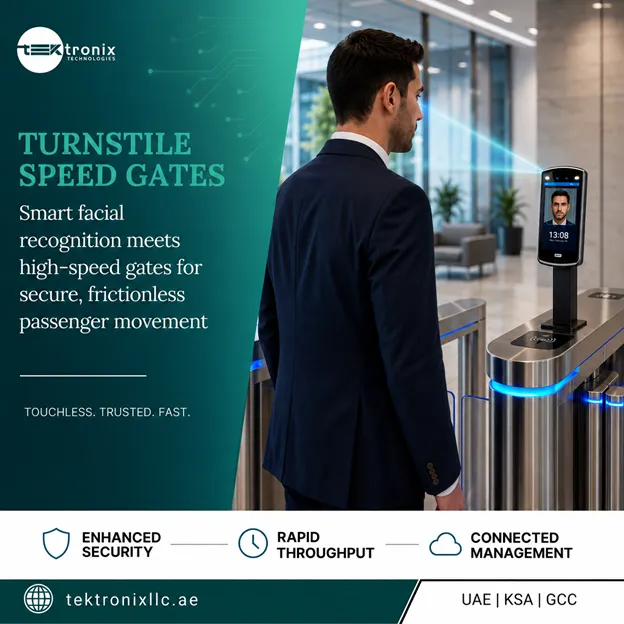

Turnstile Speed Gates are showing up in more UAE procurement decisions than ever, not because facility managers suddenly discovered the technology, but because the business case behind it has become impossible to ignore. As Dubai and Abu Dhabi towers fill with more tenants, more daily visitors, and higher security expectations, enterprises are re-evaluating what they actually need from a lobby entrance — and increasingly concluding that a manual checkpoint or a slow single-lane gate no longer fits the bill. This guide looks at the decision drivers behind this shift and what enterprises should weigh before making the switch themselves.
The Business Case Driving UAE's Shift to Smart Gate Technology
Facility decision-makers rarely upgrade lobby hardware on a whim — the shift toward intelligent gate systems across the UAE is being driven by a combination of rising occupancy, tightening security expectations, and a genuine appetite for the operational data these systems can now provide. Understanding what specifically is pushing enterprises to act helps clarify whether the same drivers apply to your own facility.
Rising Occupancy Density in Dubai and Abu Dhabi Towers
Business towers across both emirates continue to add tenant companies and daily visitor traffic at a pace that older, single-lane entry systems were never designed to handle. What was once an acceptable five-minute queue during morning arrival has become a genuine productivity and image problem for facilities hosting dozens of companies under one roof.
What Enterprises Are Moving Away From
Manual guard checkpoints depend entirely on staff vigilance and cannot produce a reliable digital record without significant additional administrative work. Basic single-arm turnstiles solve the physical barrier problem but do little to actually verify identity, leaving facilities with a barrier that slows down legitimate staff without meaningfully stopping a determined intruder.
Turnstile Access Control: The Policy Layer Behind Every Gate
Enterprises evaluating gate hardware quickly discover that the physical barrier is only half the equation — the policy layer connecting every lane to a centralized credential system is what actually makes a multi-gate lobby manageable. A single rule change, such as restricting after-hours access to a service entrance, should apply instantly across every relevant lane without requiring a technician to reconfigure each gate individually.
Tripod Turnstile Gates: Where Budget-Conscious Enterprises Start
For enterprises testing the waters with automated pedestrian control, or securing a lower-risk secondary entrance, compact tripod gates offer a straightforward entry point into gate technology without the capital outlay of a full lobby overhaul. Many facilities start here for staff cafeterias or gym access before expanding to more sophisticated hardware at the main entrance once the operational benefits are proven internally.
Swing Barrier Turnstile Gates: The Preferred Choice for Premium Lobbies
Enterprises prioritizing first impressions for clients and investors increasingly favour swinging glass or acrylic barrier gates over rotating-arm alternatives, since the aesthetic difference is immediately noticeable to anyone walking through a lobby. Their wider lane design also satisfies accessibility requirements more comfortably than narrower gate types, which has become a genuine procurement consideration rather than an afterthought for UAE developers.
Full Height Turnstile Gates: Reserved for Maximum-Security Perimeters
Enterprises with genuine perimeter security requirements — industrial sites, data centers, or after-hours staff entrances — continue to specify floor-to-ceiling rotating barriers specifically because climbing over or ducking under one is effectively impossible. These gates rarely appear in a client-facing lobby, but they remain the clear choice wherever a facility genuinely cannot tolerate a physical bypass attempt succeeding.
Flap Barrier Turnstile Gates: Why Speed-Focused Enterprises Choose Flaps
Enterprises processing high staff volumes through a single lobby during a narrow morning window consistently gravitate toward retracting flap-panel gates, since they combine some of the fastest available throughput with a slim, quiet mechanism that doesn't dominate a premium lobby's design. This combination of speed and subtlety is precisely why flap gates have become the default recommendation for corporate headquarters weighing options for their main entrance.
Intelligent Facial Recognition Turnstiles: The Technology Convergence Enterprises Want
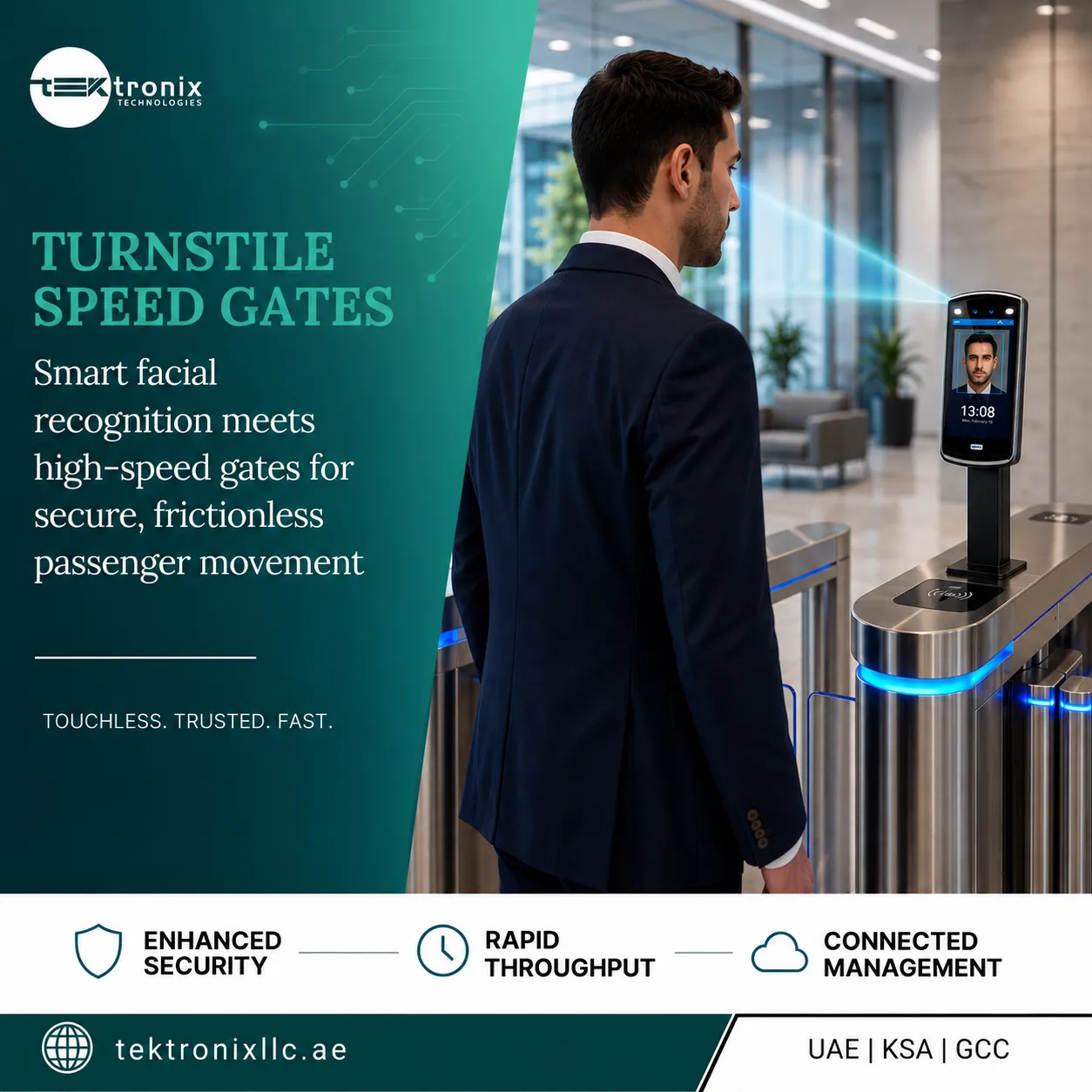
The single biggest shift in enterprise procurement conversations over the past several years has been the expectation that a gate should open automatically for a recognized face, rather than requiring a separate card tap even after biometric identity has already been confirmed. Enterprises evaluating an intelligent turnstile system for UAE facilities increasingly treat this camera-to-gate synchronization as a baseline requirement rather than a premium add-on, since a poorly synchronized system can actually create more friction than the card-based process it was meant to replace.
Biometric Turnstiles: Beyond the Face
Some enterprise deployments extend verification beyond facial recognition to fingerprint or palm-vein readers at specific lanes, typically reserved for a smaller group requiring an additional confirmation layer at a more sensitive internal gate. This flexibility lets a single lobby serve both general staff traffic through fast biometric lanes and a smaller, more rigorously verified population through a secondary method.
Warranty, Maintenance Contracts, and What Enterprises Should Expect
Enterprise buyers increasingly scrutinize warranty terms and maintenance contract structure as closely as the gate hardware itself, since a mechanical failure at a primary entrance during business hours creates an immediate operational problem regardless of how good the underlying technology is. Reasonable expectations include a documented response-time commitment for critical failures, clear coverage for both mechanical wear parts and software updates, and transparency about which components are covered under standard warranty versus requiring a separate service agreement. Enterprises that negotiate these terms clearly before signing tend to face far fewer surprises during the multi-year life of the deployment than those who treat the contract as a formality.
Cybersecurity Considerations for Connected Gate Platforms
As gate systems increasingly connect to cloud management platforms and integrate with identity systems, enterprise IT security teams have started applying the same scrutiny to gate infrastructure that they would to any other connected corporate system. Encryption of credential data, regular security patching, and network segmentation between the gate platform and core corporate systems have all become standard requirements in enterprise procurement conversations rather than considerations left solely to the physical security team.
Physical Design Considerations That Influence the Final Decision
Lobby layout, approach path width, and the number of gates relative to expected peak traffic often end up shaping the final gate selection just as much as the security requirements themselves. Enterprises frequently discover during the design phase that their preferred gate type doesn't physically fit the available lobby footprint at the desired lane count, forcing a reconsideration between gate type, lane number, and approach path design before a final specification is locked in.
How Enterprises Are Measuring Success After Deployment
Forward-thinking facility teams don't stop at installation — they track average check-in time, tailgating alert frequency, and employee satisfaction scores for several months after go-live to confirm the upgrade delivered what the original business case promised. This post-deployment measurement also gives procurement teams concrete data to bring back to leadership when justifying future phases of a broader security modernization program, turning a single gate project into evidence supporting the next investment.
Lessons from Early UAE Adopters
Enterprises that deployed intelligent gate systems earliest in the region generally report that underestimating lane count for peak occupancy, not biometric accuracy, was their most common early mistake — a lobby with excellent recognition technology still creates queues if there simply aren't enough lanes for the morning rush. A second recurring lesson involves change management: facilities that ran a brief staff communication campaign before go-live report meaningfully fewer help-desk complaints in the first month than those that simply switched on the new system without warning.
Five Business Drivers Behind the Enterprise Shift to Smart Gates
Beyond the technology itself, five recurring business drivers show up in nearly every enterprise procurement conversation: reducing reception and security staffing costs, improving the visitor and employee arrival experience, producing a genuinely auditable entry record for compliance purposes, reducing tailgating-related security incidents, and future-proofing the lobby against continued occupancy growth. Enterprises that can clearly articulate which of these five drivers matters most to their own organization tend to make faster, better-justified purchasing decisions than those evaluating gate technology purely on hardware specifications.
Total Cost of Ownership: Why Enterprises Look Past the Sticker Price
Procurement teams increasingly push vendors for a full multi-year cost picture rather than comparing initial hardware quotes alone, since mechanical maintenance, software licensing, and replacement part availability can shift the real cost comparison significantly between competing proposals. A gate system with a higher upfront cost but faster, more reliable local support has repeatedly proven more cost-effective over a five-year horizon than a cheaper alternative with slow or unavailable regional service.
Employee Experience as a Procurement Factor
HR and workplace experience teams have increasingly gained a seat at the table in gate procurement decisions, since a frustrating, queue-inducing entrance genuinely affects how employees feel about arriving at work each morning. Enterprises now frequently pilot a new gate system with employee feedback surveys before committing to a full rollout, treating the entrance experience as a workplace satisfaction factor rather than purely a security line item.
Integration Requirements Enterprise IT Teams Are Now Demanding
IT security teams increasingly insist that any new gate platform integrate cleanly with existing identity management, HR onboarding systems, and building management platforms rather than operating as an isolated system requiring separate administration. This requirement has pushed several vendors to open up their integration architecture considerably compared to just a few years ago, when many gate platforms functioned as closed, standalone products.
Compliance and Audit Pressure Driving Adoption
Enterprises operating in regulated sectors — banking, healthcare, and government-adjacent industries — increasingly cite audit and compliance pressure as a direct driver behind gate modernization, since a manual checkpoint simply cannot produce the kind of timestamped, searchable entry record that modern compliance frameworks expect. This pressure has moved gate technology from a discretionary security upgrade to a documented compliance requirement for a growing number of UAE organizations.
Common Objections Enterprises Raise — and How They're Answered
The most common objection procurement teams raise is disruption during installation, which experienced vendors address through phased rollouts that keep at least one lane operational throughout construction. A second frequent concern involves accessibility for visitors using wheelchairs or mobility aids, typically resolved by specifying at least one wider swing-barrier lane alongside faster flap or tripod lanes elsewhere in the lobby. A third objection — concern about biometric data privacy — is generally addressed through clear enrollment policies and transparent data retention commitments communicated to staff before rollout.
Vendor Selection Criteria UAE Enterprises Are Prioritizing
Beyond hardware specifications, enterprise buyers increasingly weigh a vendor's regional service network, since a gate mechanism failure at a busy headquarters entrance needs same-day or next-day resolution rather than waiting on parts shipped from outside the region. References from comparable regional deployments, documented throughput testing under real conditions, and a clear answer on fail-open versus fail-locked behaviour during an outage have all become standard parts of the enterprise evaluation checklist.
Scaling Gate Infrastructure Across a Growing UAE Portfolio
Enterprises expanding across multiple UAE properties increasingly prefer a single vendor and platform capable of maintaining consistent gate policies and reporting across every location, rather than managing a patchwork of different systems installed at different times by different providers. This consistency becomes particularly valuable during due diligence for a merger or acquisition, when a buyer needs a clear, uniform picture of physical security posture across an entire portfolio rather than site-by-site variation.
Business Continuity Expectations from Enterprise Buyers
Enterprise procurement teams now routinely ask vendors to document exactly what happens to gate operation during a power or network outage before signing a contract, rather than discovering the answer during an actual incident. Vendors able to demonstrate local credential caching and a clear fail-open or fail-locked policy, tailored to the specific risk profile of each entrance, tend to win enterprise business over those unable to answer the question with specificity.
Building an Internal Business Case for Gate Modernization
Facility managers proposing a gate upgrade internally tend to succeed more often when they quantify the current cost of manual checkpoints — staffing hours, average queue time, and any documented tailgating incidents — rather than presenting the upgrade as a generic security improvement. Pairing this current-state cost picture with a phased implementation plan, starting with the highest-traffic entrance, gives budget committees a concrete, low-risk starting point rather than asking for approval of an entire building-wide overhaul at once.
Turnstile Speed Gates UAE: Adoption Trends
Adoption across the country continues to accelerate across corporate towers, free zones, and large public venues, driven by the combination of rising occupancy density and increasing enterprise expectations for a professional, secure, and data-rich arrival experience. Facility owners are increasingly specifying automated gate hardware as a standard requirement in new building tenders rather than an optional upgrade considered after the fact.
Turnstile Speed Gates Dubai: Business Hub Momentum
The emirate's dense concentration of multi-tenant business towers and free zone campuses has made it the fastest-moving market for gate modernization in the country, with new developments increasingly specifying biometric-ready lobbies from the design phase rather than retrofitting them after construction.
Turnstile Speed Gates Abu Dhabi: Government and Institutional Demand
Government ministries and large institutional campuses in the capital have driven a steady, compliance-oriented demand for gate technology, often prioritizing full height and swing barrier options that balance the emirate's stricter security expectations with the accessibility standards expected of public-facing institutional buildings.
Why Organizations Choose Tektronix LLC
Tektronix LLC has delivered turnstile and pedestrian access projects for corporate, government, and transit clients across the UAE and wider GCC, with engineering teams experienced in matching gate types to throughput requirements and integrating biometric verification directly into gate hardware. Its regional deployment portfolio spans single-lobby corporate towers to multi-gate transit and institutional installations requiring centralized oversight. Organizations evaluating a rollout can review the full Tektronix LLC turnstile speed gates for the UAE to see how these capabilities are applied on real regional projects.
Implementation Checklist for Turnstile Deployment
Before selecting a provider, facility and security managers should confirm the following:
- Gate throughput has been validated under actual peak-hour traffic conditions
- Lane count is sized appropriately for the facility's expected occupancy
- Biometric integration is synchronized properly with gate opening speed
- The platform integrates with existing identity management and building systems
- Fail-open or fail-locked behaviour during a power or network outage is clearly defined
- The vendor maintains a regional service network for rapid parts and support
- Vendor references include comparable regional deployments, not only international case studies
Conclusion
Turnstile Speed Gates paired with proper Turnstile Access Control now give UAE enterprises a full spectrum of options, from cost-effective Tripod Turnstile Gates and elegant Swing Barrier Turnstile Gates to maximum-security Full Height Turnstile Gates and fast Flap Barrier Turnstile Gates. Intelligent Facial Recognition Turnstiles and Biometric Turnstiles add verification directly into the gate itself, closing gaps that card-only lanes cannot. As Turnstile Speed Gates UAE adoption accelerates and Turnstile Speed Gates Dubai and Turnstile Speed Gates Abu Dhabi deployments both continue to grow, enterprises that build a clear, quantified business case now will move faster than those still weighing the decision.
FAQs
1. How do enterprises justify the cost of a gate upgrade internally?
Most successful business cases quantify current manual checkpoint costs — staffing hours and queue time — and pair that figure with a phased rollout plan starting at the highest-traffic entrance, rather than presenting the upgrade as a generic security improvement.
2. What is the biggest procurement mistake enterprises make when choosing gates?
Comparing hardware quotes alone without accounting for regional support response times, mechanical maintenance costs, and integration work tends to produce a total cost of ownership that is significantly higher than the initial comparison suggested.
3. Can a single vendor manage gates across multiple UAE properties consistently?
Yes, enterprises with multi-site portfolios increasingly prefer one platform and vendor relationship that maintains consistent policies and reporting across every location rather than a patchwork of separately installed systems.
4. How do enterprises address employee concerns about biometric enrollment?
Clear communication about enrollment policies, data retention, and how the information is used, delivered before rollout rather than after, is the most common and effective approach organizations use to address staff concerns.
5. Is it worth piloting a new gate system before a full rollout?
Many enterprises find a single-lane or single-entrance pilot valuable for gathering employee feedback and validating throughput claims before committing budget to a building-wide deployment.
For more information contact us on:
Tektronix Technology Systems Dubai-Head Office
+971 50 814 4086
+971 55 232 2390
Office No.1E1 | Hamarain Center 132 Abu Baker Al Siddique Rd – Deira – Dubai P.O. Box 85955




























Sign in to leave a comment.