

Agencies often start with a small, focused team handling Google Ads in-house. Early on, campaigns run smoothly, reporting is manageable, and client feedback is positive. Teams are responsive, insights flow easily, and performance seems predictable.
However, once client volume grows, this model struggles. Each new account adds complexity-not just in campaign management, but in reporting, optimization, and client communication. What worked for a handful of clients quickly becomes inefficient, and teams begin to feel stretched. Agencies often realize too late that scaling requires more than simply adding staff-it requires a structural change in how campaigns are executed.
The limitations of in-house Google Ads teams at higher client volumes

In-house teams excel when the number of accounts is manageable. Specialists can devote time to individual campaigns, closely monitor performance, and experiment with bidding strategies, ad creatives, and targeting. The result is tight control and personalized attention.
As client volume increases, these advantages erode. Teams begin dividing attention across multiple accounts, and optimization becomes reactive rather than proactive. Urgent tasks take precedence over strategic improvements, causing small inefficiencies to accumulate. Reports take longer to prepare, insights are delayed, and mistakes become more likely.
The issue isn’t skill-experienced in-house PPC specialists deliver excellent results at low volume, but rather capacity. Human attention and time are finite, and once agencies exceed their internal bandwidth, account quality, performance, and client satisfaction all begin to suffer.
Read More: Dominate Google Ads: PixelCrayons’ Guide to PPC Success
Hidden costs of scaling internal Google Ads teams

Hiring additional staff seems like the obvious solution, but it rarely solves the underlying problem. Recruitment, onboarding, and training are time-intensive and often slow down senior team members who must manage newcomers. Salaries rise, tools become more expensive, and account oversight becomes inconsistent as team sizes expand.
Furthermore, agencies often become dependent on specific employees. When a key specialist leaves, knowledge, workflow habits, and historical insights leave with them, potentially disrupting multiple accounts. This not only increases operational risk but can also affect client retention.
Operational costs grow quietly behind the scenes, eroding margins. While agencies appear to be scaling, profitability may stagnate or even decline because resources are focused on maintenance rather than growth.
Read More: Guide to Optimizing Google Ads for Higher Conversion Rates
Performance gaps that arise when internal teams are overextended

Google Ads requires ongoing monitoring and fine-tuning. Tasks like reviewing search terms, adjusting bids, testing creatives, and aligning campaigns with landing pages are continuous. Overloaded teams often prioritize “keeping campaigns running” over strategic experimentation, resulting in stagnating performance.
Over time, ROAS (Return on Ad Spend) declines, and inefficiencies multiply. Even well-trained internal teams struggle to maintain consistent quality when client volume rises. Clients notice subtle changes in results or slower reporting, which can erode trust and make renewal discussions more challenging.
At this point, agencies must ask a critical question: do they continue adding more people and infrastructure, or do they adopt a smarter, more scalable approach?
Read More: How Much Does Google Ads Cost in 2026?
White-label Google Ads management as a solution for scaling agencies

This is where white-label Google Ads management becomes a viable alternative. Instead of increasing internal headcount, agencies leverage specialized teams that focus solely on PPC execution. The agency retains strategy, client communication, and brand ownership, while execution is handled efficiently and systematically.
White-label partners offer expertise in campaign setup, ongoing optimization, and reporting, all aligned with agency workflows. Accounts are monitored regularly, optimizations are consistent, and performance insights are delivered in a structured format. This approach allows agencies to maintain client trust, uphold quality, and scale without overburdening internal staff.
Expanding paid media offerings without overloading internal teams

Agencies often need to manage multiple paid media channels-Google Ads, Facebook Ads, LinkedIn campaigns, and remarketing strategies. Managing these internally multiplies complexity and increases the risk of errors or missed opportunities.
With white-label PPC management services for agencies, internal teams can focus on strategy, client engagement, and growth, while execution is handled externally. Many agencies also integrate White Label Facebook Ads services alongside Google Ads, providing cohesive campaigns across platforms with unified reporting. This combination simplifies workflows, maintains quality, and allows agencies to expand offerings without hiring additional full-time specialists.
Predictable results and reduced operational risk through white-label models
Another key advantage of white-label models is predictability. Internal teams can fluctuate in performance depending on workload, experience, and turnover. White-label partners provide consistent execution because campaigns follow process-driven workflows rather than depending on individual team members.
Agencies also reduce operational risk. There’s no need to worry about turnover, vacation gaps, or inconsistent knowledge sharing. Performance tracking, reporting, and client communication remain seamless. The agency maintains control over branding, messaging, and client interactions, while operational efficiency improves significantly.
A simple comparison highlights this:
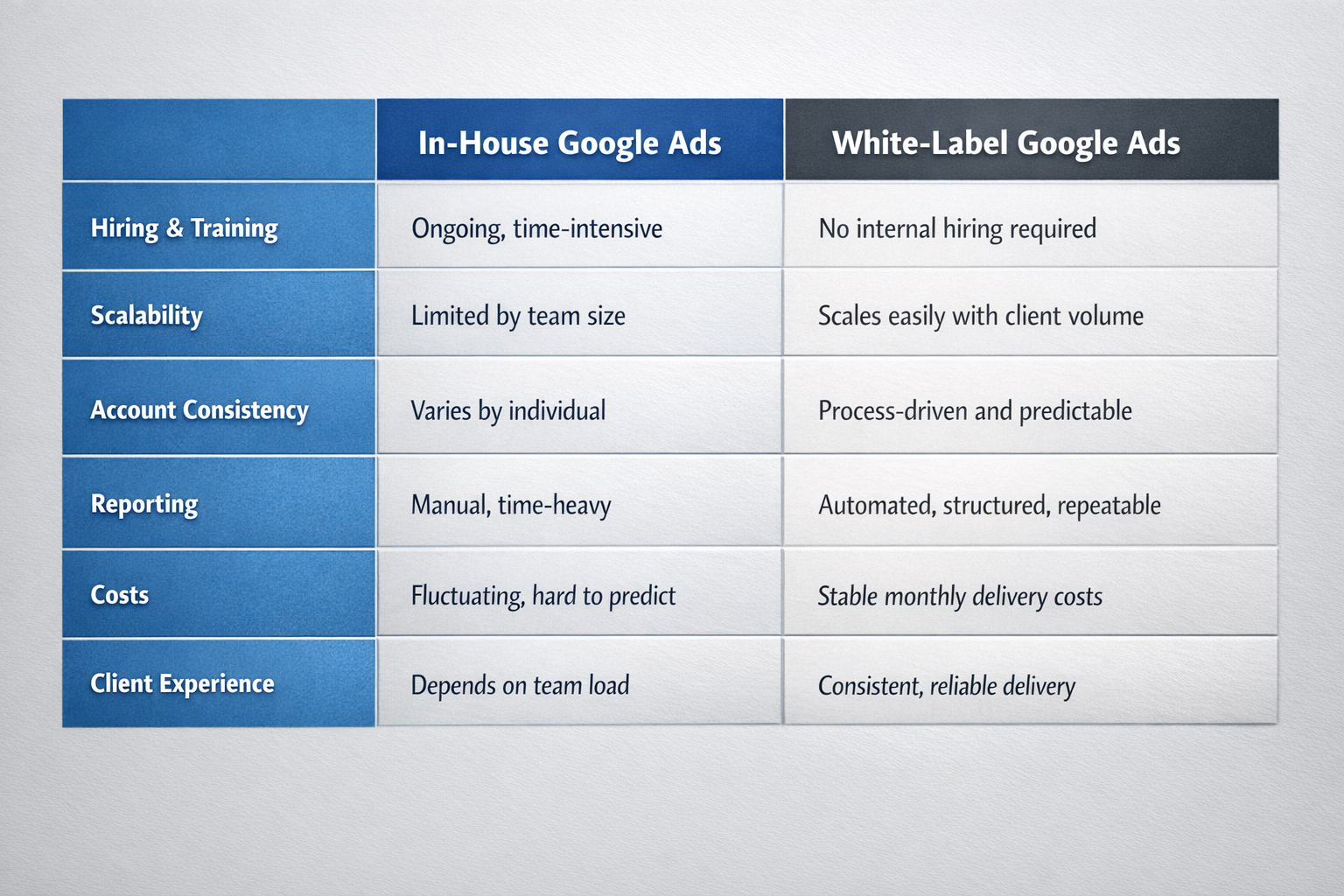
This table clearly shows why agencies with high client volume find white-label partners more effective for long-term growth.
Final Thoughts
In-house Google Ads management isn’t inherently broken. It works well at low volume, when teams are small, and clients are few. But as agencies grow, the limitations of internal execution become clear-performance plateaus, operational costs rise, and team stress increases.
White-label Google Ads agencies offer a practical, scalable solution. They allow agencies to maintain high-quality execution, deliver consistent client results, and expand paid media offerings without overloading internal staff.
For agencies looking to grow sustainably, the question isn’t whether white-label solutions work-it’s whether you can afford to keep stretching in-house teams when client volume increases.
Scaling successfully isn’t about working harder internally; it’s about building smarter, more resilient workflows that grow with the agency.



























Sign in to leave a comment.