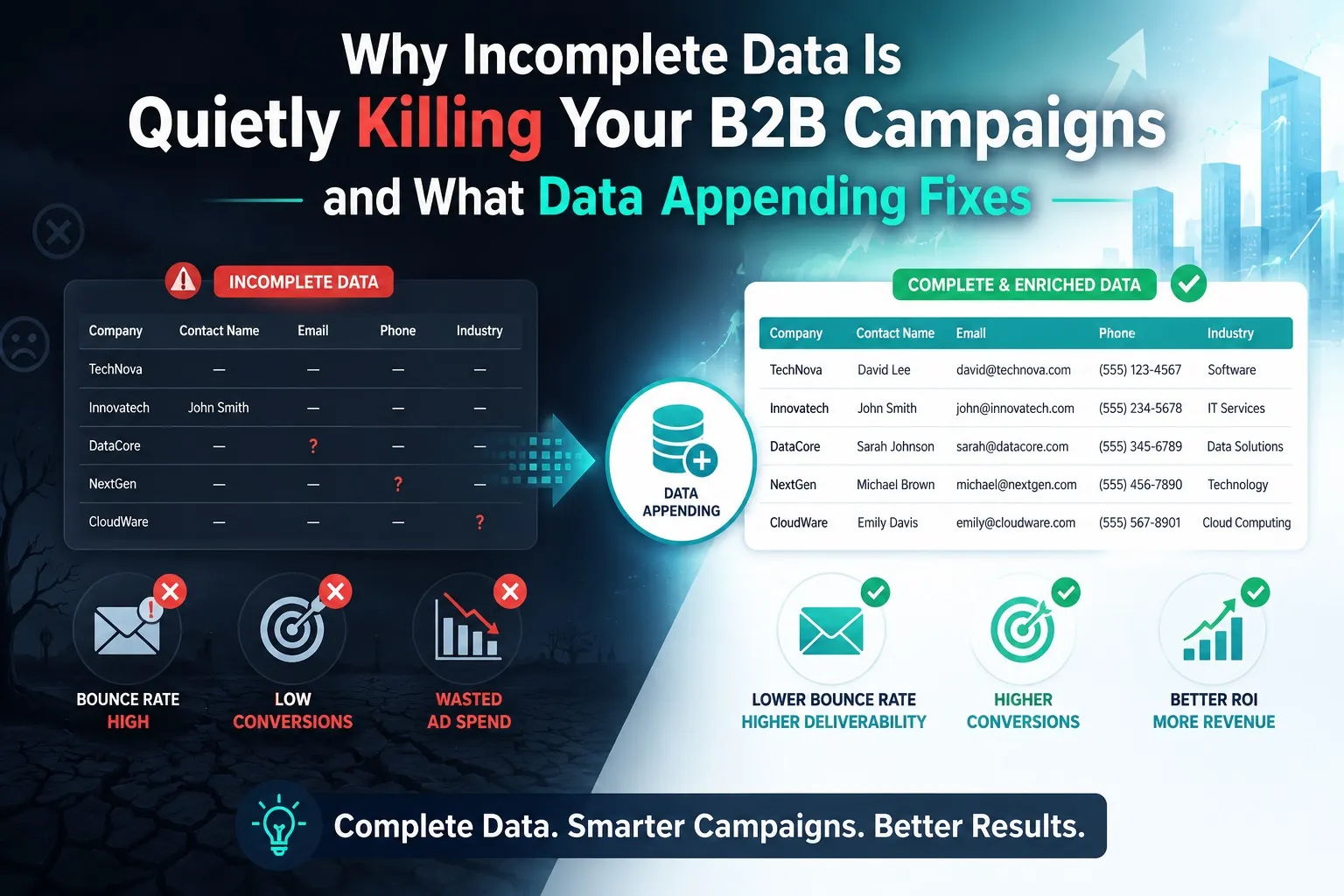

Marketing teams tend to blame the campaign when numbers slip. The subject line, the offer, the channel mix. The real culprit is often sitting one layer down, in the database that every campaign draws from. When a quarter of your records are wrong, no amount of creative rescues the send.
Poor data quality already carries a measurable price. Many industry reports suggest that it costs a lot for the average organization through wasted effort, misdirected spends, and decisions made on shaky inputs. For B2B teams, that cost hides inside routine work: emails to people who left, calls to disconnected numbers, and segments built on job titles that changed two roles ago. A data appending company exists to reverse that slide, filling the gaps and correcting the fields that time has broken.
This piece walks through how incomplete records erode reach, deliverability, and targeting, then shows what disciplined appending actually restores. The goal is not a tidier spreadsheet. It is campaigns that reach real people at real companies, and a pipeline you trust enough to forecast without crossing your fingers.
The Slow Leak Nobody Puts on the Dashboard
Data decay is not a single event. It is a steady erosion. People change jobs, companies merge, area codes shift, and domains get retired. Industry measurements put B2B contact decay at roughly 2 to 3 percent per month, which compounds to more than 20 percent across a year. A list of 50,000 contacts can shed 10,000 usable records in twelve months while the row count on your dashboard never moves.
That last point matters. The database looks full. Reports still show 50,000 names. Nothing flashes red, because a stale record and a fresh one occupy the same amount of space. The leak stays invisible until a campaign runs and the returns come back thin.
Partial records cause a quieter version of the same problem. A contact with a valid email but no company size, no industry code, and no title cannot be segmented properly. It ends up in the wrong nurture track or gets dropped from account-based programs entirely. The record counts toward your total, yet it contributes almost nothing to reach.
The financial drag stays hidden for the same reason. Marketing pays for a platform priced by contact volume, so dead and half-filled rows inflate the bill every month. Sales works down lists padded with unreachable names, and productivity metrics slip without an obvious cause. Finance builds projections on a funnel whose top is measured in records that will never respond. None of these losses show up as a line item labeled bad data, which is exactly why they persist. The cost is real, distributed, and easy to misattribute to something else.
Where Broken Records Drag Down Deliverability
Email deliverability punishes bad data faster than most teams expect. Send to an address that no longer exists and you earn a hard bounce. Let hard bounces accumulate and mailbox providers start reading your sender reputation as careless. Once that reputation drops, even your accurate messages land in spam, so the damage from a handful of dead addresses spreads to the whole list.
Role-based and abandoned addresses make it worse. A general inbox that once belonged to a buyer now forwards nowhere, or worse, has been converted into a spam trap. Hitting traps signals to filters that you are mailing without permission, and recovery from that takes months of careful sending.
Deliverability is only the first casualty. Targeting suffers in a way that is harder to see. When firmographic fields are missing or wrong, segmentation quietly breaks:
- Account tiers get miscalculated, so high-value accounts receive the same generic sequence as small prospects.
- Territory routing sends leads to the wrong rep, and follow-up stalls while ownership gets sorted out.
- Personalization tokens fall back to defaults, and a message meant to feel tailored reads as a mass blast.
Each of these is a targeting failure dressed up as a performance problem. The campaign did its job. The data underneath it did not.
The compounding effect is what makes the leak dangerous. A misrouted lead is not just one lost conversation; it trains the sales team to distrust marketing-sourced records, so they stop working them and revert to their own contacts. Attribution then shows marketing underperforming, budgets tighten, and the database gets even less investment. A single quarter of bad data can set that cycle in motion, and reversing it takes deliberate work rather than a better email template.
What to Expect from a Data Appending Company
Appending is the work of taking the records you already own and completing them against trusted reference data. A good data appending company treats it as three distinct jobs rather than one blurry cleanup, because reach, routing, and prioritization each depend on different fields.
Firmographic and Contact Enrichment
Firmographic enrichment restores the attributes that make segmentation possible: company size, revenue band, industry classification, location, and corporate hierarchy. With those fields in place, an account that looked like an anonymous email address becomes a mid-market manufacturer with 400 employees and a parent company you already sell to.
Contact enrichment repairs the fields that decide whether a message arrives at all. Verified work emails, direct-dial numbers, current job titles, and department tags turn a half-filled row into someone a rep can actually reach. B2B data appending services usually rerun this verification on a schedule, because a field confirmed accurate today drifts out of date on its own timeline.
Intent and Behavioral Signals
Firmographics tell you who an account is. Intent data suggests when they are worth a call. Appending buying-intent signals, technographic detail, and engagement history lets teams sort a static list into accounts showing research activity and accounts sitting quiet. That distinction changes how sales spends its hours. Instead of working alphabetically, reps start with accounts already in a buying window, and conversion rates climb because the timing is right.
Technographic fields add a second layer of precision. Knowing that an account runs a particular billing platform, cloud provider, or marketing suite tells a rep which integrations to lead with and which pain points are likely already on the table. A prospect wrestling with a tool your product replaces is a warmer conversation than a cold name of the same company size. Appended correctly, these signals let a small sales team behave as if it had done hours of manual research on every account, without anyone actually doing it.
Inside the Work: Matching, Verification, and Quality Control
The credibility of an append rests on how records get matched. Loose matching inflates coverage numbers while introducing errors, since a name paired to the wrong company is worse than a blank field. Tight matching uses several identifiers together, such as email, domain, and company name, so a record only updates when the evidence agrees.
Match rate is the headline metric, and it deserves scrutiny. A vendor promising to fill 95 percent of your records may be padding the count with low-confidence guesses. A disciplined process reports match rates honestly, flags low-confidence matches for review, and leaves a field blank rather than filling it with a plausible fabrication. Ask any prospective partner to show match rate alongside an accuracy sample, not on its own.
Verification is where quality gets earned. Strong providers cross-check appended values against more than one source, run email addresses through validation that confirms the mailbox accepts mail, and test phone numbers before they hand the file back. Teams that outsource data appending services should ask exactly which sources feed the append and how often those sources refresh. A partner who cannot answer is guessing, and guesses become your bounce rate.
Quality control closes the loop. A sample of appended records gets checked by hand against public sources, error rates get logged, and the process gets tuned before the full file runs. That extra pass costs a little time. It saves you from pushing thousands of wrong values straight into the system your reps trust.
Coverage and confidence deserve separate reporting. A useful handoff shows how many records were matched, how many were verified against a second source, and how many were left untouched because the evidence fell short. Those three numbers tell you far more than a single headline percentage. They also give the account team a baseline to measure against the next time decay is checked, so improvement becomes something the team can prove rather than assume.
Keeping the CRM Clean After the Project Ends
A one-time append is a snapshot, and snapshots age. The database that gets corrected in January starts decaying again in February at the same 2 to 3 percent monthly clip. Treat appending as a single event and you buy a few good months before the leak returns.
The durable approach builds maintenance into the system. Deduplication rules stop the same account entering three times under three spellings. Standardized formatting keeps job titles and industry codes consistent, so segmentation logic keeps working. Scheduled reverification catches decay while it is small, rather than waiting for a campaign to expose it.
Governance matters as much as mechanics. Someone owns data quality, standards are written down, and new records entering through forms or imports get validated at the point of entry. An experienced partner sets these guardrails during the engagement, so the account team can hold the line after the project closes. Clean data is a practice, not a purchase.
Consent and Compliance Are Part of the Job
Appending contact data without regard for privacy law is a liability wearing the costume of efficiency. The General Data Protection Regulation (GDPR) requires a lawful basis for processing personal data, and appended fields fall squarely inside its scope. Adding a direct-dial number to a European contact without justification invites the same penalties as any other mishandling.
United States rules pull in a similar direction from a different angle. The Controlling the Assault of Non-Solicited Pornography And Marketing (CAN-SPAM) Act governs commercial email, mandating accurate headers, honest subject lines, and a working unsubscribe path. An append that revives long-dead addresses without checking suppression lists can push you straight into violations you did not intend.
Responsible providers weave compliance into the workflow rather than treating it as paperwork. That means honoring suppression and do-not-contact lists during the match, sourcing reference data from channels with a defensible basis, and keeping records of where each value came from. When a regulator or a prospect asks how you obtained their details, documented provenance is the difference between a short answer and a long problem. Reach and legality are not in tension here; a clean, consented database is the one that performs.
Turning a Cleaner Database into Real Pipeline
Incomplete data does its damage quietly, draining reach and deliverability long before anyone traces the slump back to its source. The fix is neither glamorous nor complicated: complete the records, verify the fields, and keep them fresh. A capable data appending company turns a decaying list into an asset your campaigns can rely on, and it does so without cutting corners on consent. If your bounce rates are creeping up and your segments feel unreliable, structured data appending services are a practical place to start. Get the data right, and every downstream number, from open rates to forecast accuracy, gets a little more honest.






























Sign in to leave a comment.