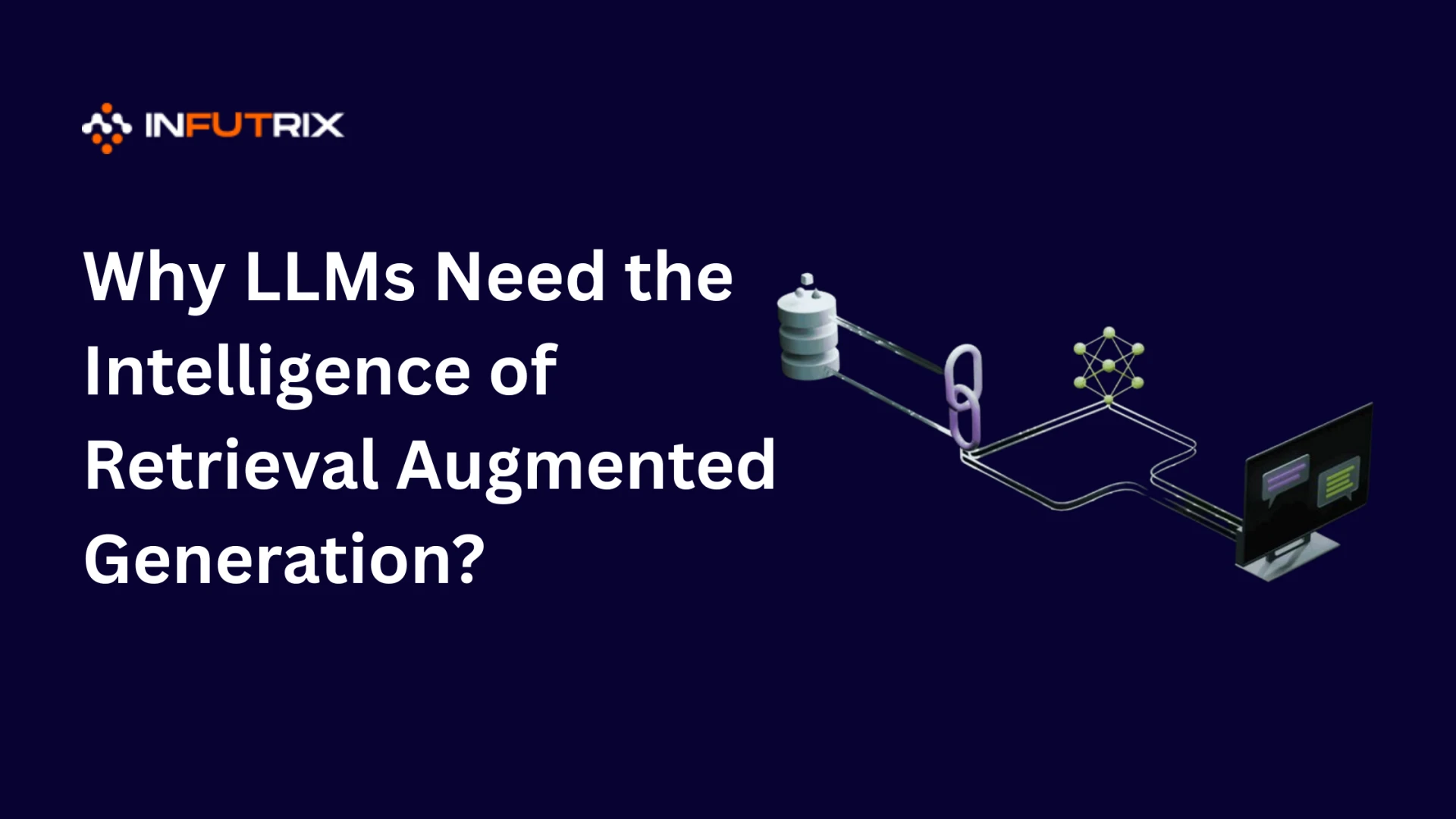

Large Language Models like those powering GPT, Gemini, and Anthropic do wonders when prompted to generate images, videos, and text. But they struggle to provide accurate data when asked about a niche subject.
If you ask LLM (Large Language Model), “How to increase our average gross profit margin from 20% to 40%?”, without any background knowledge, it will likely provide vague answers.
Though their ability to comprehend natural language and generate responses is remarkable, when asked to provide context-specific information, these models are out of sorts. To bridge this gap between users and LLMs, we have Retrieval Augmented Generation under the hood of AI development services.
What is Retrieval-Augmented Generation (RAG)
The role of Retrieval-Augmented Generation is to provide LLM with additional context, improving its relevance and accuracy.
RAG resolves three limitations that LLMs face:
- Outdated database
- Factually incorrect information
- Limited storage
RAG addresses these issues by combining retrieval-based and generation-based models. But what does this imply?
RAG enables the LLM to access additional data, retrieving relevant documents and using them in tailored response generation. Let’s understand the practical working of LLM with RAG.
How Does RAG Work?
Before we look at the chain of working, let’s get clear on vector databases. As mentioned above, RAG enables LLM to access additional data sources to provide tailored and factually correct responses.
This additional data is stored in a vector database. Unlike a traditional database that stores information in rows and columns, a vector database stores data in a set of numbers representing different pieces of information, coined as vectors.
An Overview on Mechanism of RAG
RAG integrates two models to generate accurate responses.
- Retrieval-based
The retriever fetches relevant documents and knowledge snippets from the vector database. The vector database matches the user query to the data embedded and indexed and retrieves context for the LLM.
- Generation-based
Whereas the generation model (LLM) uses the retrieved documents along with the input query to generate a fluent response by conditioning on both the original input and the external knowledge provided by the retriever.
Practical Use Cases of RAG in Real-World Systems
RAG is rapidly finding its way across different industries with its ability to amplify LLMs with relevant and credible data sources. Here are some practical use cases of RAG worth not missing:
- Healthcare Reporting
RAG-powered chatbots trained on medical data can provide medical information and support to customer queries 24//7.
- Customer Support Services
For accurate redressal of customer queries, RAG can retrieve company policies and product manuals for up-to-date responses.
- Industry Trend Analysis
By using the industry data, RAG can generate market reports, product development processes, and competitor analysis.
- Research Assistant
In-house departments like HR and Legal can use RAG-powered chatbots for company documents to ease and optimize their process.
Benefits and Challenges of Using Large Language Models with RAG
Using LLMs with RAG comes with its own set of benefits and challenges. Let’s break them down one by one.
Benefits of Retrieval-Augmented Generation
To increase the capability of Large Language Models, RAG offers several benefits. Take a look:
- Versatility
LLMs work on limited data. RAG enables LLMs to access large external databases and go beyond internal parameters. This makes RAG scalable and versatile for domain-specific tasks.
- Accuracy
RAG overcomes the limitation of outdated knowledge. The retriever fetches accurate data resources from the vector database, whic h the LLM model incorporates into the response.
- Up-to-the-Minute
RAG models are dynamic. They can draw instant inferences from external databases, which is helpful in domains where real-time information is critical.
Challenges of Implementing Retrieval-Augmented Generation
Despite its advantages to ease the process of credible response generation. Implementing LLMs with RAG faces certain challenges, like:
- Clash with Internal Knowledge
LLMs are trained on vast general knowledge datasets, which can clash with the retrieved information. Balancing the internal knowledge with retrieved data demands fine-tuning for relevant output.
- Delayed Response
Retrieving data from an external knowledge base increases the response processing time. To mitigate this challenge, these models need regular optimization that can be easily achieved with a trusted AI development company.
- Ambiguity in Retrieved Documents
If the retriever pulls outdated or irrelevant data, the response generated will be inaccurate. The success of RAG models depends on the relevance of documents. To overcome this, feed the retriever domain-specific data.
Conclusion
There is no doubt that Large Language Models (LLMs) are powerful tools. However, they often face limitations such as outdated knowledge, hallucinations, and a lack of context-specific accuracy.
Fortunately, Retrieval-Augmented Generation (RAG) provides an effective solution by enhancing LLMs with up-to-date, domain-specific data, resulting in context-aware responses.
At Infutrix, we recognize the transformative potential of RAG in building innovative, more responsive AI solutions. Let’s overcome these obstacles and open up new ways to use data effectively.
Sign in to leave a comment.