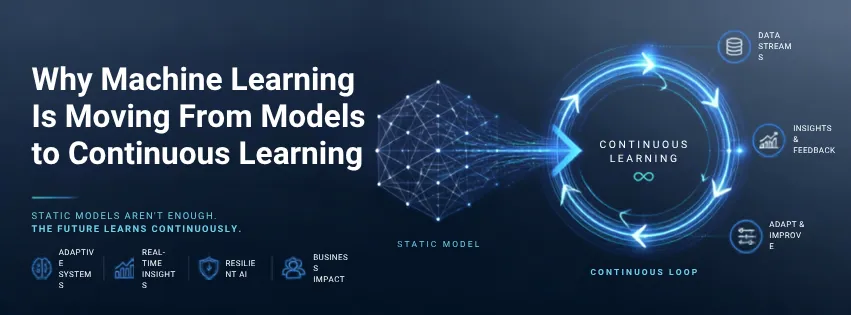

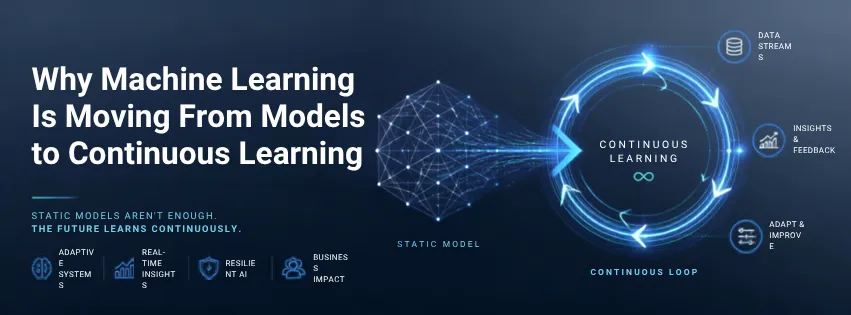
Deploying a machine learning model to production used to feel like crossing a finish line. Data science teams would spend months cleaning static training sets, tuning hyperparameters, and validating accuracy scores before handing off a frozen binary file to engineering. Once deployed, the model was considered "done."
In the real world, static models decay the moment they interact with live users. Consumer habits shift, market conditions fluctuate, and operational data drifts away from original training baselines. Treating machine learning as a series of isolated, one-off builds creates immediate technical debt and degrades system accuracy over time.
To stay reliable, modern systems are shifting away from static deployments toward dynamic continuous learning pipelines - architectures built to ingest fresh data, evaluate performance live, and update automatically without breaking production stability.
The Silent Crisis of Static Deployments - Concept and Data Drift
When a traditional machine learning model fails in production, it rarely throws a clear HTTP 500 error or crashes a container instance. Instead, it fails silently by generating confident predictions based on stale patterns.
Understanding Data Drift
Data drift occurs when the input data used by the inference engine no longer matches the distribution characteristics of the training data. For example, fraud detection models trained on pre-pandemic purchase behavior become ineffective at detecting real fraud cases because behavior shifted toward online deliveries.
Understanding Concept Drift
Concept drift occurs when the underlying relationship between inputs and target outputs changes. A credit risk model might evaluate income-to-debt ratios accurately today, but sudden macro-economic shifts or interest rate changes can alter what actually constitutes a high-risk borrower.
Relying on manual retrain cycles every quarter leaves enterprise applications blind to these real-time operational shifts.
Core Pillars of Next-Generation Continuous Learning Systems
Transitioning to a continuously updating architecture - especially when deploying machine learning on edge devices requires a fundamental redesign of software engineering and MLOps practices.
Real-Time Feedback Ingestion and Automated Labeling
A model cannot learn without feedback signals. Next-generation systems construct automated feedback loops that capture user actions or ground-truth outcomes immediately. In recommendation engines, a user clicking or ignoring a suggested item provides an instant implicit label that feeds directly back into the retraining pipeline.
Continual Learning Algorithmic Design
Simply feeding new data to a neural network causes a well-documented mathematical failure known as catastrophic forgetting - the model rewrites its weight distribution to master new incoming data while completely losing its memory of past patterns.
Modern enterprise AI solutions solve this by using specialized update strategies-
- Experience Replay Memory: Storing a strategic subset of historical samples alongside fresh data to anchor older baseline patterns during fine-tuning.
- Regularization-Based Updating: Restricting weight changes on critical nodes that hold foundational knowledge.
- Parameter Isolation: Allocating specific sub-networks to handle distinct context shifts without altering core system capabilities.
Guardrailed Online Evaluation and Canary Deployments
Automated updates require strict safety rails. Before an updated model weights package handles live traffic, automated evaluation pipelines run shadow tests comparing the candidate model against current production baselines. If the new iteration passes performance thresholds, traffic is routed gradually using canary deployment patterns to prevent regression spikes.
Most operational machine learning failures do not happen because of bad algorithms. Instead, systems break down after launch when teams struggle with weak integration practices and blind spots in their data pipelines.
Key Industry Drivers and Operational Trends
Enterprises across logistics, financial services, and industrial manufacturing are rebuilding their tech stacks around continuous feedback loops and continuous learning to keep automated systems aligned with changing real-world data.
- Rise of Streaming Data Infrastructure- Real-time event streaming platforms like Apache Kafka and Redpanda serve as the primary nervous system for continuously updated applications, feeding fresh transactional telemetry directly into edge inference engines.
- Decentralized On-Device Retraining- Pushing lightweight model updates directly to local hardware allows mobile applications and smart industrial devices to adapt to local user patterns without exposing sensitive personal data to central cloud servers.
- Agentic Memory Systems- Enterprise AI agents rely on continuously updated long-term vector stores and memory graphs to maintain operational context across multi-step business workflows.
Deploying optimized ML solutions supported by automated MLOps pipelines cuts manual maintenance overhead while keeping production predictions accurate during market volatility.
Strategic Roadmap for Engineering Teams
Moving from fixed model builds to an adaptive, self-updating architecture requires a structured, multi-phase engineering approach.
Step 1- Establish Data Drift Observability
Before automating updates, deploy monitoring frameworks like Evidently AI or Arize to track feature drift metrics (such as Wasserstein distance or Kolmogorov-Smirnov tests) across live prediction logs.
Step 2- Automate Retraining Triggers
Replace manual calendar-based retrains with event-driven pipelines. Set automated triggers that fire retrain jobs whenever statistical drift crosses a pre-defined threshold or when live prediction accuracy drops below baseline metrics.
Step 3- Implement Shadow Deployment Testing
Route real production traffic through new model candidates in a passive "shadow" mode. Compare candidate outputs against live production responses to verify performance before authorizing automated promotion.
Step 4- Partner with Domain Engineering Specialists
Designing resilient feedback loops, setting up automated feature stores, and managing edge deployments demand specialized expertise. Working with an established AI ML development company helps teams avoid common architectural pitfalls like feedback loops that propagate bad data.
Implementing custom machine learning solution architectures with native feedback channels ensures digital platforms adapt seamlessly as business realities evolve.
Concluding Thoughts
Machine learning is undergoing a permanent structural evolution. The era of treating a model as a static piece of compiled code is over. Building long-term value through continuous learning requires treating artificial intelligence as a live, adaptive process - one that continuously ingests fresh environmental signals, updates its underlying logic safely, and scales alongside changing market realities. Organizations that invest in automated feedback infrastructure today will build resilient digital systems capable of handling tomorrow's unpredictable data environments.
























Sign in to leave a comment.