

For years, the way most people approached property investment in India was fairly straightforward — pick a city, pick a locality, and hope for the best. Bengaluru was a safe bet. Mumbai always appreciated. Hyderabad was the dark horse. The conversation rarely went deeper than the city level, because city-level data was all most investors had access to, and frankly, all most investors thought they needed.
That era is over.
India's real estate market in 2026 is telling a fundamentally different story — one where the city you choose matters far less than the specific pocket within that city. Across every major metro, there are micro-markets dramatically outperforming their surrounding areas while the broader city numbers look flat or even muted. Understanding this shift is no longer optional for serious buyers and investors. It is the single most important lens through which to evaluate any property purchase today.
The Numbers Behind the Shift
India's residential real estate in 2025 recorded sales across the top seven cities valued at over ₹6 lakh crore, even as total unit volumes moderated. This divergence between value and volume is telling. Buyers are paying more per home, selecting projects more deliberately, and concentrating their demand in very specific pockets rather than spreading it broadly across a city. Homes priced above ₹1 crore accounted for more than half of total sales across major cities — a figure that would have seemed implausible even five years ago.
Premium segment homes priced between ₹1.5 crore and ₹3 crore saw roughly 10 percent growth even as the broader market softened. What drove this? Not any single city's overall performance, but specific micro-markets where infrastructure delivery, employment growth, and land scarcity converged at the right moment. The macro story was mixed. The micro story was exceptional — in the right places.
What Makes a Micro-Market?
A micro-market is not simply a neighbourhood. It is a self-reinforcing ecosystem where several factors compound over time to create sustained demand and price appreciation. The first factor is connectivity — specifically, the presence of or credible timeline for metro rail, expressways, ring roads, or airport access. The second is employment proximity, particularly the presence of IT parks, Global Capability Centres, or manufacturing clusters that bring a steady stream of working professionals who need housing nearby. The third is developer quality and project pipeline, because a micro-market with one good project is different from a micro-market where multiple credible developers are competing for land.
When these three factors align, a micro-market begins to attract both end-users who want to live there and investors who want to hold. That dual demand creates the kind of price stability and appreciation that city-level averages rarely capture.
The Infrastructure-First Principle
Every standout micro-market of the past decade — whether Whitefield in Bengaluru, Hinjewadi in Pune, or the Dwarka Expressway corridor in Gurugram — had one thing in common: infrastructure arrived before the crowd. The investors who entered when the road was being built, not when it was inaugurated, captured the maximum upside.
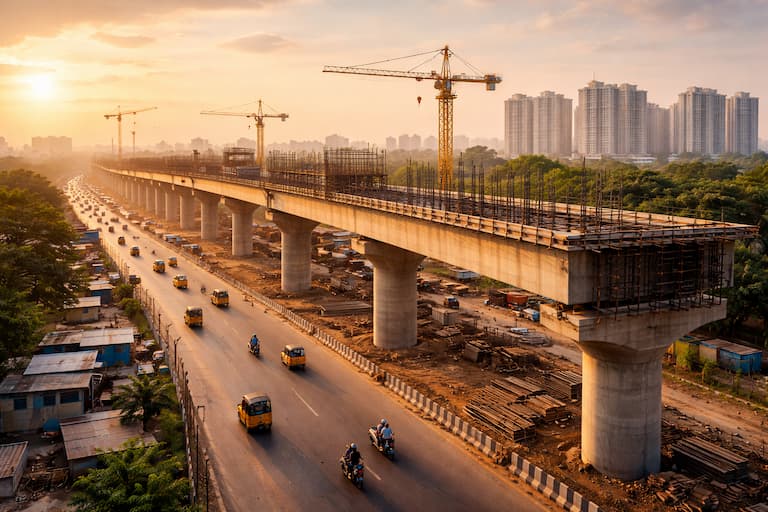
In 2026, the infrastructure pipeline across India is arguably the most robust it has ever been. Metro networks are being extended in virtually every major city. New expressways are opening up previously inaccessible urban peripheries. Airports in Tier II cities and on the outskirts of metros are reshaping commute patterns and catalysing entirely new residential corridors. The government's continued capital push into physical infrastructure is not incidental to real estate — it is the most reliable leading indicator the sector has.
Developers themselves are recalibrating their land acquisition strategies around this logic. JLL data indicated that new launches in the ₹1–3 crore bracket rose around 9 percent year-on-year in 2025, even as overall launches declined. The concentration of new supply is in infrastructure-adjacent corridors, not in the saturated cores of established cities.
North Bengaluru: The Micro-Market That Changed the Conversation
No discussion of micro-market-led growth in India is complete without addressing North Bengaluru, particularly the Devanahalli-Nandi Hills corridor. What was peripheral scrubland a decade ago has transformed into one of the most closely watched real estate investment zones in the country, driven by the Kempegowda International Airport, the proposed ITIR zone, the upcoming aerospace and defence park, and connectivity projects linking it to the rest of Bengaluru.
For buyers and investors trying to navigate this corridor with clarity, devanahalli.co.in has emerged as a focused intelligence resource, aggregating new project launches, locality insights, and investment data specifically for this micro-market. The existence of such dedicated platforms is itself a signal — when a geography generates enough investor interest to sustain specialised research and content ecosystems, it has crossed a threshold of credibility that broad city-level portals cannot adequately serve.
The North Bengaluru story is a textbook case of the infrastructure-first principle playing out in real time, and it continues to attract both domestic end-users and NRI investors seeking long-term capital appreciation.
The Role of REITs and Institutional Capital
The sophistication of the micro-market thesis is being validated not just by retail buyers but by institutional capital. India's REIT market crossed ₹1.66 lakh crore in value, and SEBI's reclassification of REITs as equity instruments for institutional investors in 2026 is channelling significant new capital into the sector. Institutional investors do not make city-level bets — they underwrite specific assets in specific locations based on granular demand and supply analysis. The markets they favour tend to validate themselves over time.
For retail investors, this institutional vote of confidence in certain corridors and asset classes is an important signal. When pension funds and sovereign wealth vehicles are buying Grade A assets in a particular geography, the underlying micro-market fundamentals tend to be sound.
What Smart Buyers Are Doing Differently
The buyers and investors navigating this market well in 2026 share a common approach. They research micro-markets before they research projects. They look at employment data, infrastructure timelines, developer pipelines, and land pricing before they evaluate floor plans and amenity lists. They understand that the best apartment in the wrong micro-market will underperform a decent apartment in the right one.
They are also thinking beyond the traditional apartment. Plotted developments in emerging corridors, gated villa communities, and township-format projects are all capturing disproportionate demand from buyers who prioritise long-term lifestyle value alongside investment returns. Developers are responding — new launches in these formats are concentrated precisely in the micro-markets where infrastructure is arriving fastest.
The Takeaway
India's real estate market is not slowing down. It is maturing. The era of broad-based, city-level price appreciation is giving way to a more discriminating market where knowledge, timing, and location precision determine outcomes. The buyers who treat "which city" as the primary question will increasingly find themselves on the wrong side of the return curve compared to those asking "which corridor, which micro-market, and why now."
The data from 2025 and the projections for 2026 are unambiguous: in Indian real estate today, the micro-market is the macro strategy.





























Sign in to leave a comment.