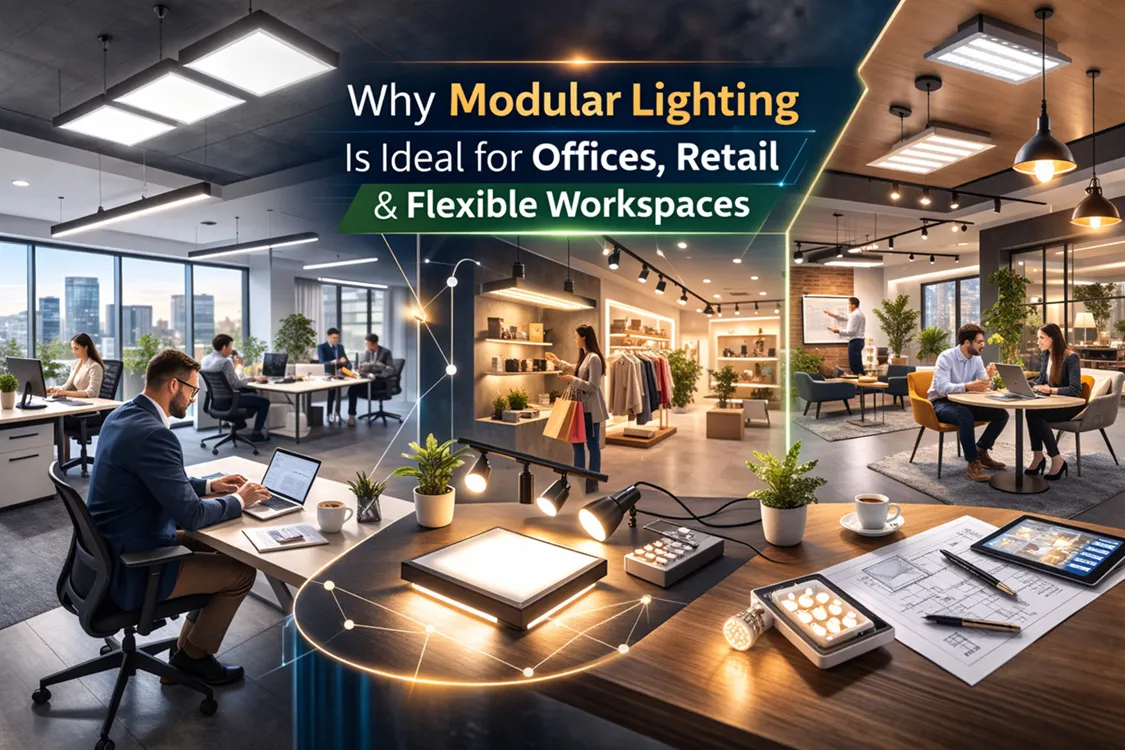

Commercial spaces have to adapt to working methods and market expectations. Today's offices must accommodate hybrid working, retail spaces are adapting to the changing requirements of display and promotion, and flexible workspaces need lighting that evolves with their function. Modular systems of lighting are intelligent, efficient solutions that prepare businesses for the demands of the future.
Modular lighting involves the installation of interchangeable lighting modules that function independently but work as part of a unified system. Unlike traditional lighting fixtures that must be removed and replaced when they've reached the end of their useful life, modular systems allow individual parts to be upgraded, repaired or reconfigured. It is this flexibility that makes them ideal for offices, shops and other workspaces.
Efficiency, Sustainability and Cost Savings
The most obvious benefit of modular lights is their energy efficiency. Most modular systems use LED technology, which can reduce energy consumption by up to 80% compared to incandescent or fluorescent lighting. This is because LED lamps produce very little heat, which means most of the energy they use is converted into light.
However, energy savings are only one of the advantages. Modular lighting makes a significant contribution to sustainability. Individual modules can be replaced or upgraded, which means there is no longer a need to discard entire fixtures. This minimises waste and reduces the consumption of resources over the life of the system. It enables businesses to adhere to the principles of the circular economy by reusing and repairing elements of their lighting systems instead of relying on single-use products.
Sustainability reporting and green building certifications are integral to modern businesses, and modular systems make it easier for them to meet their energy-efficiency targets, lower their carbon footprint and reduce their operational costs.
Flexibility and Adaptability in a Changing Commercial World
Offices and flexible workspaces need adaptable lighting. Working patterns change as teams grow, departments are restructured, and hybrid working puts new demands on physical layouts. Going modular is the perfect answer. Lighting fixtures can be repositioned, expanded or reduced without the need to embark on rewiring and construction projects.
This flexibility is especially helpful in collaborative spaces where lighting needs can vary across open-plan areas, meeting rooms, and breakout zones. It enables businesses to reconfigure their lighting at a moment's notice, thus ensuring that the quality of light is always appropriate to specific circumstances.
Similarly, in the retail sector, product and promotional displays can be updated at the flick of a switch. Track lighting and movable LED modules can be adjusted to highlight seasonal promotions, draw the attention of customers to new products and transform the look and feel of the whole store.
Smarter, Easier Maintenance
The major flaw in most traditional lighting systems was the need to replace the whole system upon the failure of one part. In modular fittings, only the faulty part is replaced, which reduces downtime, labour costs and waste. Maintenance becomes much more efficient, and the lighting systems can be kept up to date with the latest energy-saving technology.
In the long term, this targeted replacement translates into significant cost savings. Businesses can phase their upgrades, install new smart control features and add advanced modules when needs change and budgets allow.
Productivity, Wellbeing and the Customer Experience
Lighting plays an important role in employee performance and satisfaction. Modular systems can be fitted with smart sensors, occupancy controls, and daylight-harvesting technologies to ensure that spaces are properly lit throughout the day and lights are never left on in empty rooms. Lighting controls can also be used to match circadian rhythms, helping staff stay well-regulated and energised.
Modular lighting improves the comfort of employees by reducing eye strain and improving concentration. Productivity and wellbeing increase. The same is true in the retail sector: good lighting makes the environment inviting for shoppers and improves the visibility of products. That can only be good for sales.
Preparing for the Future
Increasingly, modular systems are integrated with IoT platforms and advanced control systems. The benefits of this include:
- automated dimming
- adaptive colour temperature
- adjustments based on occupancy
- compatibility with building management systems
These smart capabilities deliver further energy savings and future-proof commercial spaces against the uncertainties of future technological standards.
The Many Benefits of Modular Lighting
Businesses understand the importance of flexible, sustainable working environments, and modular systems provide a scalable method of meeting both current and future demands. In offices, retail outlets and flexible workspaces, modular systems work with and not against the grain of innovation and growth.
Ultimately, it's a question of perception. Modular lighting isn't just an upgrade, it's a long-term investment in efficiency, sustainability and versatility.




























Sign in to leave a comment.