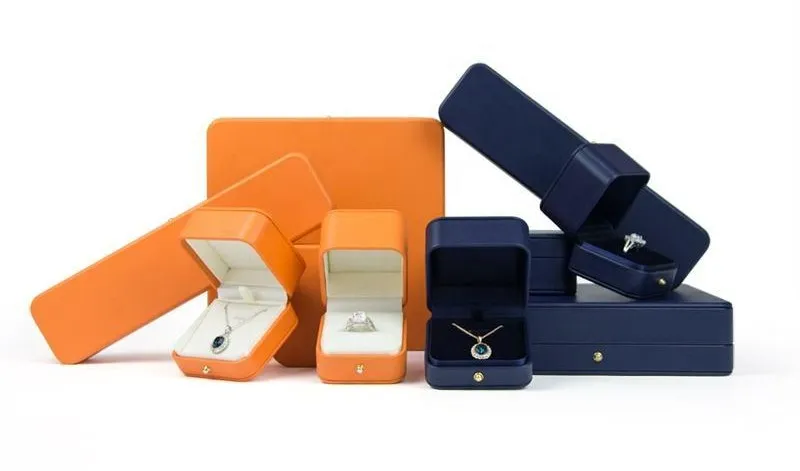

You've seen it. A customer sends you a photo six months after purchase. They're not showing off the necklace. They're showing you the box—peeling at the corners, hinge wobbling, interior lining shedding fibers onto their dresser. They're not angry, exactly. Just disappointed. And disappointment, for a brand, is way harder to fix than a broken clasp.
Most packaging failures aren't random accidents. They're predictable outcomes of specific manufacturing shortcuts. The good news is that once you know what those shortcuts look like, you can avoid them entirely. This article breaks down the four most common failure points in jewelry packaging and explains what a leather jewelry box manufacturer should be doing differently at each stage.
The Glue Problem Nobody Talks About
Let's start with the most boring, least visible, and most destructive component in any jewelry box: adhesive. Cheap glue is the silent killer of packaging. It off-gasses inside the box, which can tarnish silver. It dries out and becomes brittle, so your suede lining separates from the board underneath. It fails in humidity, so boxes stored in a bathroom or shipped to a tropical climate start delaminating within weeks.
And here's the thing—you'd never know from looking at a new sample. A freshly glued box looks perfect. It takes months for the adhesive to reveal its weaknesses. By then, you've already shipped hundreds of units.
A quality-focused manufacturer uses water-based, low-VOC adhesives that remain flexible after curing. Flexibility matters because boxes expand and contract with temperature changes. A rigid adhesive cracks. A flexible one moves with the material. The cost difference is negligible. The performance difference is massive. When you're vetting a supplier, ask them directly: "What adhesive do you use, and how does it perform in high-humidity environments?" If they can't answer, they're probably using the cheap stuff.
Hinges That Hold Up vs. Hinges That Give Up
Now, this is where most people go wrong. They focus on how a hinge looks—brass finish, gold tone, antique silver—and ignore how it's built. A hinge is a mechanical component, not a decorative one. It has a job to do, and that job gets harder every time someone opens the box.
Cheap hinges are typically made from zinc alloy with a thin cosmetic plating. The internal pin is undersized for the load it carries. After a few hundred cycles, the holes elongate, the pin shifts, and the lid starts to wobble. Eventually the plating wears off at the friction points, exposing dull gray metal underneath.
A proper hinge uses stainless steel or solid brass with a properly sized pin and reinforced mounting points where it attaches to the box structure. It should cycle smoothly without lubrication and maintain alignment even when the lid is opened to its full range of motion. Ask your supplier for a cycle-test rating. A decent hinge should handle at least five thousand opens without failure. If they look confused by the question, move on.
The Lining That Becomes a Liability
Interior lining is the part your customer touches most. It's also the part most likely to fail in embarrassing ways. Flocked velvet—that sprayed-on fuzzy coating—sheds. Every time. It looks decent at first, but the fibers aren't woven in; they're glued on. Friction from removing and replacing jewelry gradually rubs them off, leaving bald patches and a fine dust that gets on everything.
Woven velvet or suede, properly backed and adhered, doesn't have this problem. Neither does a dense microfiber with a knit backing. These materials cost more per yard, but they don't self-destruct. When you're discussing specs with a custom leather jewelry box supplier, feel the lining sample aggressively. Rub it with your thumb. Scratch it lightly. If anything flakes off, reject it. Your customers will be doing the same thing, intentionally or not, every time they take their jewelry out.
| Failure Point | Cheap Shortcut | What to Look For |
| Adhesive | Solvent-based, dries brittle | Water-based, stays flexible after curing |
| Hinge | Zinc alloy, undersized pin | Stainless steel or brass, rated for 5K+ cycles |
| Lining | Sprayed flocked velvet | Woven velvet, suede, or knit-backed microfiber |
| Corner joints | Butt-joined, glue-only | Reinforced with internal stays or wrapped leather |
Corners: Where the Whole Thing Comes Undone
The corners of a box take more abuse than any other part. They get bumped during shipping, knocked against nightstands, dropped into bags. If the corner construction is weak, that's where the failure starts.
Cheap boxes use butt joints—two pieces of board meeting at a right angle with nothing but glue holding them together. Good boxes wrap the leather continuously around the corner or reinforce the internal joint with a structural stay. The difference is immediately visible if you know to look. Run your finger along the corner of a sample. Is it solid all the way through, or does it flex? Flex means failure is coming.
These four failure points—glue, hinges, lining, corners—account for the vast majority of packaging complaints. None of them are hard to solve if the manufacturer cares enough to solve them. The challenge is finding a partner who thinks in terms of years, not shipments. Working with an experienced leather jewelry box manufacturer that builds with proper adhesives, rated hardware, and reinforced construction means your packaging survives daily use without slowly coming apart at the seams. And that means your customers remember the jewelry, not the disappointment.
Frequently Asked Questions
How can I test packaging durability before placing a bulk order?
Order a pre-production sample and abuse it. Open and close it a hundred times. Leave it in a humid bathroom for a week. Drop it from waist height onto a hard floor. Ship it to yourself in actual transit conditions. If it survives all of that, it'll survive your customers.
What's the shelf life of a well-made leather box?
Decades, if stored in reasonable conditions. Full-grain leather develops a patina but doesn't degrade structurally. The limiting factor is usually the adhesive, which is why water-based flexible adhesives matter so much for long-term durability.
Does climate affect leather packaging differently?
Yes. Dry climates can cause leather to stiffen if it's not properly conditioned during manufacturing. Humid climates accelerate adhesive failure in cheap boxes. A good manufacturer adjusts their production process based on where the boxes are ultimately going.
Is it normal for new leather boxes to have a smell?
A mild leather scent is normal and desirable. A sharp chemical odor is not. That smell indicates solvent-based adhesives or synthetic materials off-gassing. It usually fades, but the fact that it's there at all tells you something about what's inside the box.
Can packaging failure damage the jewelry itself?
Absolutely. Off-gassing adhesives can accelerate tarnish on silver. Shedding fibers from cheap linings can get caught in chain links and settings. A box that doesn't close securely can allow pieces to fall out. Packaging failure isn't just an aesthetic problem.
Boxes fall apart for predictable reasons. The fixes are well-known, affordable, and entirely within a good manufacturer's capability. You just have to ask the right questions before you order, and you have to be willing to walk away from a supplier who can't answer them. Your brand's reputation lives inside that box. Make sure it's built to stay there.























Sign in to leave a comment.