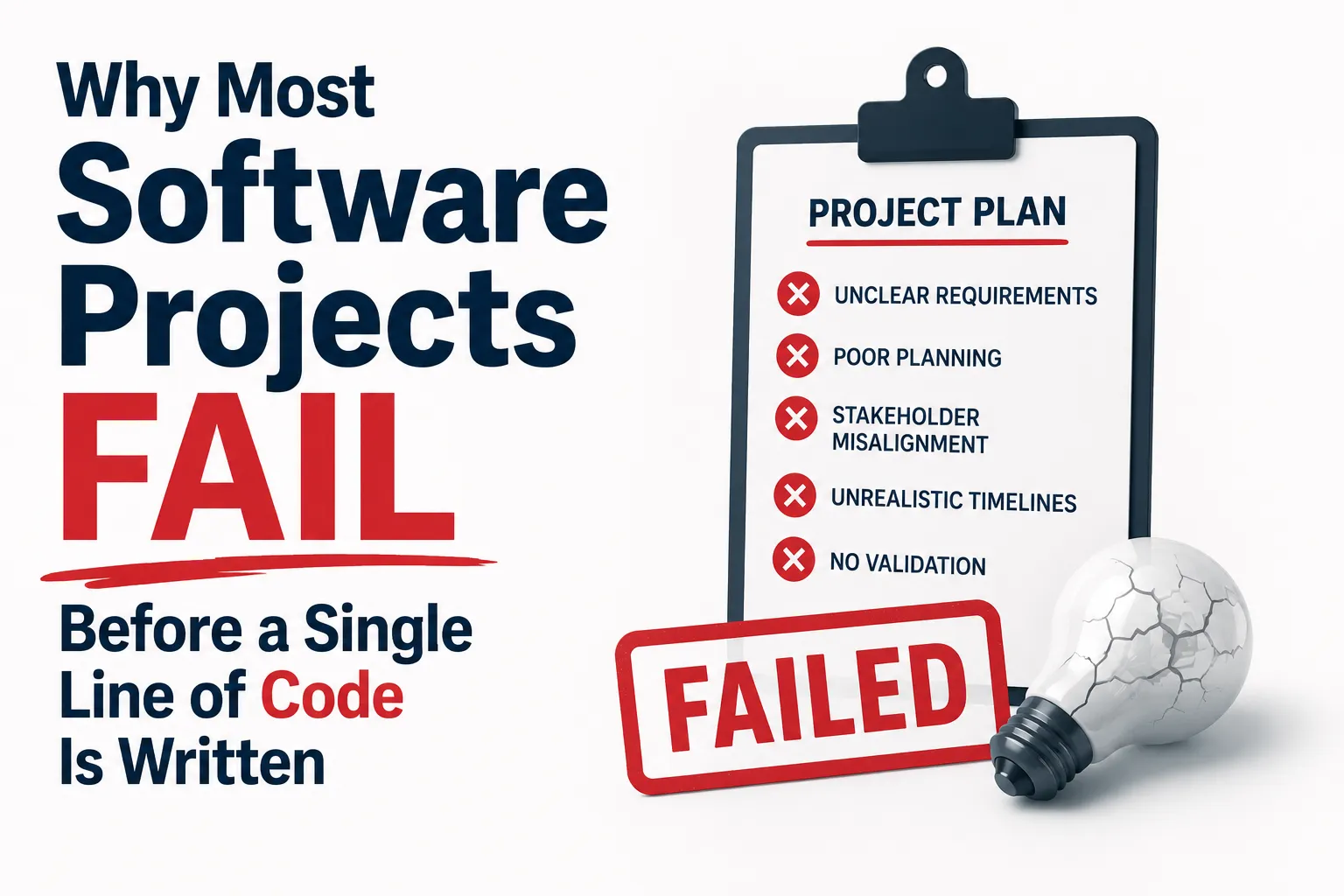

When software projects fail, people usually blame development.
They point to coding errors, missed deadlines, budget overruns, or technical problems.
In reality, many software projects are already heading toward failure long before developers start writing code.
The biggest risks often emerge during planning, strategy, and decision making.
A great development team can build exactly what was requested. The problem is that businesses sometimes request the wrong solution.
The Cost of Building Without Clarity
Many organizations approach software development with a simple objective.
"We need an app."
"We need a platform."
"We need a custom system."
The technology itself becomes the focus.
What often gets ignored is the business problem that the software is supposed to solve.
Without clearly defined objectives, development teams are forced to make assumptions. Every assumption increases the risk of building features that users do not need and businesses do not benefit from.
Software should solve a problem.
If the problem is unclear, the software will struggle to create value.
Features Do Not Equal Success
One of the most common mistakes in software development is measuring success by the number of features delivered.
More features often mean:
- Higher development costs
- Longer timelines
- Increased complexity
- Greater maintenance requirements
Successful software is rarely the software with the most features.
Successful software is the software that solves important problems with the least amount of friction.
The goal should not be feature accumulation.
The goal should be user adoption.
Why User Experience Matters More Than Technology
Businesses frequently focus on programming languages, frameworks, and technology stacks.
While technical decisions are important, users rarely care about the technology powering an application.
Users care about results.
Can they complete tasks quickly?
Can they find information easily?
Can they achieve their goals without confusion?
An application built with the latest technology can still fail if the user experience is frustrating.
On the other hand, software built on mature technologies can succeed if it delivers a smooth and intuitive experience.
The Hidden Cost of Poor Requirements
Software development becomes expensive when requirements constantly change.
Many businesses underestimate the importance of requirements gathering.
A few extra weeks spent defining workflows, user journeys, and business rules can save months of redevelopment later.
Every change made during development affects:
- Design
- Development
- Testing
- Documentation
- Deployment
The earlier problems are identified, the cheaper they are to fix.
Custom Software Is Not Always the Right Choice
There is a common belief that custom software is automatically superior.
Sometimes it is.
Sometimes it is not.
Businesses should evaluate whether existing solutions already solve their challenges.
Custom development becomes valuable when:
- Unique workflows exist
- Competitive differentiation is important
- Existing tools create operational limitations
- Scalability requirements exceed standard platforms
The decision should be based on business value rather than technology preferences.
Scalability Should Be Planned From Day One
Many startups focus exclusively on launching quickly.
Speed is important, but scalability matters too.
Software architecture decisions made during the first few months often influence performance, maintenance costs, and growth potential for years.
A system designed for one hundred users may struggle when serving one hundred thousand.
Planning for growth early reduces future technical debt and prevents expensive rebuilds.
Software Development Is a Business Investment
Too many organizations treat software development as a technical expense.
The most successful companies view it differently.
Software is an investment in efficiency, customer experience, automation, and growth.
Every feature should contribute to measurable business outcomes such as:
- Revenue growth
- Cost reduction
- Productivity improvements
- Customer retention
- Market expansion
When software aligns with business goals, development becomes easier to justify and easier to measure.
The Rise of Outcome Driven Development
Modern software development is shifting away from feature driven thinking.
Leading organizations are focusing on outcomes instead.
Instead of asking:
"What features should we build?"
They ask:
"What business result are we trying to achieve?"
This mindset creates better products because development decisions are tied directly to measurable objectives.
The result is software that delivers value rather than simply functionality.
Final Thoughts
The success of a software project depends on far more than coding skills.
Clear objectives, user understanding, strategic planning, and business alignment all play critical roles.
Technology can accelerate growth, improve operations, and create competitive advantages.
But only when it is built with purpose.
The most successful software projects are not the ones with the biggest budgets or the most advanced technologies.
They are the ones that solve real problems in ways that users genuinely appreciate.


























Sign in to leave a comment.