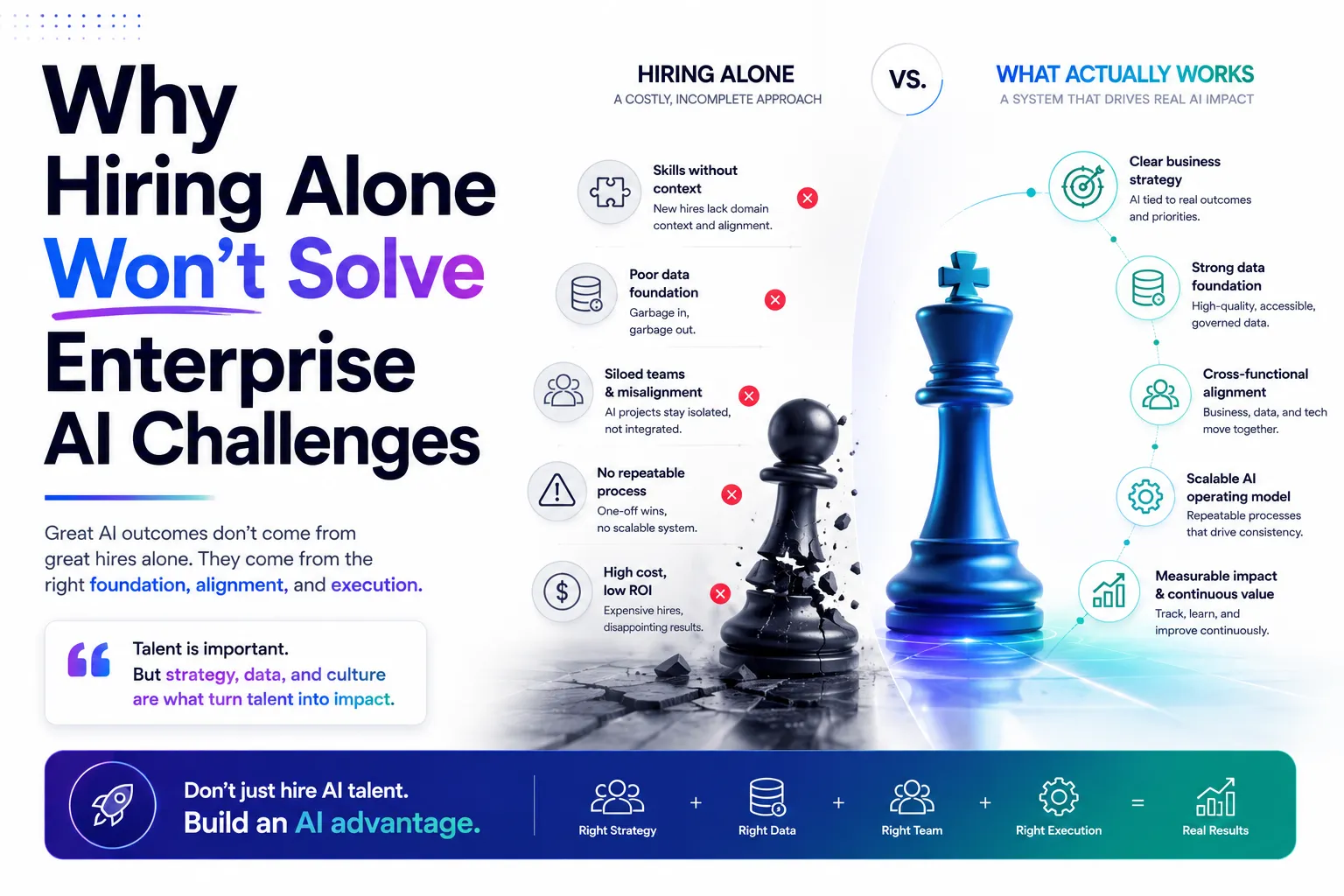

When executives discuss enterprise AI initiatives, the conversation often turns to hiring. Organizations assume the fastest path to AI adoption is recruiting more machine learning engineers, data scientists, and AI specialists. While talent is important, many enterprises discover that hiring alone does not solve the deeper challenges involved in building production-ready AI systems.
The reality is that enterprise AI is not a single technology project. It is an organizational transformation that touches infrastructure, security, data governance, software development, compliance, product strategy, and business operations. A company may hire several talented AI engineers and still struggle because the surrounding systems and processes are not prepared to support AI at scale.
This is one reason flexible engineering models are gaining attention across enterprise technology teams. Organizations increasingly recognize that AI projects require different expertise at different stages. Instead of permanently expanding headcount for every possible skill requirement, many companies are exploring elastic engineering approaches that allow them to bring in specialized capabilities when they are needed most. Industry engineering pod models already follow this principle by providing cross-functional expertise that works alongside internal teams to deliver specific outcomes.
Direct Answer: Hiring more engineers can help enterprise AI initiatives, but hiring alone is rarely enough. Successful AI programs require flexible access to infrastructure, data, security, software, and AI expertise that changes throughout the project lifecycle. Elastic engineering teams help enterprises access those capabilities without building oversized permanent teams.
The Enterprise AI Talent Problem Is More Complex Than It Appears
Most enterprise leaders begin their AI journey by focusing on skills shortages. This is understandable because experienced AI professionals remain in high demand. However, the challenge extends beyond finding machine learning expertise.
Consider a company building an AI-powered knowledge assistant for employees. The project may begin with a few AI engineers developing prompts and workflows. Very quickly, however, additional requirements emerge. Data engineers must connect internal systems. Cloud architects must manage infrastructure. Security teams must address governance concerns. Product managers must align the solution with business objectives. Operations teams must monitor performance after deployment.
The project becomes much larger than the original hiring plan.
This pattern appears repeatedly across enterprise AI initiatives. Organizations discover that AI is not a standalone function. It depends on a broad ecosystem of technical and operational capabilities. Research on enterprise AI deployment highlights the importance of integrating tools, workflows, evaluation systems, training pipelines, and enterprise applications into a unified environment rather than treating AI as an isolated layer.
As a result, hiring a handful of AI specialists often solves only one piece of a much larger problem.
Why Fixed Teams Struggle With AI Initiatives
Traditional software teams are usually designed around relatively stable requirements. AI projects behave differently.
During the early stages of development, organizations may require architects and platform engineers to establish infrastructure foundations. Once systems are operational, demand shifts toward AI engineers, data specialists, and integration experts. Later, governance, evaluation, and monitoring become major priorities. Each phase requires a different combination of skills.
A fixed team structure can create inefficiencies because the expertise required changes over time.
For example, a company may hire infrastructure specialists for an AI initiative. Those specialists are essential during implementation but may be underutilized after the environment is fully established. Conversely, organizations sometimes delay projects because they lack a specific capability needed for only a short period.
This mismatch creates both financial and operational challenges.
Elastic engineering models help address the problem by aligning resources with project phases. Instead of maintaining every capability permanently, enterprises can access specialized expertise when it creates the greatest value. This flexibility allows organizations to move faster without carrying unnecessary staffing overhead throughout the lifecycle of the project.
Enterprise AI Requires More Infrastructure Than Most Leaders Expect
One reason AI projects become difficult is that organizations often focus on models while underestimating infrastructure requirements.
Modern enterprise AI systems depend on far more than large language models. They require retrieval systems, search layers, data pipelines, monitoring tools, orchestration frameworks, access controls, and governance mechanisms. The infrastructure surrounding the model often determines whether the solution succeeds in production.
This is particularly true for retrieval-augmented generation systems and enterprise search experiences. Elastic's own AI positioning emphasizes the importance of combining search, retrieval, and enterprise data access to improve AI outputs and provide context-driven responses.
Building this infrastructure requires expertise that many organizations do not possess internally. Hiring every specialist full-time can be difficult, especially when those skills may only be required during specific implementation phases.
Elastic engineering teams provide an alternative by allowing organizations to access infrastructure expertise without permanently expanding internal departments. This creates a more efficient path toward deployment while reducing the risks associated with long-term staffing commitments.
Why Cross-Functional Collaboration Matters More Than Individual Talent
Enterprise AI success depends less on individual brilliance and more on coordination.
A highly skilled machine learning engineer cannot solve data quality problems alone. A cloud architect cannot define business objectives. A security specialist cannot optimize user experience. Each discipline contributes something important, but value emerges when those capabilities work together effectively.
This is why enterprise engineering has historically focused on viewing organizations as interconnected systems of people, information, and technology rather than isolated departments. Enterprise AI amplifies this requirement because successful deployments depend on cooperation across multiple teams and business functions.
Unfortunately, many enterprises still structure projects around organizational silos. AI teams work separately from infrastructure teams. Security teams become involved late in the process. Product groups and engineering teams operate with different priorities.
These disconnects often slow progress more than technology itself.
Elastic engineering teams help reduce these barriers by bringing together specialists around a shared outcome rather than departmental boundaries. The focus shifts from managing functions independently to solving business problems collaboratively.
For AI initiatives, this cross-functional structure can significantly improve execution speed and alignment.
Why Enterprise AI Is Becoming an Ongoing Capability
Another reason hiring alone is insufficient is that AI adoption is no longer a one-time project.
Many organizations initially approached AI through pilots and proofs of concept. Today, the conversation has shifted toward operationalizing AI across multiple departments and workflows. Companies increasingly want AI systems that improve continuously and become embedded in everyday business operations.
Recent enterprise AI discussions emphasize ownership of organizational intelligence rather than reliance on isolated AI tools. Businesses are focusing on building systems that accumulate knowledge, integrate with operational processes, and generate long-term competitive advantages.
This shift changes staffing requirements.
Organizations no longer need teams solely for development. They also need capabilities for optimization, monitoring, governance, evaluation, and ongoing enhancement. Research into enterprise AI assurance similarly highlights that evaluation and risk management must become core engineering disciplines rather than afterthoughts.
Elastic engineering models support this reality by providing adaptable access to expertise throughout the lifecycle of an AI system. Enterprises can scale resources according to evolving priorities rather than committing to rigid staffing structures.
What Enterprise Leaders Should Focus on Instead
Many AI initiatives begin with a hiring plan. A better starting point is a capability plan.
Instead of asking which roles need to be hired immediately, leaders should identify the capabilities required at each stage of the AI journey. Those capabilities may include data engineering, cloud infrastructure, security, retrieval systems, evaluation frameworks, governance, product strategy, and AI development.
Once those requirements are understood, organizations can determine which capabilities should remain internal and which can be accessed through flexible engineering models.
This approach often produces better outcomes because it aligns talent decisions with business objectives rather than organizational assumptions. It also helps companies avoid overbuilding teams before actual needs are fully understood.
Organizations exploring an elastic engineering team model often discover that flexibility itself becomes a strategic advantage. They gain the ability to move quickly, adapt to changing requirements, and access expertise without lengthy hiring cycles.
In an environment where AI technologies evolve constantly, that adaptability can be just as important as technical talent.
Conclusion
The biggest challenge facing enterprise AI is not simply a shortage of engineers. It is the complexity of coordinating diverse capabilities across rapidly changing projects. AI initiatives require infrastructure, governance, security, software development, data management, and business alignment working together as a cohesive system.
Hiring remains important, but hiring alone rarely solves these challenges. Fixed team structures often struggle to keep pace with evolving requirements, while oversized permanent teams create unnecessary costs and inefficiencies.
Elastic engineering teams offer a more adaptable approach. By providing flexible access to specialized expertise, they help organizations align resources with project needs and accelerate AI delivery without sacrificing agility. As enterprise AI adoption continues to expand, the ability to scale engineering capabilities intelligently may become one of the most important competitive advantages organizations can develop.
FAQs
Why isn't hiring more AI engineers enough?
Enterprise AI requires expertise in infrastructure, data, security, governance, software engineering, and business operations in addition to AI development.
What is an elastic engineering team?
An elastic engineering team is a flexible group of specialists that can expand or contract based on project requirements.
How do elastic engineering teams help AI projects?
They provide access to specialized expertise when needed, helping organizations avoid bottlenecks and staffing inefficiencies.
Why are AI projects difficult to staff?
The skills required change throughout the project lifecycle, from infrastructure and data preparation to deployment and optimization.
What capabilities are most important for enterprise AI?
Data engineering, cloud infrastructure, security, governance, AI development, monitoring, and product alignment are all critical components.
Why are enterprises adopting flexible engineering models?
They allow companies to access expertise faster, reduce hiring delays, and align resources more effectively with changing project needs.


























Sign in to leave a comment.