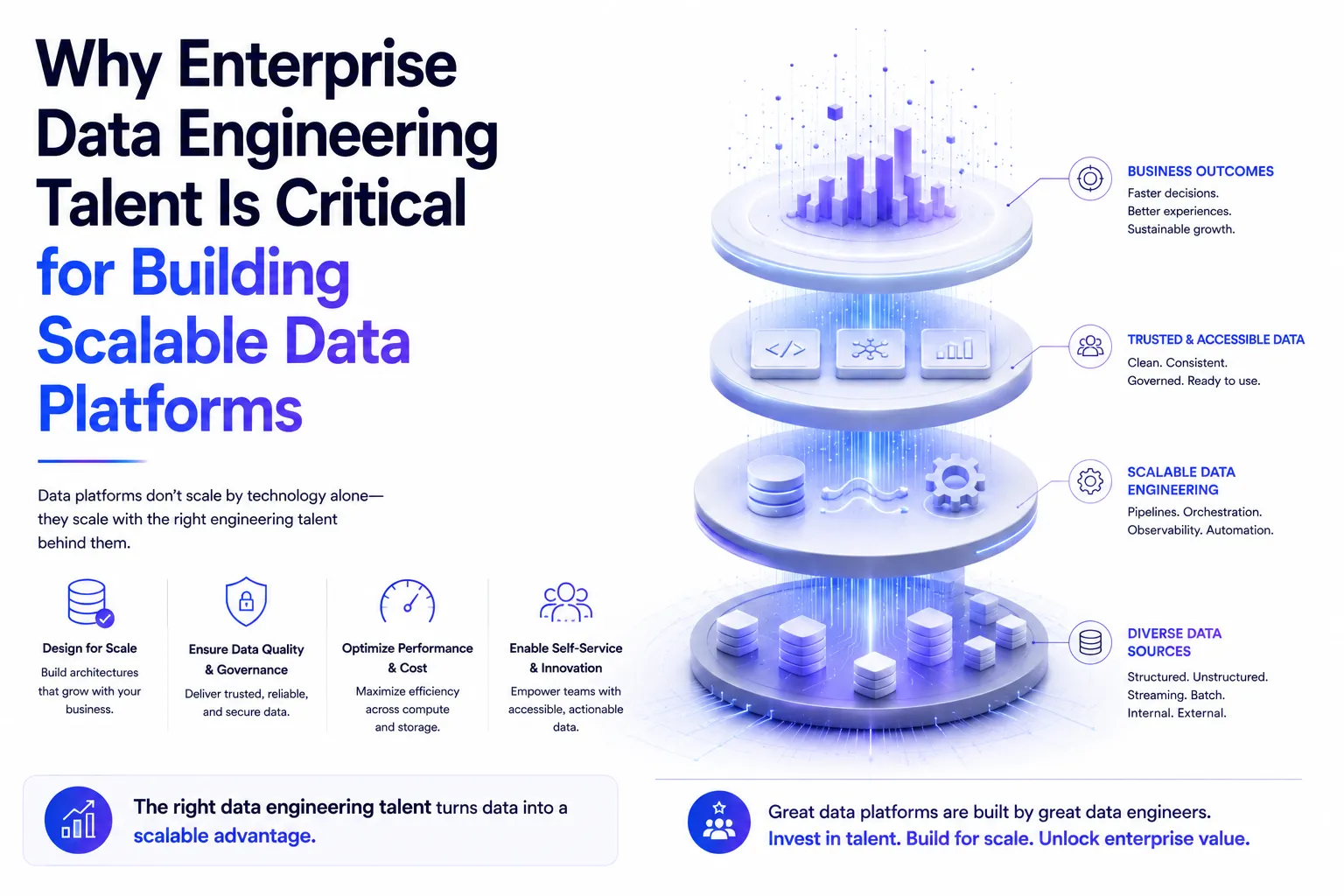

Modern businesses run on data. Every customer order, financial transaction, operational process, and business decision depends on information moving between systems quickly and accurately. As companies grow, the amount of data they manage increases rapidly. Without the right infrastructure, even simple tasks can become slower, more expensive, and harder to manage.
This is why enterprise data engineering has become one of the most important parts of modern technology. Data engineers build the systems that collect, organize, and deliver information across the business. Their work allows employees, applications, and AI systems to access reliable data whenever it is needed.
As digital transformation continues across every industry, organizations are realizing that hiring experienced data engineering talent is not just about filling technical positions. It is about building scalable platforms that support future business growth, reduce operational challenges, and prepare the organization for new technologies.
A Scalable Data Platform Supports Business Growth
Many organizations build data systems that work well when the business is small. They support a limited number of users, process manageable amounts of information, and connect only a few applications. During this stage, everything appears to work as expected because demand is relatively low.
The situation changes as the company grows. More employees begin using business applications. New software is introduced across different departments. Customer data increases every day, and executives expect faster reporting and deeper business insights. Suddenly, the existing platform has to handle far more work than it was originally designed for.
A scalable data platform is built with future growth in mind. It allows businesses to process larger amounts of information without slowing down performance or increasing operational complexity. Instead of rebuilding systems every few years, organizations can continue expanding while using the same strong foundation.
Good Architecture Matters More Than Bigger Servers
Many people believe scalability simply means buying more powerful servers or increasing cloud resources. While additional infrastructure can improve performance, it cannot solve problems caused by poor system design.
The foundation of scalability is good architecture. Experienced data engineers carefully plan how information moves across the business. They decide how data should be stored, how applications should connect with one another, and how new systems can be added without disrupting existing operations.
These decisions have a long-term impact. A well-designed architecture can support business growth for many years. A poorly designed one may work during the early stages but eventually becomes difficult to maintain as workloads increase.
This is why experienced engineering talent is so valuable. They build platforms that remain reliable as the business continues growing instead of creating systems that need frequent redesign.
Enterprise Data Continues to Become More Complex
Business data is no longer stored in one location.
Customer information may exist inside a CRM platform. Financial records may be managed through accounting software. Supply chain data comes from ERP systems, while employee information lives inside HR platforms. Every department depends on different applications, yet all of them need to work together.
Managing this environment requires much more than moving data from one system to another. Engineers must ensure information remains accurate, secure, and available across every connected platform. They also need to maintain consistent data quality while supporting changing business requirements.
As organizations continue adding new software, the complexity only increases. Without experienced engineers, businesses often struggle to keep systems connected and reliable. Over time, these challenges reduce productivity and slow down future technology projects.
Reliable Data Improves Decision-Making
Business leaders make important decisions every day. They decide where to invest, which products to improve, how to reduce costs, and how to respond to changing customer demands. Every one of these decisions depends on accurate information.
If reports contain outdated or inconsistent data, leaders lose confidence in the numbers. Teams spend extra time checking reports instead of acting on them. Different departments may even work with conflicting information because their systems are not properly connected.
Strong data engineering solves these problems by creating reliable pipelines that deliver trusted information throughout the organization. Employees no longer need to question whether reports are correct because everyone works from the same consistent data.
This improves decision-making at every level of the business. Executives gain better visibility into performance, managers respond to problems more quickly, and employees spend more time creating value instead of correcting information.
AI Depends on Strong Data Engineering
Artificial intelligence is becoming part of everyday business operations. Companies are using AI to improve customer service, automate repetitive work, predict future demand, and help employees make faster decisions. Although AI receives most of the attention, its success depends heavily on the quality of the underlying data.
AI systems cannot produce reliable results if the information they receive is incomplete or inaccurate.
Experienced data engineers prepare data before it reaches AI models. They remove duplicate records, organize information into consistent formats, monitor data quality, and ensure information is updated continuously. This allows AI applications to produce results that businesses can trust.
Organizations that invest in strong engineering foundations usually achieve better AI outcomes because their systems are built on reliable, well-managed information from the beginning.
Strong Engineering Reduces Technical Debt
Many businesses create temporary solutions when they need to move quickly. A new pipeline is added to support one department. Another integration is built for a short-term project. Manual processes remain in place because replacing them is postponed until later.
Over time, these temporary solutions become permanent.
The result is technical debt. Systems become harder to maintain, integrations become more complicated, and engineers spend more time fixing old problems than building new capabilities. Innovation slows because so much effort is spent maintaining existing infrastructure.
Experienced data engineers help prevent this situation. They design reusable solutions, follow consistent engineering standards, and build platforms that are easier to maintain over time. This reduces long-term costs while allowing future projects to move much faster.
Investing in Engineering Talent Creates Long-Term Value
Hiring experienced data engineers requires both time and investment. However, the value they create extends far beyond technology projects.
Reliable engineering improves reporting accuracy, strengthens AI initiatives, reduces operational delays, supports cloud transformation, and helps every department work more efficiently. Instead of solving the same infrastructure problems repeatedly, businesses can focus on innovation and growth.
Strong engineering teams also create flexibility. As new technologies emerge, organizations can adopt them more quickly because their data platforms are already designed to support future expansion. This makes technology investments more valuable over the long term.
Companies looking for enterprise data engineering talent are increasingly focused on building these long-term capabilities instead of simply filling technical positions. They understand that experienced engineers create business value that continues long after the initial project is complete.
Conclusion
Scalable data platforms are the foundation of modern enterprise technology. They support business growth, improve decision-making, enable AI, and allow organizations to manage increasing amounts of information without sacrificing performance. None of this happens without experienced data engineering talent.
The best data engineers do far more than build pipelines. They design reliable architectures, improve data quality, reduce technical debt, and create systems that continue supporting the business as it grows. Their work allows organizations to adopt new technologies with confidence while maintaining stable and efficient operations.
As enterprises continue investing in digital transformation, experienced data engineering talent will remain one of the most valuable assets any organization can build. Companies that invest in these capabilities today will be better prepared for future growth, stronger innovation, and long-term business success.
FAQs
Why are scalable data platforms important?
They allow businesses to manage growing amounts of data without reducing performance or rebuilding systems every few years.
What does a data engineer do?
Data engineers build and maintain the systems that collect, organize, process, and deliver data across the business.
Why is architecture important for scalability?
Good architecture allows systems to grow smoothly as more users, applications, and data are added over time.
How does data engineering support AI?
Data engineers prepare reliable, accurate, and well-organized data that AI systems need to generate useful and trustworthy results.
What is technical debt?
Technical debt happens when temporary solutions remain in place for too long, making systems harder to maintain and slower to improve.
Why should companies invest in enterprise data engineering talent?
Experienced engineers build scalable platforms, improve business efficiency, support future technologies, and create long-term value across the organization.


























Sign in to leave a comment.