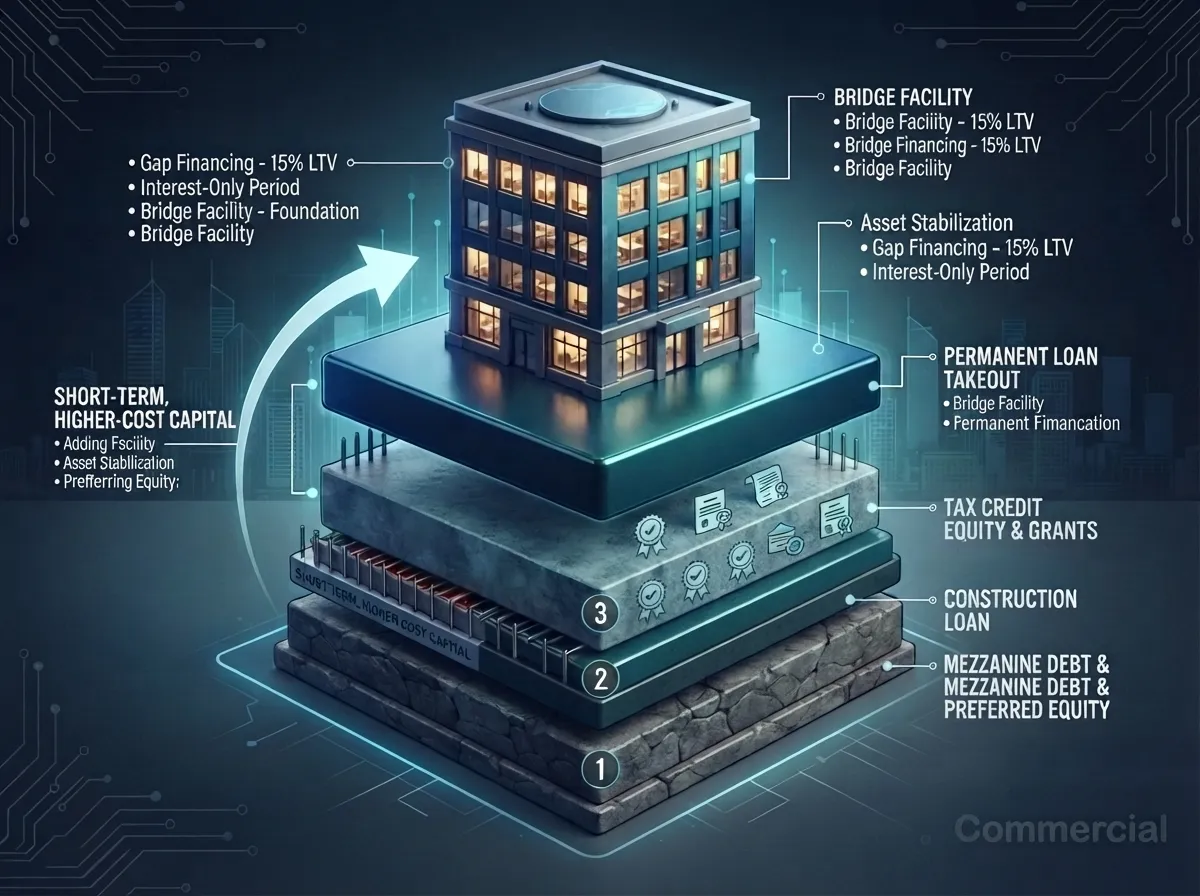
Investors who've financed a stabilized apartment acquisition before often assume a conversion project will follow a similar playbook: get a loan, close, collect rent. In practice, office-to-apartment conversions rarely use a single loan at all. They're built from several distinct financing layers stacked on top of each other, and understanding why requires understanding what makes these deals fundamentally riskier than buying an occupied building.
The Core Problem: No Income Until the Building Exists
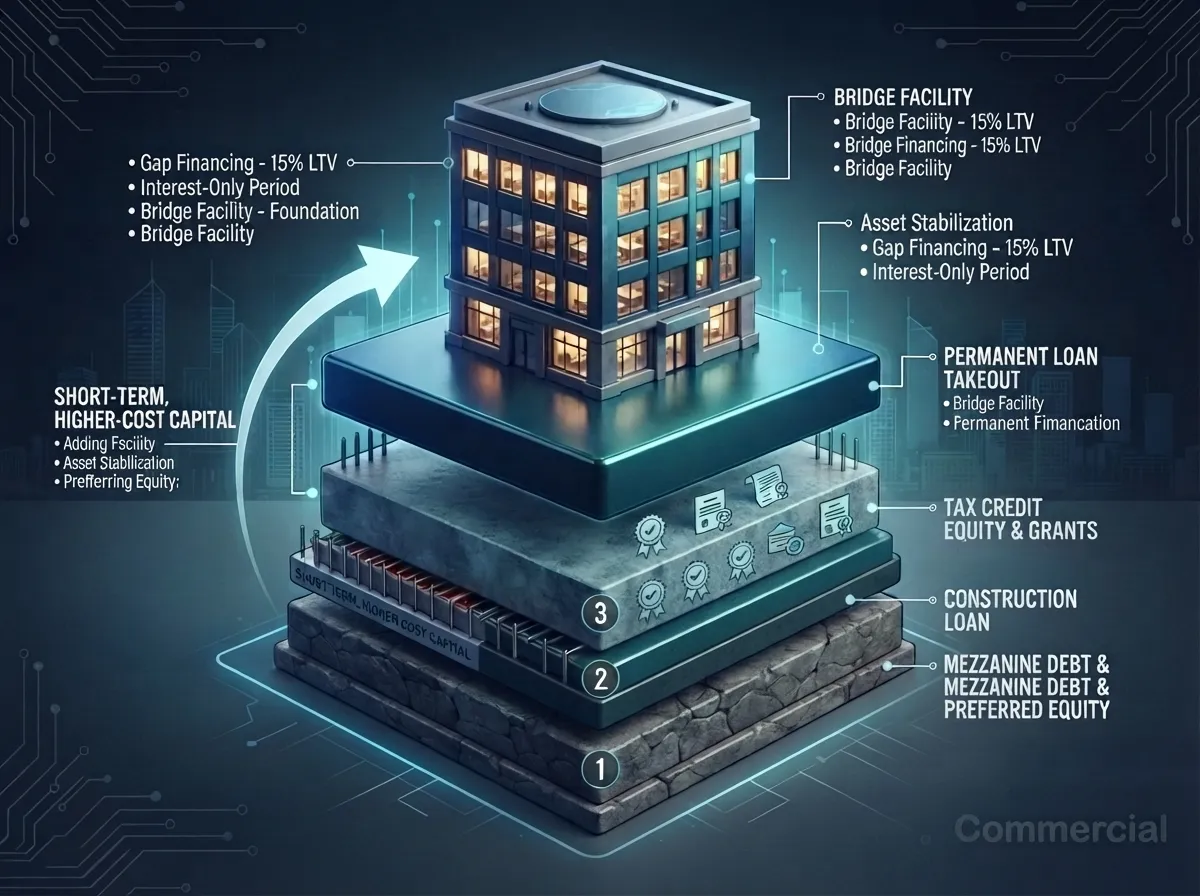
A standard multifamily loan is underwritten against existing rent rolls. A conversion loan has no rent roll to underwrite against, because the units don't exist yet. That single difference is why conversion financing almost never looks like one clean permanent loan and instead becomes a layered stack: short-term acquisition and construction debt, followed by one or more subsidy or gap-filling tools, followed eventually by a permanent refinance once the building is leased up.
Layer One: Bridge Debt to Get Through Construction
The first layer is almost always short-term, interest-only bridge or construction debt. This capital exists specifically to fund the acquisition and the heavy lift of gutting an office floor plan and rebuilding it as residential units. It's priced higher than permanent debt because the lender is taking construction and lease-up risk, not stabilized cash-flow risk, and it's structured to be paid off, not lived with long-term.
Layer Two: Energy and Resiliency Financing Nobody Talks About Enough
One of the most underused tools in a conversion capital stack is Commercial Property Assessed Clean Energy financing. According to the U.S. EPA's official C-PACE program overview, this financing mechanism lets owners fund up to 100% of the upfront cost of qualifying energy, water, and resiliency upgrades, HVAC replacement, building envelope work, and similar improvements, repaid over the useful life of the equipment through a voluntary property tax assessment rather than a conventional loan.
The advantage in a conversion context is significant: a full mechanical, electrical, and plumbing overhaul is one of the single largest cost centers in converting an office floor into individual residential units with their own kitchens and bathrooms. Routing that specific portion of the project through C-PACE, rather than expensive senior or mezzanine debt, can materially change a project's overall cost of capital. PACENation, the industry's national nonprofit tracking PACE programs, notes that terms can extend up to 30 years, which is a dramatically different repayment profile than the 12- to 36-month bridge debt funding the rest of the project.
Layer Three: Historic Tax Credits, Where They Apply
For older, architecturally significant office buildings, the federal Historic Tax Credit can meaningfully close an equity gap. It's not usable on every conversion, only certified historic structures qualify, but where it applies, it functions less like debt and more like a direct reduction in the equity an owner needs to bring to the deal.
Layer Four: Equity, and Why It's Often Syndicated Rather Than Single-Sponsor
Because conversion projects combine construction risk with lease-up risk, many sponsors don't fund the equity portion alone. Instead, multiple investors pool capital into a single-purpose entity formed specifically for that project, spreading the risk across a group rather than concentrating it with one sponsor. This is especially common on larger Class B and Class C office buildings, where the basis has fallen enough to make the deal pencil, but the total capital need is still too large for a single investor to comfortably absorb alone.
Why the Timing Pressure Is Getting More Intense
None of this capital stack complexity is happening in a vacuum. A large volume of office debt is maturing at exactly the moment many of these buildings have lost significant value, pushing more owners toward conversion out of necessity rather than pure opportunity. That dynamic means more buildings are entering the financing pipeline than in a typical year, and lenders are correspondingly more selective about which capital stack structure they'll support for which building.
Getting the Structure Right Before You Approach Lenders
The mistake many first-time conversion sponsors make is approaching a single lender looking for one loan to cover the entire project, the same way they would for a stabilized acquisition. Conversion financing works differently: it's assembled, not simply borrowed. Knowing which layer of the stack, bridge debt, C-PACE, historic credits, or syndicated equity, actually fits your specific building and location is the real skill involved, and it's worth working through in detail before your first lender conversation. A full breakdown of how each of these tools works together is covered in Private Financing for Office to Multifamily Conversion, which is worth reading closely once you understand why a single loan was never going to be the answer in the first place.
The Bottom Line
Conversion projects don't fail because sponsors can't find a lender. They fail because sponsors go looking for the wrong kind of financing, a single stabilized-asset loan for a project that actually requires four or five different capital sources working in sequence. Understanding that distinction upfront is what separates conversions that get funded from ones that stall in underwriting.






















Sign in to leave a comment.