

Why Lawn Care Is Getting a Serious Upgrade
For most of the past century, mowing the lawn meant one thing: you, a machine, and an hour or two of your weekend gone. Gas-powered lawn mowers dominated the market, and while they got the job done, they came with a familiar set of trade-offs — noise, fumes, ongoing fuel costs, and the kind of engine maintenance that most homeowners quietly dread.
That's starting to change. A new generation of homeowners is rethinking what lawn care should actually look like in their lives, and the robot lawn mower is at the center of that shift. Across North America and Europe, autonomous mowers are moving from curiosity to mainstream — and the reasons go well beyond novelty.
What Makes a Robot Lawn Mower Different from a Traditional Lawn Mower
The most obvious difference is that a robotic lawn mower does the work without you. But that's only the beginning of what separates it from a conventional lawn mower.
Traditional gas or push mowers operate on a simple model: you provide the labor, the machine provides the blade. You decide when to mow, how long to spend, and how carefully to work around edges and obstacles. The quality of the result depends almost entirely on the time and attention you put in.
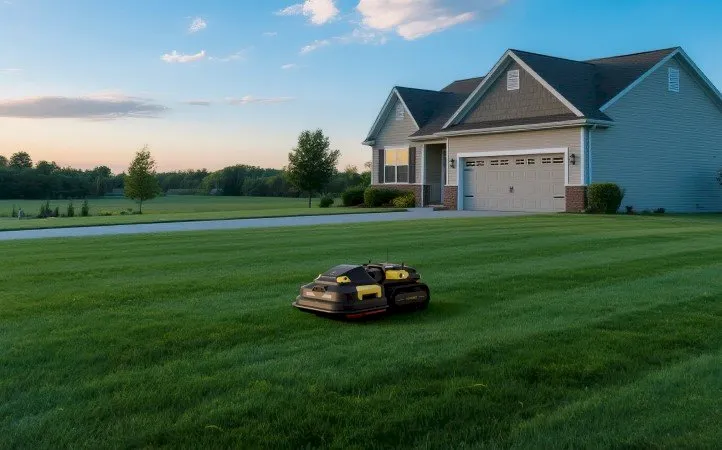
A robot lawn mower flips that model entirely. It maps your yard, plans an efficient mowing path, detects obstacles, and returns to its charging dock when the battery runs low — then picks up exactly where it left off. Rather than mowing once a week in long, infrequent sessions, most robotic lawn mowers cut little and often, trimming a small amount of grass every day or two. This "micro-mowing" approach actually produces a healthier lawn than weekly cuts, because the clippings are so fine they decompose directly into the soil as natural fertilizer.
Yarbo's wire-free robot lawn mower, for example, combines RTK-GPS, binocular cameras, and ultrasonic sensors to navigate complex yards with precision — no boundary wire to install, no perimeter to manually define. It handles up to 6 acres and climbs slopes of up to 70%, putting it well beyond the reach of most conventional automatic lawn mowers in its category.
Key Reasons Homeowners Are Making the Switch
Less time spent on manual mowing
Time is the most straightforward reason people make the switch. The average homeowner spends 3 or more hours per week on lawn maintenance during the growing season. Multiply that across a full summer, and it's a significant chunk of weekends that could be spent elsewhere.
A robot lawn mower doesn't just reduce that time — it effectively eliminates it. Once the initial setup is complete, the mower runs on its own schedule. You're not trading a Saturday morning for a tidy yard; you're simply waking up to one. For households with demanding work schedules, young children, or aging family members who can no longer manage physical yard work, that shift is genuinely life-changing.
More consistent cutting results
One of the underappreciated advantages of a robotic lawn mower is the consistency it delivers. Human mowing is, by nature, variable — some weeks you get to it promptly, other weeks the grass gets long before you have a chance. That inconsistency shows in the lawn.
Because a robot lawn mower operates on a daily or near-daily cycle, the grass never gets the chance to grow long and uneven. The result is a lawn that looks consistently well-maintained throughout the season — not just the day after you mow. Yarbo's AI-powered route planning and precise navigation mean each pass is methodical and even, producing the kind of uniform finish that's difficult to replicate manually.
Quieter operation for you and your neighbors
Anyone who's ever been woken up by a neighbor's gas mower on a Saturday morning knows how disruptive traditional lawn mowers can be. Gas-powered machines typically operate at 85–95 dB — well above the threshold where extended exposure becomes a hearing concern, and loud enough to cut through walls, windows, and any attempt at a peaceful morning.
Robotic lawn mowers operate at a fraction of that noise level. Yarbo runs at around 60 dB — roughly equivalent to a normal conversation. That quiet operation isn't just more pleasant for the operator; it means the mower can run early in the morning or in the evening without disturbing the neighborhood. In areas with noise ordinances or dense suburban streets, this is a genuinely practical advantage, not just a comfort perk.
A better fit for busy schedules and modern lifestyles
Beyond the practical metrics of time and noise, there's a broader lifestyle shift at play. Homeowners today increasingly expect their homes to work smarter, not harder. Smart thermostats, automated lighting, robot vacuums — the automatic lawn mower fits naturally into a household that already thinks this way.
Yarbo takes that integration further with its modular design. The same core robot that mows your lawn in summer can be fitted with a snow blower module in winter or a leaf blower attachment in autumn. It's a yard care system built around a modern homeowner's actual life — one that changes with the seasons and doesn't ask you to buy a separate machine for every task. Continuous firmware updates mean the system keeps improving after purchase, which is a level of long-term value that no gas-powered lawn mower can offer.
What the Rise of the Automatic Lawn Mower Means for the Future of Yard Care
The shift toward the robot lawn mower isn't just about convenience — it signals a broader change in how homeowners think about their outdoor spaces. Yards are increasingly seen as extensions of the home to be enjoyed, not just maintained. The less time and energy that maintenance demands, the more that vision becomes reality.
On the environmental side, the move from gas to electric lawn mower technology matters too. Zero-emission electric motors eliminate fuel costs and reduce the carbon footprint of routine yard care — a meaningful consideration as more homeowners factor sustainability into their purchasing decisions.
The automatic lawn mower is still a relatively young category, but it's maturing fast. Better navigation, smarter obstacle avoidance, longer battery life, and modular platforms like Yarbo are raising the ceiling on what these machines can do. What was once a premium novelty is becoming a practical, accessible choice for a wide range of homeowners.
If you're still pushing a mower every weekend and wondering whether there's a better way — there is. The technology has arrived. Visit yarbo.com to see what a genuinely modern yard care system looks like.




























Sign in to leave a comment.