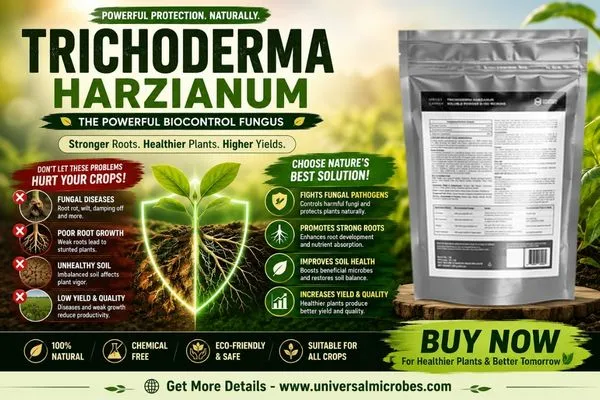

Crop diseases often begin below the soil surface, where farmers cannot easily see them. By the time symptoms such as yellow leaves, wilting, root decay, weak seedlings, or uneven crop growth become visible, the infection may already be established.
This is why Trichoderma harzianum generally performs better when applied before serious disease develops. It is a beneficial fungus that needs suitable conditions and sufficient time to become active around seeds, roots, and the surrounding soil. It should therefore be understood as a preventive biological input, not as an instant cure for severely infected plants.
Trichoderma harzianum Needs Time to Establish
Unlike many chemical fungicides that act directly after application, Trichoderma harzianum is a living microorganism. After being introduced into the soil or growing medium, its viable spores must germinate, grow, and establish themselves near the plant roots.
Early application gives the beneficial fungus an opportunity to occupy the root zone before harmful organisms become dominant. This is particularly useful during seed germination, seedling establishment, transplantation, and early root development.
Research has shown that root colonisation by T. harzianum can prepare plants to respond more effectively when they later encounter certain pathogens.
It Occupies Space Before Harmful Fungi Arrive
The root zone contains limited space and nutrients. Beneficial and harmful microorganisms continuously compete for these resources.
When Trichoderma harzianum is established early, it can compete for available nutrients and colonisation sites around plant roots. This can make it more difficult for some soil-borne pathogens to establish themselves.
Preventive application is therefore similar to filling an empty field before weeds take over. Once harmful fungi have already occupied the root surface, penetrated plant tissues, or spread through the surrounding soil, biological competition becomes more difficult.
A study involving red kidney bean plants examined the preventive inoculation of T. harzianum before root-rot development and found that it influenced antioxidant activity and the microbial community around the roots.
It Can Prepare the Plant’s Natural Defences
Another important benefit of early application is biological defence priming.
Defence priming does not mean that the plant remains in a constant state of stress. Instead, interaction with the beneficial microorganism prepares the plant to produce a faster or stronger defensive response after pathogen attack.
Research on tomato plants found that root colonisation by T. harzianum increased resistance to Botrytis cinerea in above-ground plant tissues. The beneficial fungus and the pathogen remained physically separated, indicating that plant defence signalling contributed to disease reduction.
This preparation takes time. Applying the microorganism only after extensive wilting or root damage may be too late to gain the full benefit of defence priming.
Severe Root Damage Cannot Be Reversed Easily
Once a soil-borne disease has caused root decay, damaged the crown, blocked water movement, or destroyed young seedlings, applying a biological input cannot restore dead tissue.
A rescue application may still support the remaining healthy root zone or help reduce further pathogen activity, depending on the crop, pathogen, environmental conditions, product strain, and disease stage. However, results are usually less predictable after the infection is well established.
In cucumber research, T. harzianum treatments improved root activity, seedling quality, protective enzyme activity, and the management of Fusarium wilt. The results also showed that performance depended on the concentration used, demonstrating that correct product selection and application are important.
Farmers should therefore avoid waiting for severe symptoms before taking action.
When Should Farmers Apply Trichoderma harzianum?
The most suitable timing depends on the crop and the product formulation, but preventive use commonly begins during one or more of these stages:
Seed Treatment
Treating seeds places the beneficial microorganism close to the emerging root. This gives it an early opportunity to establish around the seed and young seedling.
Nursery-Bed Preparation
Applying it during nursery preparation can support seedlings when they are most vulnerable to damping-off, root rot, and poor establishment.
Root Dipping Before Transplanting
Seedling roots may be treated before transplantation according to the product directions. This allows direct contact with the root surface before plants enter the main field.
Soil or Growing-Media Application
Applying the product to compost, potting media, planting pits, raised beds, or field soil can help establish biological activity around the developing roots.
Early Drip or Drench Application
Where the product label permits, Trichoderma harzianum may be applied through irrigation or as a root-zone drench. It should reach moist soil near active roots rather than remain only on the dry surface.
Always follow the product label because strains, formulations, viable counts, crop recommendations, and application rates can differ.
Prevention Still Requires Good Farm Management
Trichoderma harzianum should not be treated as a replacement for every crop-management practice. Better results are more likely when farmers also use healthy planting material, suitable crop rotation, proper drainage, balanced irrigation, field sanitation, clean nursery media, and regular crop monitoring.
Excess moisture, poor drainage, infected crop residues, damaged roots, and repeated cultivation of susceptible crops can continue to increase disease pressure.
Conclusion
Trichoderma harzianum works best as a preventive input because it needs time to colonise the root zone, compete with harmful microorganisms, interact with the plant, and support natural defence responses. Applying it before disease becomes severe gives farmers a better opportunity to protect young roots and maintain healthier growing conditions.
Farmers, nursery operators, gardeners, and commercial growers looking to include beneficial microorganisms in their crop-management programmes can explore Universal Microbes for Trichoderma harzianum and other agricultural microbial solutions. Start supporting crop health before visible damage appears. Shop Trichoderma harzianum from Universal Microbes today.

























Sign in to leave a comment.