
You have finally finished your brand new web project. After several months of work and planning, a lot of money, many meetings with the entire company and even more meetings with the web development agency, you happily arrive to check your Google Analytics, thinking that your users are delighted with the redesign and the new texts and… suddenly HORROR!
Traffic has plummeted! From thousands of visitors, the site has dropped to just a handful of users. That landing page that brought in so much traffic about that service or product that makes your company so unique, suddenly no longer brings traffic. This wouldn't have happened if you had done an SEO strategy before starting your web project.
You get really angry with the agency. They told you that the website would be SEO-optimized. You call them. They show you that they have set up Yoast SEO or Rank Math SEO and that everything is “green.” You don’t understand anything. And, what’s worse, you have to justify that after spending a fortune on the new website, the traffic has gone down the drain.
Does this situation sound familiar to you? Unfortunately, it does to us a lot.
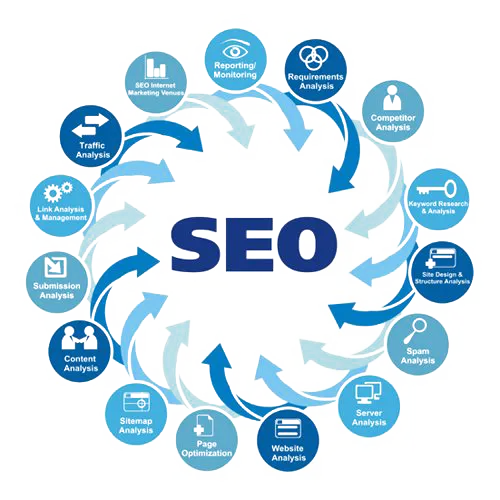
In most, if not all, cases, planning is the key to successful digital marketing strategies. Especially when it comes to white label SEO services, since the organic positioning of a web project in search engines is the result of the ideal combination of a long series of actions.
Actions that include a before, during and after in the project. In this post we will talk about the crucial stage prior to launching a website.
Join us!
The importance of SEO from the beginning
When a brand invests in creating a website, it does so with the aim of improving its online presence, optimizing visibility and authority, attracting qualified organic traffic and increasing business profitability.
Achieving this is no easy task; it is necessary to make the page attractive to users and search engines. This requires an aesthetic and technical design optimized for SEO, what we call On-Page SEO, in which a large number of elements are considered, from the ideal arrangement of the components to the selection of keywords for each page.
Postponing this work until the end will require modifications, which not only imply a reinvestment of time and money, but also delay the achievement of the brand's initial objectives.
Benefits of implementing an SEO strategy from the beginning
When we include the best SEO company in the website construction process from the beginning we get:
Optimizing site architecture
SEO gives the website architecture the proper logical and hierarchical order , making it easy for users to navigate, and easy for search engines to crawl and index.
The key is to group related content and link pages appropriately, that is, in a clear and coherent way .
Saving time and resources
A purposeful website must necessarily be designed to rank in search engines and attract the target audience. In other words, it must meet SEO optimization criteria.
This is a step that must necessarily be completed at some point in the creation process, and doing it from the beginning avoids corrections or modifications that require a considerable investment of time and money.
Better User Experience (UX)
The application of SEO optimizations brings with it a significant improvement in the user experience.
There are several techniques that are applied in this regard , for example, making the site intuitive to navigate, guaranteeing a fast loading speed and ensuring that it has a responsive design so that it works properly on any device, are essential elements that can be configured without problems during the design and construction of the website.
Crucial SEO factors to consider before you start
There are numerous factors that contribute to organic search engine rankings and they are all important. Now, there are three SEO strategies that you should pay special attention to before you start building a website :
Keyword Research
Keywords are the terms that users use to search for information about your niche or sector in search engines. In other words, they represent an opportunity for your buyer persona to find you. Therefore, it is essential to carry out precise keyword research, which allows you to create relevant content for your audience.
There are several very efficient tools to carry out this task, such as SEMRush or the Google Keyword Planner, among others, which will help you identify a list that you can use in texts, URLs, tags, categories, meta descriptions, among others.
Competitive analysis
Who are your main competitors and what is their strategy to rank at the top? There are various tools to find out. SEMRush, Screaming Frog and MozBar are just a few among a wide variety, which allow you to identify, for example, the keywords they use and the way they structure the content on their site.
This will give you a clearer picture to identify the opportunities and threats you face in your sector and, above all, the level of SEO competition in your sector.
Definition of objectives and KPIs
Setting clear goals and defining metrics to measure the performance of each action is another essential step in your SEO services strategy. It is a very efficient way to monitor each marketing action, to make the relevant adjustments and ensure success.
Key components of an initial SEO strategy
Below we explain some of the key components of an SEO strategy for web design:
Site structure and content map
Planning the site architecture and content organization plays a major role in SEO strategy because:
- Optimize the user experience.
- It makes navigation easier and even guides conversions in the sales funnel.
- Improves crawling and indexing in search engines.
- Prioritize content and avoid cannibalization.
There are several types of web structure to choose from . The recommendation is to go for a simple one, whose content is organized following a logical hierarchy.
On-Page SEO and basic techniques
On-page SEO controls numerous variables within the website . Some of the most common techniques include:
- Use keywords in titles, descriptions and tags.
- Organize the content in h1, h2, h3…
- Identify users' search intent and take advantage of it.
- Optimize images by using alt text that contains one of your keywords. Also, make sure that the size does not negatively affect page loading speed.
- Use an internal linking strategy to reinforce the structure of the page and position it on a topic of interest to the audience.
In addition, SEO trends for 2024 have brought some new features that you shouldn't overlook.
Content planning
Content is a key element in your strategy. Once you have done your keyword research, you can start creating an editorial calendar based on topics relevant to your audience.
Ready to get your website to the top?
Competition on the web scene is relentless and extremely demanding. When designing your corporate website, blog or e-commerce site, it is essential to take care of every detail from the moment you start building the idea. In this post we have only given you a preview of all the elements you need to take into account.































Sign in to leave a comment.